
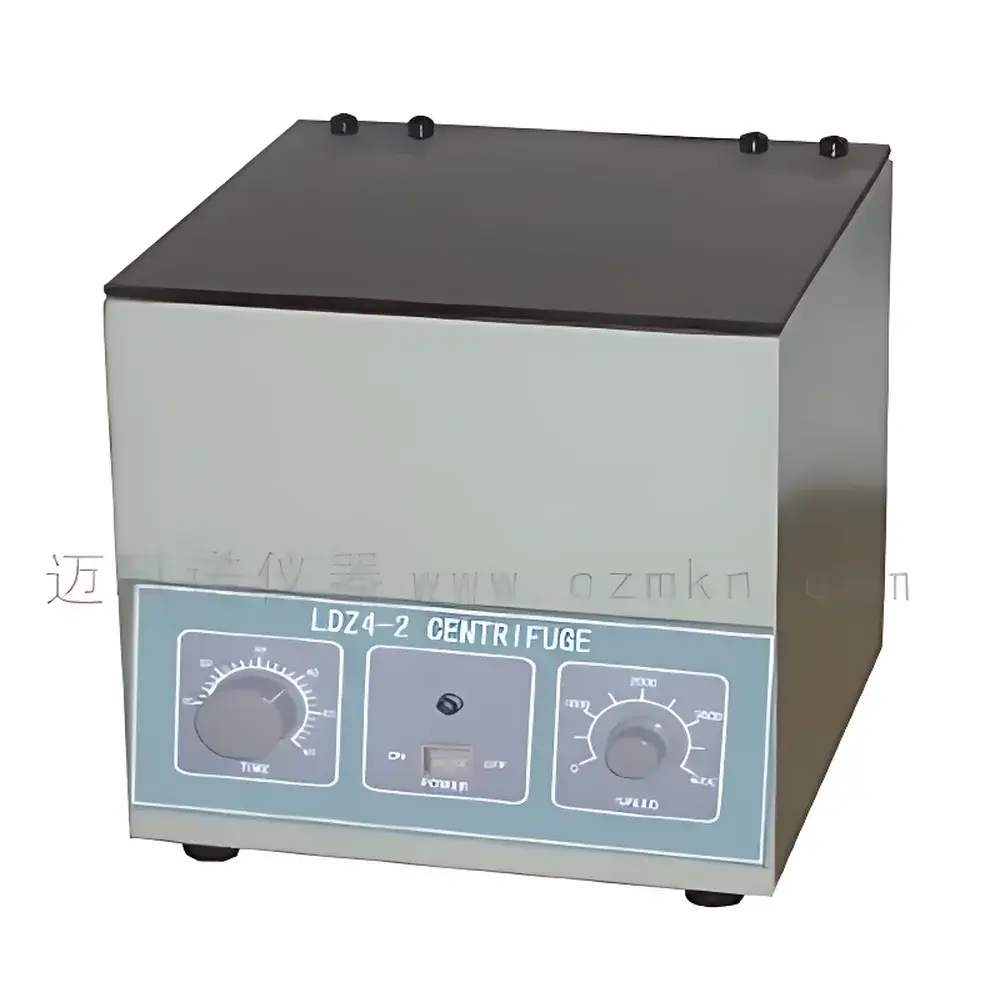
MKN LDZ4-2 Automatic Balancing Centrifuge
| Brand | MKN |
|---|---|
| Origin | Jiangsu, China |
| Manufacturer Type | General Distributor |
| Country of Origin | Domestic (China) |
| Model | LDZ4-2 |
| Max Speed | 4000 rpm (stepless speed control) |
| Relative Centrifugal Force (RCF) | 2325 × g |
| Capacity | 8 × 20 mL or 8 × 15 mL |
| Timer Range | 0–60 min |
| Noise Level | ≤60 dB(A) |
| Power Supply | AC 220 V, 50 Hz, 2 A |
Overview
The MKN LDZ4-2 Automatic Balancing Centrifuge is a compact, benchtop centrifugal separation instrument engineered for precision and reliability in routine laboratory workflows. It operates on the principle of sedimentation under controlled rotational force—utilizing angular acceleration to separate components of heterogeneous mixtures based on differences in density, size, and shape. Unlike manually balanced units, this model integrates an automatic rotor balancing mechanism that dynamically compensates for minor mass asymmetries during acceleration, eliminating the need for manual tube pairing and significantly reducing vibration-induced wear or operational instability. Designed for continuous duty in clinical diagnostics, biochemical assay preparation, and quality control environments, the LDZ4-2 delivers consistent RCF generation across its full speed range while maintaining thermal stability and acoustic performance suitable for shared lab spaces.
Key Features
- Stepless speed control from 0 to 4000 rpm enables fine-tuned optimization for diverse sample viscosities and sedimentation kinetics.
- Integrated automatic balancing system ensures stable operation even with slight load imbalances—reducing mechanical stress and extending bearing service life.
- Die-cast aluminum rotor with reinforced cavity geometry provides structural integrity and minimizes centrifuge tube deformation or breakage during high-speed runs.
- Low-noise design (<60 dB[A]) meets ISO 15712-1 ambient noise guidelines for multi-user laboratory facilities.
- Programmable timer (0–60 minutes) supports unattended operation with automatic shut-down and rotor deceleration profiling to prevent resuspension of pellets.
- Thermally optimized motor housing and airflow path limit temperature rise during extended use—critical for heat-sensitive biological samples such as serum, plasma, or immunoglobulin preparations.
Sample Compatibility & Compliance
The LDZ4-2 accommodates standard conical-bottom centrifuge tubes (15 mL and 20 mL), supporting common protocols in clinical chemistry, hematology, and immunoassay preprocessing—including serum separation, platelet-poor plasma isolation, and antigen-antibody complex pelleting. Its mechanical design conforms to IEC 61010-1:2010 safety requirements for electrical equipment used in laboratory environments. While not certified for biosafety level (BSL)-2 or higher containment applications, the unit complies with general-purpose centrifugation standards referenced in CLSI GP45-A4 and ISO 13485-aligned manufacturing practices. Routine calibration verification can be performed using traceable tachometers and RCF calculators per ASTM E29-23 guidelines.
Software & Data Management
This model operates via analog interface without embedded firmware or digital data logging capabilities. All operational parameters—including speed, time, and start/stop commands—are set manually using front-panel dials and push-button controls. As a Class I standalone device, it does not incorporate network connectivity, audit trail functionality, or electronic record retention. Consequently, it is suitable for GLP-compliant laboratories where manual entry into bound logbooks satisfies documentation requirements under 21 CFR Part 11 Subpart B—provided procedural SOPs define operator responsibilities for parameter recording and run validation. For environments requiring electronic data capture, external timing devices or integrated LIMS interfaces may be deployed alongside the centrifuge.
Applications
- Routine serum and plasma separation in hospital core labs and point-of-care testing centers.
- Pre-analytical processing of whole blood specimens prior to ELISA, lateral flow assays, or electrophoresis.
- Sedimentation of cell suspensions in microbiology and basic immunology research.
- Clarification of reaction mixtures in small-scale enzymatic or nucleic acid extraction workflows.
- Removal of particulates from reagent stocks or buffer solutions prior to filtration or sterilization.
FAQ
What is the maximum relative centrifugal force (RCF) achievable with the LDZ4-2?
The LDZ4-2 generates a peak RCF of 2325 × g at its rated maximum speed of 4000 rpm when using 20 mL tubes positioned at the rotor’s maximum radius.
Does the centrifuge require paired tube loading?
No—the automatic balancing system eliminates the necessity for symmetrical tube placement, though balanced loading remains recommended for optimal rotor longevity and reproducible pellet geometry.
Is the unit suitable for use with infectious or hazardous samples?
It is intended for non-biohazardous, low-risk samples only. No aerosol-tight rotor lids or sealed bucket configurations are available; users must implement secondary containment per institutional biosafety policies.
Can the LDZ4-2 be validated for GMP-regulated processes?
Yes—its mechanical consistency, repeatability, and adherence to IEC 61010-1 allow inclusion in IQ/OQ protocols; however, PQ must be conducted in situ using user-defined acceptance criteria and calibrated reference instruments.
What maintenance is required to ensure long-term performance?
Routine cleaning of the rotor chamber and inspection of the rubber damping feet are advised after every 100 operating hours; annual bearing lubrication and speed calibration verification are recommended by the manufacturer.



