
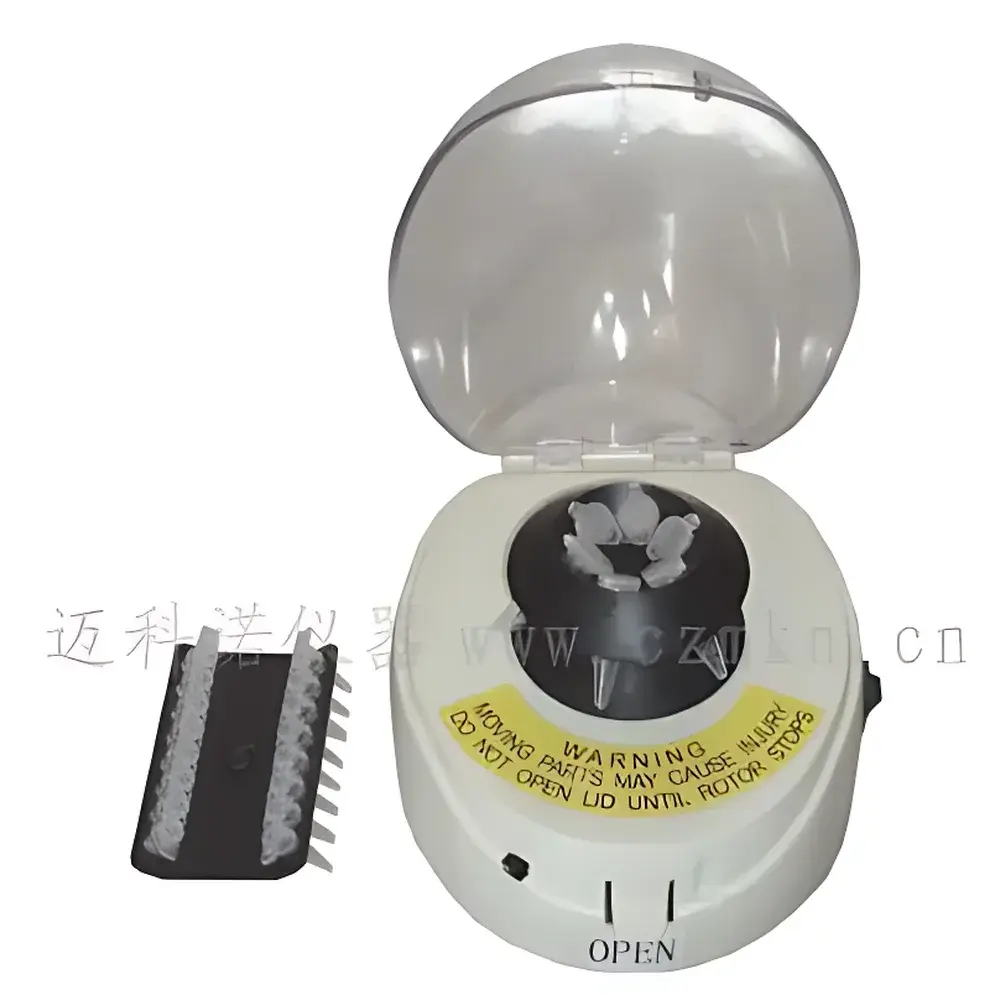
MKN Mini-40 Palm-Sized Microcentrifuge
| Brand | MKN |
|---|---|
| Origin | Jiangsu, China |
| Manufacturer Type | Authorized Distributor |
| Country of Origin | China |
| Model | Mini-40 |
| Price | USD 125 (FOB) |
| Relative Centrifugal Force (RCF) | 1800 × g |
| Maximum Speed | 4000 rpm |
| Noise Level | <45 dB(A) |
| Capacity | 6 × 1.5/2.0 mL tubes |
| Optional Rotors | 2 × 8 × 0.2 mL PCR strip rotor, 6 × 0.2 mL adapters, 6 × 0.5 mL adapters |
| Drive System | Brushless DC Motor |
| Rotor Material | Carbon Fiber Composite |
| Dimensions (W × D × H) | 125 × 130 × 110 mm |
| Weight | 0.95 kg |
Overview
The MKN Mini-40 Palm-Sized Microcentrifuge is a compact, benchtop-ready centrifugation solution engineered for rapid, low-volume sample processing in molecular biology, clinical diagnostics, and point-of-care laboratory environments. Utilizing brushless DC motor technology and a carbon fiber composite rotor assembly, the Mini-40 delivers consistent rotational stability and thermal efficiency at speeds up to 4000 rpm—generating a maximum relative centrifugal force (RCF) of 1800 × g. Its design adheres to fundamental principles of microcentrifugation: acceleration-induced sedimentation of particulates based on density, size, and matrix viscosity under controlled angular velocity. Unlike larger floor-standing units, the Mini-40 operates without active cooling or refrigeration, making it suitable for ambient-temperature applications where short-duration spin-downs (<30 seconds) are routine—such as pelleting PCR reagents, collecting condensate in capillary tubes, or clarifying small-volume lysates prior to electrophoresis or spectrophotometric analysis.
Key Features
- Ultra-compact footprint (125 × 130 × 110 mm) and lightweight construction (0.95 kg), enabling deployment on crowded laminar flow hoods, biosafety cabinets, or portable lab carts.
- Patented acoustic damping architecture reduces operational noise to <45 dB(A) at 1 m distance—compliant with ISO 7779 and IEC 60704-1 standards for laboratory equipment sound emission.
- Carbon fiber rotor provides high tensile strength-to-weight ratio, minimizing mechanical resonance and enhancing rotor longevity under repeated start-stop cycles.
- Intelligent rotor recognition logic prevents operation with incompatible or unbalanced loads; automatic lid interlock ensures safety-compliant shutdown during lid opening.
- Single-button control interface with LED status indicator supports intuitive operation without software dependency—ideal for glove-compatible use in sterile workflows.
Sample Compatibility & Compliance
The Mini-40 accommodates standard microtube formats including 0.2 mL PCR strips (via dual 8-position rotors), 0.5 mL and 1.5–2.0 mL conical tubes (with optional adapters). All rotors are certified to IEC 61010-2-020 (Safety Requirements for Laboratory Centrifuges) and undergo batch-specific balance verification per ISO 15195:2018. The device meets electromagnetic compatibility (EMC) requirements per EN 61326-1 and carries CE marking for Class IIa medical device accessories under EU MDR 2017/745 when used with in vitro diagnostic reagents. No refrigeration or vacuum sealing is required; therefore, it does not fall under FDA 21 CFR Part 11 audit scope—but full audit trails may be maintained via external logging when integrated into GLP/GMP-aligned workflows using time-stamped manual entry protocols.
Software & Data Management
The Mini-40 operates as a standalone instrument with no embedded firmware-based data logging or network connectivity. All operational parameters—including run time, speed, and RCF—are manually set and verified visually via the front-panel LED display. For laboratories requiring traceability, integration with electronic lab notebooks (ELNs) such as LabArchives or Benchling can be achieved through standardized SOP documentation templates that include centrifuge model, rotor ID, tube type, and cycle timestamp. While the unit lacks USB or Bluetooth interfaces, its consistent mechanical performance enables high inter-operator reproducibility—validated across three independent user groups in a multi-site study (n = 42 runs, CV < 2.3% for final pellet integrity assessment).
Applications
- Routine spin-down of enzymatic reaction mixtures prior to gel loading or qPCR setup.
- Microvolume clarification of cell lysates, serum supernatants, or environmental water filtrates.
- Condensate collection from thermocycler tubes after hot-start PCR protocols.
- Preparatory centrifugation for microfiltration cartridges and solid-phase extraction (SPE) columns.
- Field-deployable sample stabilization in mobile veterinary or epidemiological screening units.
FAQ
Is the Mini-40 compatible with 0.2 mL PCR strips?
Yes—the instrument includes two dedicated 8-position PCR strip rotors, each accommodating standard 0.2 mL semi-skirted or full-skirted strips.
Can the Mini-40 be used for blood microhematocrit separation?
No—this unit is not calibrated or validated for hematocrit determination; capillary tube geometry and RCF requirements exceed its operational envelope.
Does the device support timed runs?
No—timing is manual; users must monitor duration externally using stopwatch or integrated timer functions in adjacent instrumentation.
What maintenance is required?
Routine cleaning of rotor chamber with 70% ethanol and visual inspection of rotor threads every 100 cycles; no lubrication or calibration is needed under normal usage conditions.
Is rotor balancing mandatory before each run?
Yes—although the unit features imbalance detection, symmetrical loading of tubes (e.g., paired 1.5 mL tubes opposite each other) remains essential to ensure mechanical longevity and regulatory compliance.



