
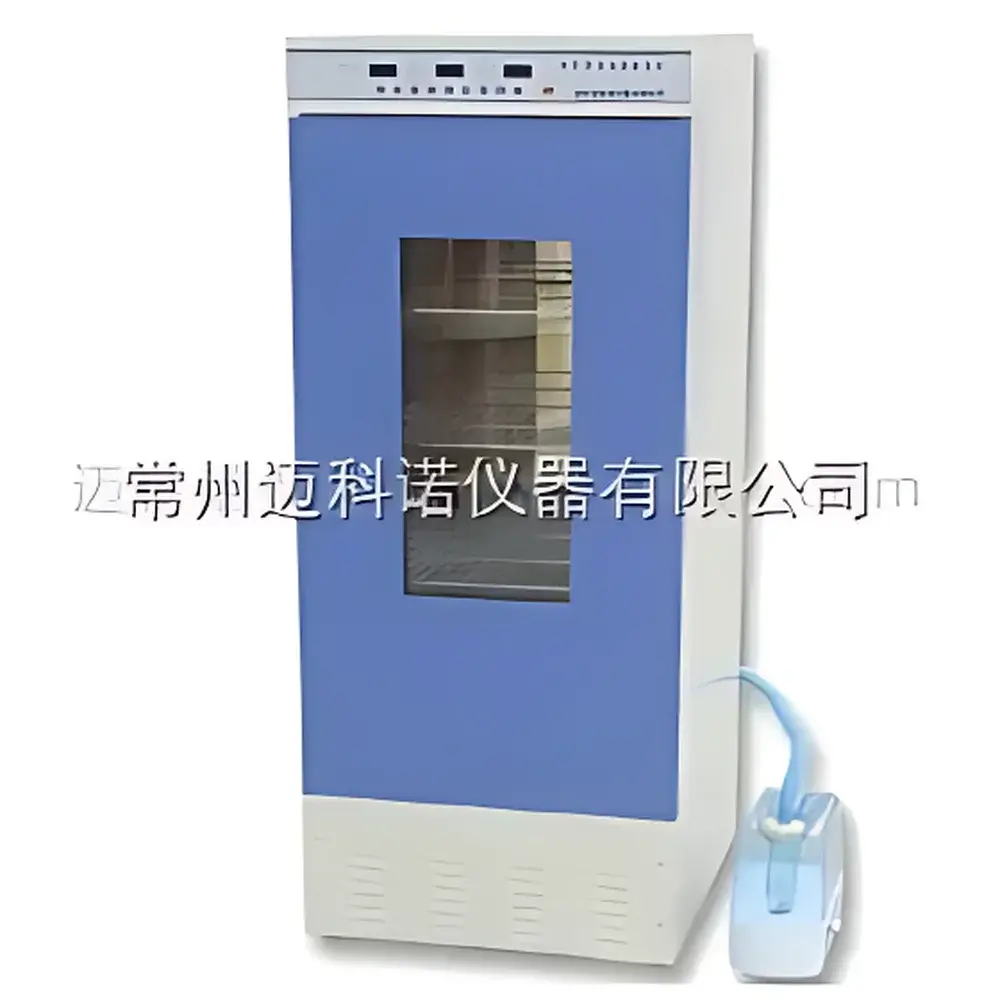
MKN C Series Temperature and Humidity Controlled Incubator
| Brand | MKN |
|---|---|
| Model | C |
| Capacity | 260 L |
| Temperature Range | 5–50 °C |
| Temperature Uniformity | ±1 °C |
| Humidity Range | 45–90 %RH |
| Humidity Control Accuracy | ±5 %RH |
| Power Supply | AC 220 V ±10%, 50 Hz ±2% |
| Operating Environment | 0–40 °C, ≤85 %RH (non-condensing) |
| Construction | External cold-rolled steel with epoxy powder coating |
| Air Circulation | Forced-air convection with optimized ducted airflow design |
| Safety Features | Compressor delay start, over-temperature/over-humidity protection, power failure recovery |
Overview
The MKN C Series Temperature and Humidity Controlled Incubator is an engineered environmental chamber designed for precise, long-term maintenance of biological samples under tightly regulated thermal and hygric conditions. Based on forced-air convection and dual-loop PID control architecture, it maintains stable setpoints across its 260 L working chamber using independent temperature and humidity regulation systems—each governed by dedicated microprocessor-based controllers with real-time feedback from calibrated NTC thermistors and capacitive RH sensors. Unlike basic incubators relying solely on heating elements, this model integrates a refrigeration compressor, Peltier-assisted dehumidification, and steam-based humidification to achieve bidirectional control across the full operational envelope (5–50 °C / 45–90 %RH). Its design meets functional requirements for GLP-compliant cell culture, seed germination studies, microbial growth kinetics, and stability testing in accordance with ISO 17025-accredited laboratory practices.
Key Features
- Microprocessor-controlled dual-parameter regulation with LED digital display for simultaneous monitoring of chamber temperature and relative humidity
- Forced-air circulation system featuring directional ducting and low-turbulence fan assembly to ensure spatial uniformity (±1 °C temperature deviation, ±5 %RH humidity deviation at steady state)
- Robust chamber construction: exterior cold-rolled carbon steel with anti-corrosive epoxy powder coating; interior 304 stainless steel walls and floor for chemical resistance and ease of decontamination
- High-efficiency polyurethane foam insulation (≥80 mm thickness) minimizing thermal bridging and reducing energy consumption during continuous operation
- Double-glazed tempered glass door with argon-filled interlayer, providing thermal isolation while enabling non-intrusive visual inspection without compromising chamber integrity
- Integrated safety logic including compressor delay-on restart (≥3 min), over-temperature cutoff (>55 °C), over-humidity shutoff (>95 %RH), and automatic power-loss recovery with parameter retention
Sample Compatibility & Compliance
The MKN C incubator accommodates standard microbiological vessels—including Petri dishes, multi-well plates, flasks, and tissue culture bottles—without interference from airflow turbulence or condensation accumulation. Its stainless-steel interior supports routine sterilization via 70 % ethanol wiping or vapor-phase hydrogen peroxide (VPHP) treatment. The unit complies with IEC 61010-1:2010 for electrical safety in laboratory equipment and conforms to ambient operating limits defined in ISO 14644-1 Class 8 cleanroom environments when installed in controlled spaces. While not certified for medical device manufacturing under ISO 13485, its performance traceability and parameter logging capability support adherence to USP , ASTM E2924-21 (Standard Guide for Environmental Chambers), and internal SOPs governing environmental qualification in academic and industrial life science labs.
Software & Data Management
The incubator operates autonomously via embedded firmware with no external PC dependency. All setpoints, real-time readings, alarm logs, and event timestamps are stored internally for up to 30 days (circular buffer). Optional RS-485 Modbus RTU interface enables integration into centralized building management systems (BMS) or LIMS platforms for remote supervision and audit-trail generation. When connected to validated data acquisition software (e.g., LabVIEW or custom SCADA), the device supports 21 CFR Part 11–compliant electronic records—including user authentication, electronic signatures, and immutable log export—facilitating regulatory submissions where environmental stability data must be archived and retrievable.
Applications
- Plant physiology research: seed stratification, photoperiod-independent germination assays, and stress-response phenotyping under controlled hygrothermal regimes
- Microbial cultivation: aerobic/anaerobic bacterial and fungal growth profiling, antibiotic susceptibility testing (AST), and biofilm development studies
- Cell culture support: pre-incubation of primary cells prior to transfection, maintenance of low-passage stem cell lines, and hypoxia-recovery experiments requiring post-anoxic rehydration control
- Environmental simulation: accelerated aging of biodegradable polymers, degradation kinetics of pharmaceutical excipients, and ecotoxicological assessment of soil microcosms
- Educational use: undergraduate laboratory instruction in microbiology, plant biology, and environmental science curricula requiring reproducible environmental replication
FAQ
Does this incubator support CO₂ control or gas mixing capabilities?
No. The MKN C Series is configured exclusively for temperature and relative humidity regulation. CO₂ supplementation requires a separate gas manifold and infrared sensor integration, available only in designated CO₂ incubator models.
Can the unit operate continuously for extended periods (e.g., >30 days)?
Yes. Designed for uninterrupted duty cycles, the incubator includes thermal overload protection, compressor cycling safeguards, and redundant humidity sensor validation to ensure operational reliability during long-term experiments.
Is calibration documentation provided with the unit?
A factory-issued calibration certificate is included, covering initial verification of temperature and humidity sensors against NIST-traceable references. Users are responsible for periodic recalibration per internal quality protocols or ISO/IEC 17025 requirements.
What maintenance intervals are recommended?
Condensate tray cleaning every 7 days under high-humidity operation; HEPA filter replacement (if equipped) every 6 months; annual verification of door seal integrity and sensor drift using reference hygrometers and dry-block calibrators.
Is the incubator compatible with Ethernet or Wi-Fi connectivity?
No. Communication is limited to RS-485 Modbus RTU. Ethernet or wireless modules are not supported due to electromagnetic compatibility constraints and regulatory restrictions on RF emissions in Class II laboratory devices.
Related Products




