
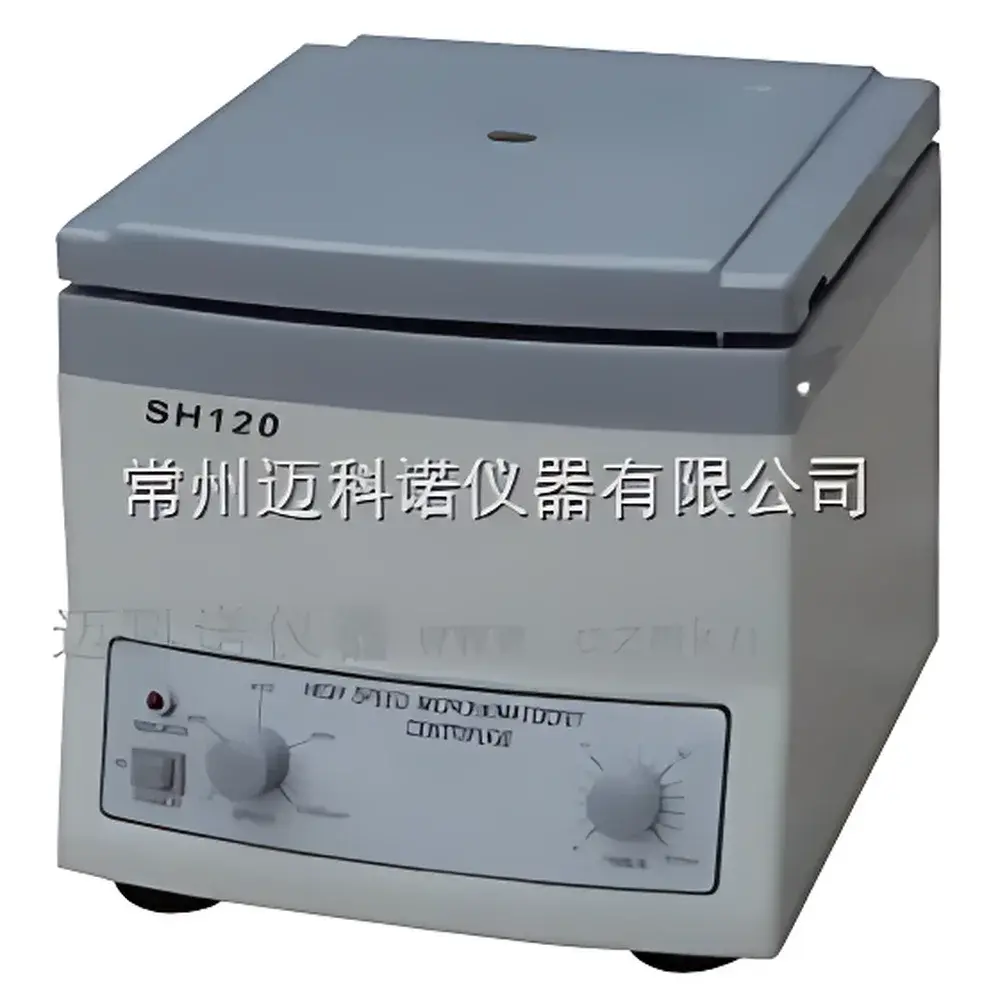
MKN SH120 Microhematocrit Centrifuge
| Brand | MKN |
|---|---|
| Origin | Zhejiang, China |
| Manufacturer Type | Authorized Distributor |
| Country of Manufacture | China |
| Model | SH120 |
| Max Speed | 12,000 rpm |
| RCF (Relative Centrifugal Force) | 13,500 × g |
| Capacity | 24 × capillary tubes (Φ1.5 mm × 75 mm) |
| Power Input | 230 VA |
| Power Output | 100 W |
| Voltage/Frequency | 110 V / 60 Hz & 220 V / 60 Hz |
| Acceleration Time | < 60 s |
| Deceleration Time | < 120 s |
| Timer Range | 0–30 min (non-continuous operation only) |
| Dimensions (L×W×H) | 280 × 310 × 265 mm |
| Net Weight | 10 kg |
Overview
The MKN SH120 Microhematocrit Centrifuge is a compact, high-speed benchtop instrument engineered for rapid and precise separation of whole blood into cellular and plasma components using capillary tube-based microhematocrit methodology. It operates on the principle of sedimentation under controlled centrifugal force—where rotational motion generates radial acceleration that drives denser erythrocytes toward the bottom of vertically oriented capillary tubes, enabling accurate hematocrit (Hct) determination in clinical, point-of-care, and veterinary laboratory settings. Designed specifically for small-volume samples (typically 10–20 µL), the SH120 supports standardized protocols compliant with CLSI H26-A3 and ISO 15189 requirements for hematology testing. Its fixed-angle rotor accommodates 24 capillary tubes simultaneously, ensuring batch consistency and minimizing inter-run variability. The unit’s robust aluminum-alloy housing, thermally stable motor assembly, and precision-balanced rotor contribute to long-term mechanical reliability and operational repeatability across daily use cycles.
Key Features
- High-speed capability up to 12,000 rpm delivering a maximum RCF of 13,500 × g—sufficient to achieve complete erythrocyte packing within clinically validated timeframes (e.g., 5–10 min at ≥10,000 rpm).
- Continuous variable speed control from standstill to full rated speed, allowing optimization for different anticoagulants (EDTA, heparin, citrate) and sample viscosities.
- Dedicated capillary tube rotor designed for Φ1.5 mm × 75 mm glass or plastic microtubes—ensuring secure retention, minimal vibration, and uniform force distribution during acceleration and deceleration phases.
- Integrated digital timer with 1-second resolution and auto-shutdown function; programmable range from 0 to 30 minutes, configured to prevent continuous-duty operation per IEC 61010-1 safety guidelines.
- Low thermal load design with passive convection cooling—no internal fan required—reducing noise (<58 dB(A)) and eliminating aerosol generation risks associated with forced-air systems.
- Compliance-ready architecture: includes non-volatile memory for last-used parameters, mechanical safety interlock on lid closure, and overload protection circuitry meeting EN 61000-6-3 EMC standards.
Sample Compatibility & Compliance
The SH120 accepts standard microhematocrit capillaries conforming to ASTM E2087 and CLSI EP5-A3 specifications. It is validated for use with lithium heparin-, EDTA-K₂-, and sodium citrate-anticoagulated whole blood specimens collected via fingerstick, earlobe puncture, or venipuncture. Capillary fill volume must be maintained between 70–85% to ensure consistent meniscus formation and avoid over-pressurization during spin. The device meets essential safety and performance criteria outlined in IEC 61010-1 (2012) for laboratory electrical equipment and supports GLP documentation workflows through manual logbook integration. While not FDA 510(k)-cleared as an IVD device, it functions as a Class I general-purpose centrifuge under 21 CFR Part 866.2120 and is routinely employed in CAP-accredited labs for QC monitoring of hematocrit reference methods.
Software & Data Management
The SH120 operates as a standalone hardware platform without embedded software or network connectivity. All parameter inputs—including speed setpoint, timer duration, and start/stop commands—are executed via tactile push-button interface with LED status indicators. No firmware updates, cloud synchronization, or electronic audit trail functionality is provided. Users are expected to maintain manual records of run conditions (date, time, speed, duration, operator ID, sample IDs) in accordance with ISO/IEC 17025 clause 7.5.1 for result traceability. Optional external data capture may be implemented using calibrated stopwatch logging or integration with LIMS via third-party barcode-scanned run sheets.
Applications
- Routine hematocrit measurement in primary care clinics, mobile health units, and field-deployable diagnostic stations.
- Quality control verification of automated hematology analyzers by comparing capillary Hct results against impedance-based CBC outputs.
- Veterinary diagnostics for small-animal species where venous sampling yields limited volumes (e.g., rodents, avian, reptilian models).
- Educational laboratories demonstrating sedimentation kinetics, density gradient principles, and centrifugation physics fundamentals.
- Blood banking support for rapid assessment of packed cell volume prior to component preparation or transfusion compatibility screening.
FAQ
What capillary tube dimensions are supported by the SH120 rotor?
The rotor is mechanically optimized for capillaries measuring 1.5 mm outer diameter and 75 mm total length—compatible with both sealed and unsealed glass or polymer tubes meeting CLSI H26-A3 dimensional tolerances.
Is the SH120 suitable for continuous operation over multiple cycles?
No. The unit is rated for intermittent duty only, with mandatory cooldown intervals of ≥5 minutes between consecutive 30-minute runs to prevent thermal accumulation in the motor windings.
Does the SH120 comply with FDA 21 CFR Part 11 requirements?
No. As a non-computerized, non-audit-trail-capable instrument, it does not meet electronic record/electronic signature criteria under Part 11; manual documentation remains the required compliance pathway.
Can the SH120 be used with anticoagulant-coated capillaries?
Yes—provided the coating does not alter tube geometry or introduce particulate shedding that could compromise rotor balance or optical reading post-centrifugation.
What maintenance schedule is recommended for routine operation?
Visual inspection of rotor integrity before each use, biweekly cleaning of the chamber cavity with 70% ethanol, and annual verification of speed calibration using a certified tachometer per ISO 8573-1 Annex B guidelines.
Related Products



