
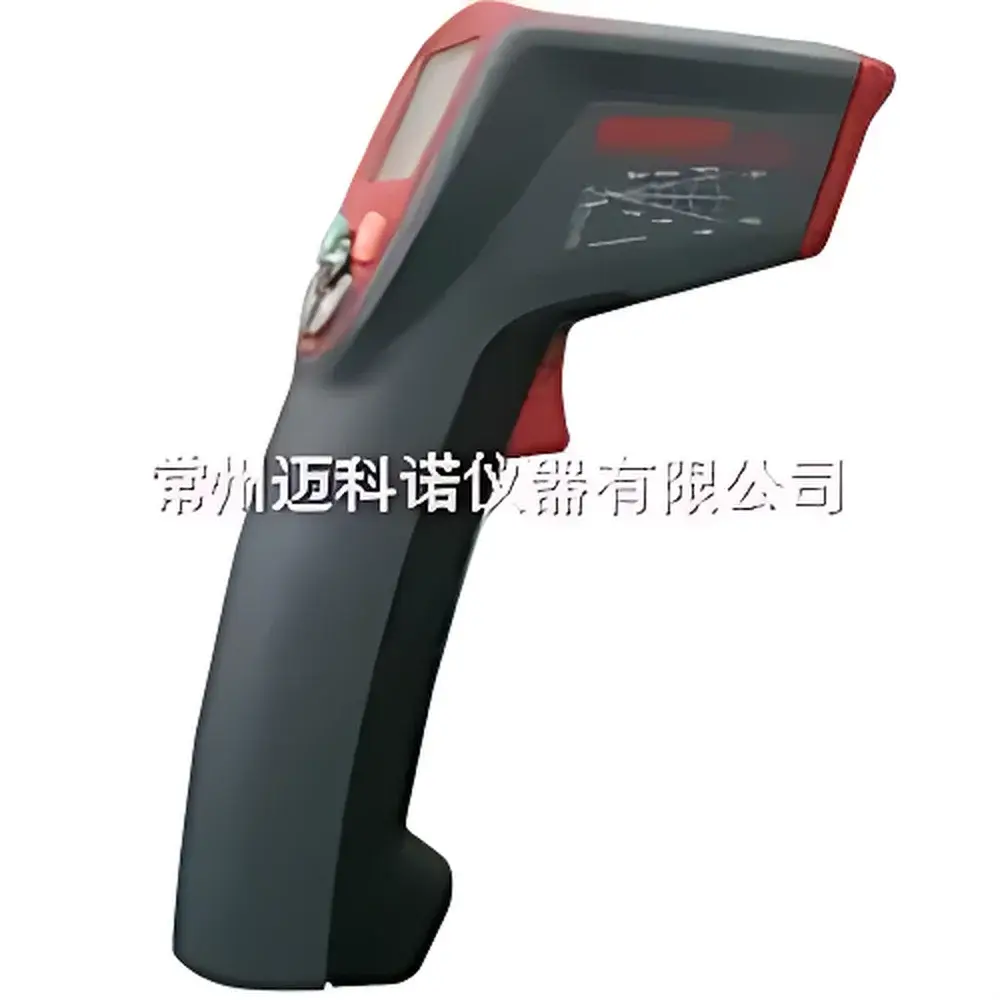
MKN ST-675 High-Temperature Infrared Pyrometer
| Brand | MKN |
|---|---|
| Model | ST-675 |
| Temperature Range | −32 to 1300 °C |
| Distance-to-Spot Ratio | 50:1 |
| Spectral Response | 8–14 µm |
| Accuracy | ±2 °C (−20 to 100 °C), ±3 °C (−32 to −20 °C), ±2% of reading (>100 °C) |
| Repeatability | ±1 °C |
| Resolution | 0.1 °C / 0.1 °F (≤2000 °F) |
| Response Time | 500 ms |
| Emissivity Adjustment | 0.10–1.00 (0.01 step) |
| Operating Environment | 0 to 50 °C, 10–90% RH non-condensing |
| Laser Targeting | Class II, 650 nm, <1 mW |
| Display | Backlit LCD with dual-parameter readout |
| Data Storage | 10 measurement records |
| Alarm | Audible threshold alert |
| Power | 9 V alkaline battery (IEC 6LR61) |
| Dimensions | 200 × 166 × 50.5 mm |
| Mounting | Standard ¼″-20 UNC tripod thread |
Overview
The MKN ST-675 High-Temperature Infrared Pyrometer is a precision non-contact temperature measurement instrument engineered for industrial process monitoring, metallurgical furnace control, ceramic sintering verification, and high-temperature R&D applications. It operates on the principle of broadband infrared radiometry within the 8–14 µm atmospheric transmission window—optimized for accurate surface temperature readings of oxidized metals, refractory materials, molten glass, and ceramics. Its 50:1 optical distance-to-spot ratio enables reliable measurements from safe working distances, minimizing operator exposure during hot-process inspections. Unlike thermocouples or RTDs, the ST-675 requires no physical contact, eliminating thermal loading errors, sensor drift from thermal cycling, or contamination risks in sterile or vacuum environments. The device complies with fundamental radiometric calibration traceability requirements per ISO/IEC 17025-accredited reference sources and adheres to the spectral responsivity guidelines outlined in ASTM E2847 for infrared thermometers used in industrial settings.
Key Features
- High-resolution dual-parameter LCD display with adjustable backlight for low-light industrial environments
- Class II visible laser targeting system (650 nm) for precise spot location confirmation
- Adjustable emissivity (0.10–1.00 in 0.01 increments) to accommodate diverse material surfaces—from polished aluminum (ε ≈ 0.05) to oxidized steel (ε ≈ 0.85) and graphite (ε ≈ 0.78)
- Real-time statistical functions: MAX/MIN/AVG/ΔT calculation with automatic capture upon stabilization
- Onboard memory storing up to 10 sequential temperature records with timestamp-equivalent recall (manual trigger only)
- Audible alarm with user-defined upper/lower thresholds for pass/fail process checks
- Robust mechanical architecture featuring IP54-rated ingress protection against dust and water splashes
- Integrated ¼″-20 UNC threaded mounting interface compatible with standard optical tripods and fixed-position brackets
- Auto-power-off after 6 seconds of inactivity to conserve battery life—critical for field technicians performing rapid multi-point surveys
Sample Compatibility & Compliance
The ST-675 is validated for use across heterogeneous high-temperature surfaces including but not limited to: annealed and hot-rolled steel billets, silicon carbide heating elements, kiln linings, exhaust manifolds, and molten salt reactors. It meets the essential performance criteria defined in IEC 62942-1:2017 (Industrial infrared thermometers — Part 1: General requirements) and aligns with measurement uncertainty practices referenced in ISO/TR 16629 for non-contact thermometry. While not certified for safety-critical SIL-rated applications, its repeatability (±1 °C) and stability over 8-hour continuous operation support routine QA/QC documentation under GLP-aligned workflows. No FDA 21 CFR Part 11 compliance features are implemented, as the unit lacks audit-trail-capable firmware or network connectivity—consistent with its role as a portable verification tool rather than a regulated process instrument.
Software & Data Management
The ST-675 operates as a standalone field instrument with no embedded Bluetooth, USB, or Wi-Fi interfaces. Temperature data are retained locally in volatile memory and accessible only via manual review on-device; no proprietary software, drivers, or cloud synchronization protocols are provided or required. This design prioritizes electromagnetic compatibility (EMC) resilience in electrically noisy environments—such as near arc furnaces, induction heaters, or variable-frequency drives—where wireless communication would suffer interference. For integration into centralized SCADA or MES systems, users must employ external IR data loggers or manually transcribe values into LIMS-compliant spreadsheets. All firmware logic resides in mask ROM, ensuring deterministic behavior without runtime updates or security patch dependencies.
Applications
- Continuous monitoring of reheating furnace exit temperatures in rolling mill operations
- Verification of thermal uniformity across ceramic kiln zones during glaze firing cycles
- Preventive maintenance checks on transformer bushings, busbar connections, and switchgear contacts
- Validation of heat treatment profiles in batch-type vacuum furnaces (post-quench surface assessment)
- Field calibration cross-checks against contact probes in HVAC commissioning of high-temp ductwork
- Rapid emissivity mapping of coated substrates during PVD/CVD process development
- Thermal signature analysis of brake rotors and exhaust components under dynamic load conditions
FAQ
What is the minimum measurable spot size at 1 meter distance?
At 1 m, the 50:1 optics resolve a circular measurement area of approximately 20 mm diameter.
Can the ST-675 measure through quartz or sapphire windows?
No—it is not spectrally tuned for transmission through common IR-transparent materials; direct line-of-sight to the target surface is required.
Is the laser used for measurement or solely for aiming?
The laser is purely an aiming aid; temperature detection relies exclusively on passive infrared radiation collection via the thermopile sensor.
How does ambient temperature affect accuracy outside the 0–50 °C operating range?
Operation below 0 °C or above 50 °C may induce thermal drift in internal compensation circuits; extended exposure invalidates stated accuracy specifications.
Does the device support emissivity presets for common materials?
No—emissivity must be manually entered; no lookup table or auto-recognition functionality is implemented.







