
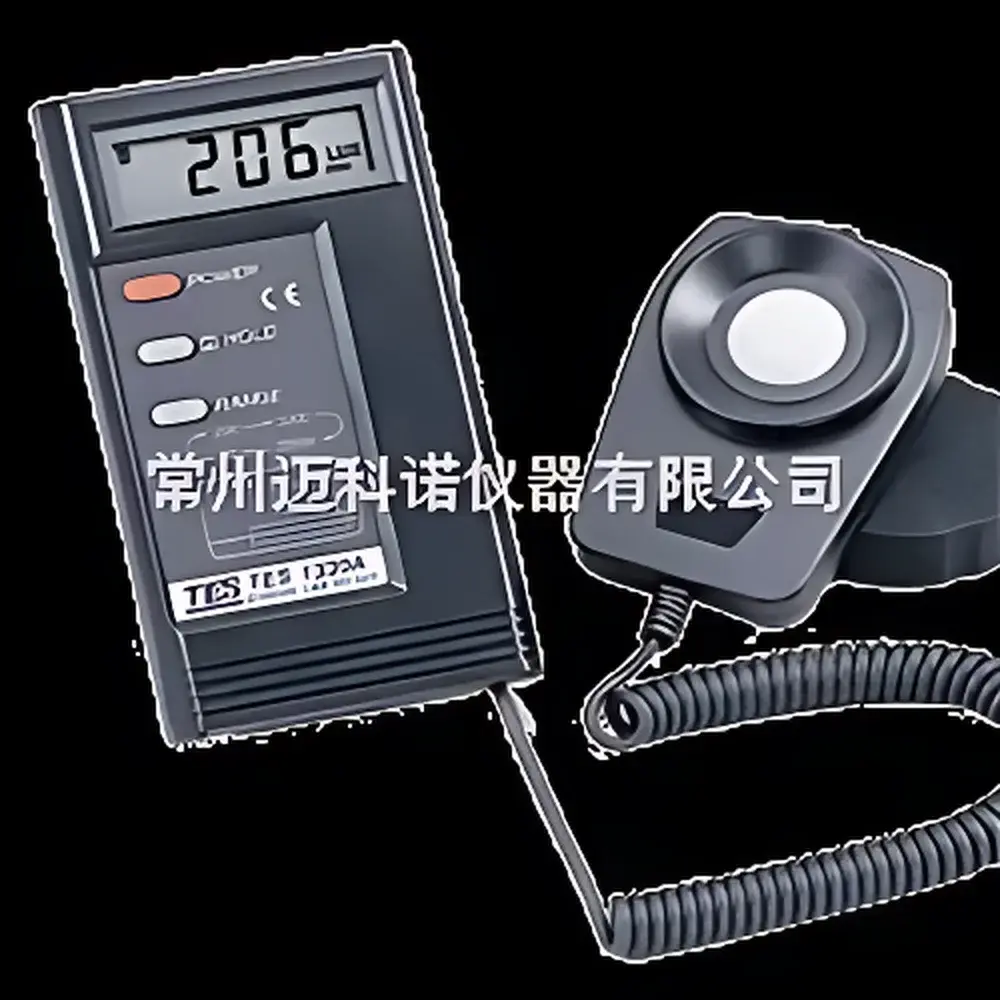
MKN TES-1334A Digital Lux Meter
| Brand | MKN |
|---|---|
| Model | TES-1334A |
| Display | 3½-digit LCD |
| Measurement Range | 20 / 200 / 2000 / 20000 lux (with footcandle capability) |
| Resolution | 0.01 lux |
| Accuracy | ±3% rdg ± 0.5% f.s. (<10,000 lux) |
| Repeatability | ±2% |
| Temperature Coefficient | ±0.1% / °C |
| Sampling Rate | ~2 Hz |
| Overload Indication | Leading digit “1” displayed |
| Hold Function | Data Hold & Peak Hold |
| Output | DC 2 V / f.s. (for external recorder compatibility) |
| Operating Temp./RH | 0–40 °C, <70% RH |
| Power | 9 V battery |
| Photodetector Dimensions | 100 × 60 × 27 mm |
| Meter Body Dimensions | 135 × 72 × 33 mm |
| Weight | 250 g |
| Accessories | Instruction manual, protective carrying case, 9 V battery |
Overview
The MKN TES-1334A Digital Lux Meter is a precision photometric instrument engineered for reliable, real-time measurement of illuminance in lux (lx) across four auto-ranging scales—20, 200, 2000, and 20000 lux—with optional footcandle (fc) conversion. Based on silicon photodiode detection and cosine-corrected optical response, the device complies with CIE photopic luminosity function (V(λ)) standards under correlated color temperature (CCT) conditions of 2856 K, ensuring metrological traceability to conventional tungsten-filament calibration sources. Its high-speed sampling (~2 readings per second), combined with dual hold modes—data hold for static reading capture and peak hold for transient maximum detection—makes it suitable for dynamic lighting assessments in industrial, architectural, and occupational health environments. Designed for field portability and laboratory-grade consistency, the TES-1334A integrates a robust 3½-digit LCD display, low-power operation via a single 9 V battery, and direct analog output for integration with data loggers or chart recorders (e.g., compatible with TES-1332A/1334A series recorders).
Key Features
- Four-range auto-scaling illuminance measurement (20–20000 lux) with 0.01 lux resolution on lowest range
- Cosine-corrected silicon photodetector aligned to CIE V(λ) spectral response curve
- Dual hold functionality: instantaneous data hold and peak-hold mode for capturing maximum illuminance events
- Analog DC output (2 V full-scale) enabling seamless connection to external recording systems or SCADA interfaces
- Overload indication via leading-digit “1” display for out-of-range measurements
- Stable thermal performance with ±0.1% / °C temperature coefficient, validated over 0–40 °C operating range
- Compact, handheld form factor (250 g) with ergonomic meter body and detachable photodetector for flexible positioning
Sample Compatibility & Compliance
The TES-1334A is optimized for ambient and task lighting evaluation in non-hazardous indoor and outdoor environments. It does not require sample preparation or consumables—measurements are performed directly on incident light fields. The instrument meets general requirements for illuminance verification under ISO/CIE 8995-1:2022 (Lighting of work places) and supports compliance workflows aligned with OSHA 1910.303(h)(1) and EN 12464-1:2021 (Lighting of indoor workplaces). While not certified to IEC 61000-4 electromagnetic immunity standards or IP-rated for dust/water ingress, its construction adheres to RoHS Directive 2011/65/EU for restricted hazardous substances. Calibration is referenced to a NIST-traceable 2856 K tungsten standard lamp; users are advised to perform periodic verification using accredited calibration services.
Software & Data Management
The TES-1334A operates as a standalone analog-output photometer without embedded firmware or digital connectivity (e.g., no USB, Bluetooth, or Wi-Fi). Data acquisition relies on external hardware: the 2 V f.s. analog output signal may be interfaced with third-party data loggers, programmable logic controllers (PLCs), or PC-based DAQ systems (e.g., National Instruments USB-6009 or Keysight 34972A). No proprietary software is provided; however, output signals conform to standard 0–2 V linear scaling (e.g., 20000 lux = 2.000 V), facilitating straightforward mapping in Excel, LabVIEW, or Python-based analysis pipelines. For GLP/GMP-regulated environments, users must implement independent audit trails, calibration logs, and instrument identification protocols—no built-in 21 CFR Part 11 compliance features are present.
Applications
- Workplace lighting audits per ISO 8995-1 and local occupational safety regulations
- Photobiological safety screening of LED and fluorescent fixtures during product development
- Validation of emergency egress lighting intensity and uniformity
- Architectural daylighting studies and façade illumination mapping
- Educational demonstrations of photometric principles (luminous flux, illuminance, inverse square law)
- Quality control checks in printing, textile, and electronics manufacturing where color rendering and brightness consistency affect process outcomes
FAQ
Does the TES-1334A support calibration certificate issuance?
No factory-issued calibration certificate is included; however, the unit is pre-calibrated against a 2856 K reference source. Users requiring documented traceability should arrange third-party calibration with an ISO/IEC 17025-accredited laboratory.
Can the photodetector be extended remotely from the meter?
Yes—the detector connects to the main unit via a fixed-length cable (not specified in datasheet but mechanically integrated); extension beyond original length may degrade signal integrity and cosine response accuracy.
Is footcandle measurement available on all ranges?
Footcandle readout is supported only on the TES-1334A model and scales proportionally to lux (1 fc ≈ 10.764 lx); conversion is manual or via external lookup tables.
What is the expected battery life under typical use?
With alkaline 9 V battery and average sampling frequency (~1 Hz), operational life exceeds 150 hours; auto-power-off is not implemented, so manual shutdown is recommended between measurements.
How does temperature affect measurement stability?
The specified ±0.1% / °C drift applies within the 0–40 °C operating range; measurements outside this band require thermal equilibration or correction using recorded ambient temperature data.
Related Products







