
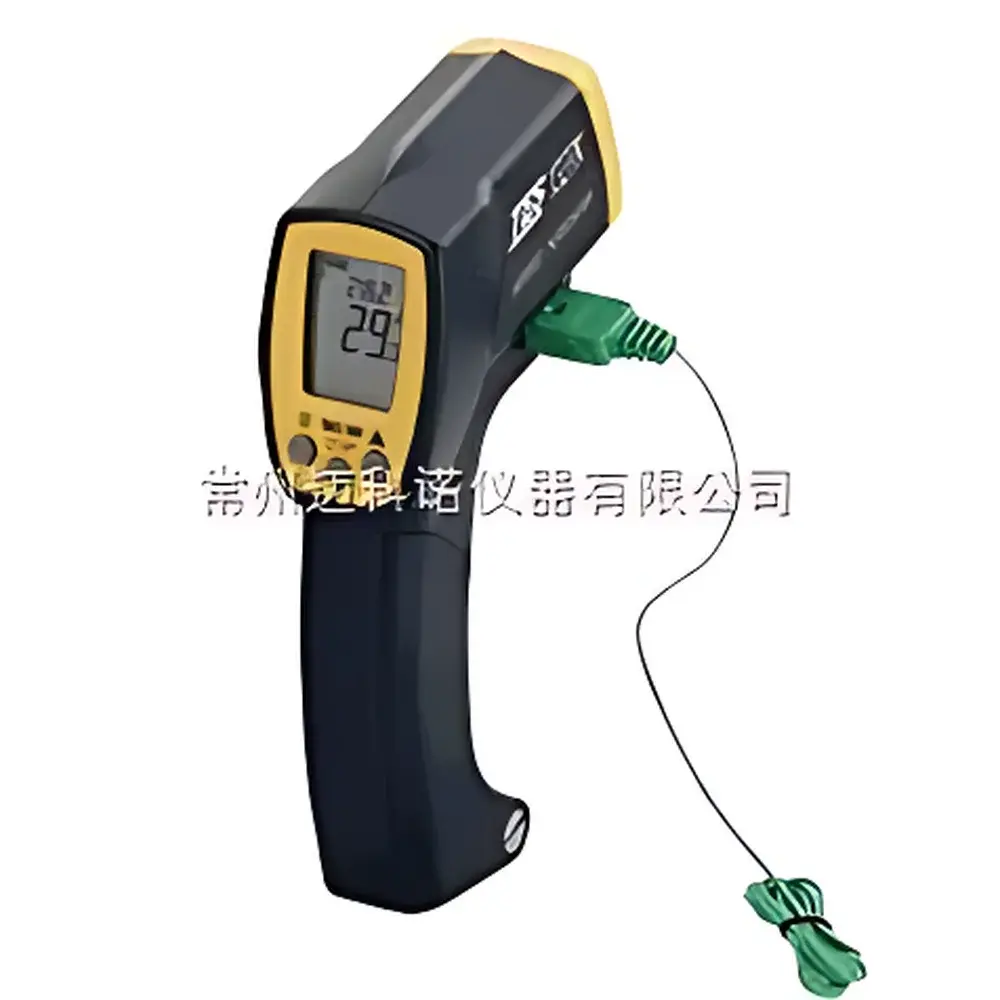
MKN TES-1327K Dual-Mode Infrared Thermometer with Integrated K-Type Thermocouple Probe
| Brand | MKN |
|---|---|
| Model | TES-1327K |
| Measurement Principle | Infrared Pyrometry (6–14 µm spectral response) + Contact Thermocouple (Type K) |
| Temperature Range (IR) | –35 °C to +500 °C (–31 °F to +932 °F) |
| Temperature Range (K-Type) | –150 °C to +1350 °C (–238 °F to +1999 °F) |
| IR Resolution | 0.1 °C / 0.2 °F |
| K-Type Resolution | 0.1 °C / 0.1 °F (≤200 °C), 1 °C / 1 °F (>200 °C) |
| IR Accuracy | ±2% of reading or ±2 °C, whichever is greater |
| K-Type Accuracy | ±(0.2% rdg + 1.0 °C) from –150 to 0 °C |
| Emissivity Adjustment | 0.17–1.00 (user-selectable) |
| Distance-to-Spot Ratio | 12:1 (min. target diameter: 25 mm) |
| Laser Targeting | Class II, ≤1 mW, visible red dot |
| Display | Backlit LCD with dual-parameter real-time readout |
| Data Logging | 50-point internal memory (viewable directly on display) |
| Auto Power-Off | ~15 seconds |
| Battery | 9 V alkaline (IEC 6LR61, 006P) |
| Operating Environment | 0–50 °C, ≤80% RH |
| Storage | –10–60 °C, ≤70% RH |
| Dimensions | 172 × 118 × 46 mm |
| Weight | 220 g |
Overview
The MKN TES-1327K is a dual-sensing portable temperature measurement instrument engineered for industrial maintenance, HVAC commissioning, laboratory validation, and quality control applications where both non-contact surface temperature profiling and contact-based high-temperature verification are required in a single handheld unit. It integrates two independent, calibrated sensing modalities: an infrared pyrometer operating in the 6–14 µm mid-wave infrared band—optimized for accurate emissivity-compensated readings across common industrial materials—and a fully isolated Type K thermocouple input compliant with IEC 60584-1:2013. The device employs a fixed-focus optical system with a 12:1 distance-to-spot ratio, enabling reliable measurements of targets as small as 25 mm at 300 mm working distance. Its dual-channel architecture allows simultaneous acquisition and comparative analysis of surface and subsurface or ambient-contact temperatures—critical for thermal gradient assessment, heat exchanger diagnostics, and furnace probe validation.
Key Features
- Dual-mode operation: Independent IR and K-type thermocouple channels with real-time side-by-side display on a backlit LCD
- User-adjustable emissivity (0.17–1.00) for precision correction across metals, plastics, ceramics, and oxidized surfaces
- Class II laser targeting (≤1 mW) for unambiguous spatial alignment without compromising eye safety
- On-device data logging of up to 50 measurement records—accessible directly via navigation keys without external software
- Programmable high/low temperature alarms with audible beeper feedback for process deviation detection
- Auto-hold function with MAX/MIN tracking for transient thermal event capture
- Low-power design supporting ~100 hours of continuous use (with laser and backlight disabled)
- Rugged ergonomic housing (220 g) with IP40-rated enclosure suitable for shop-floor deployment
Sample Compatibility & Compliance
The TES-1327K supports broad material compatibility through its adjustable emissivity setting and wide spectral response. It is routinely deployed for surface temperature validation of electrical connections (busbars, breakers), steam traps, refractory linings, polymer extrusion dies, and food-grade conveyor belts. While not certified for intrinsically safe environments, its design conforms to general-purpose industrial safety requirements per IEC 61010-1:2010 (measurement category CAT II 300 V). The K-type thermocouple interface meets cold-junction compensation accuracy specifications per ANSI MC96.1-2018. No regulatory certification (e.g., FDA 21 CFR Part 11, ATEX, or UL listing) is claimed; users requiring audit-trail compliance must implement external validation protocols and calibration documentation per ISO/IEC 17025:2017.
Software & Data Management
The TES-1327K operates as a standalone field instrument with no proprietary PC software dependency. All logged data (50 entries) are retained in non-volatile memory and retrievable directly on the LCD using intuitive menu navigation. Timestamps are not embedded—the device records only numeric values and mode identifiers (IR/K). For traceable reporting, users are advised to pair the instrument with external calibration logs and manual annotation of environmental conditions (ambient temperature, humidity, target geometry). The unit supports periodic recalibration against NIST-traceable blackbody sources (for IR channel) and dry-well calibrators (for K-type input), consistent with ASTM E2847-22 guidelines for infrared thermometer verification.
Applications
- Preventive maintenance of motors, transformers, and switchgear via hotspot detection
- Thermal mapping of HVAC ductwork, radiant floor systems, and chiller components
- Validation of sterilization cycles and autoclave door seals using contact thermocouple verification
- Monitoring of soldering iron tips, reflow oven profiles, and die-cast mold surfaces
- Educational demonstrations of emissivity effects and conduction vs. radiation heat transfer
- Field verification of thermocouple loop integrity by cross-referencing IR surface temp with probe insertion point
FAQ
Does the TES-1327K support data export to CSV or USB?
No. Data logging is limited to on-device storage and manual transcription.
Is the laser targeting essential for accurate IR measurement?
No—the laser is solely for aiming assistance; measurement relies on the fixed optics. Accuracy is unaffected if the laser fails.
Can the K-type input accept thermocouples other than Type K?
No. The analog front-end and cold-junction compensation are calibrated exclusively for Type K (Chromel–Alumel) characteristics.
What is the recommended calibration interval?
Annual calibration is advised for routine QA/QC use; more frequent verification is required in high-accuracy or regulated environments.
Does the device meet GLP or GMP documentation requirements?
It does not generate electronic audit trails or digital signatures. Full compliance requires integration into a validated lab information management system (LIMS) with procedural controls.




