
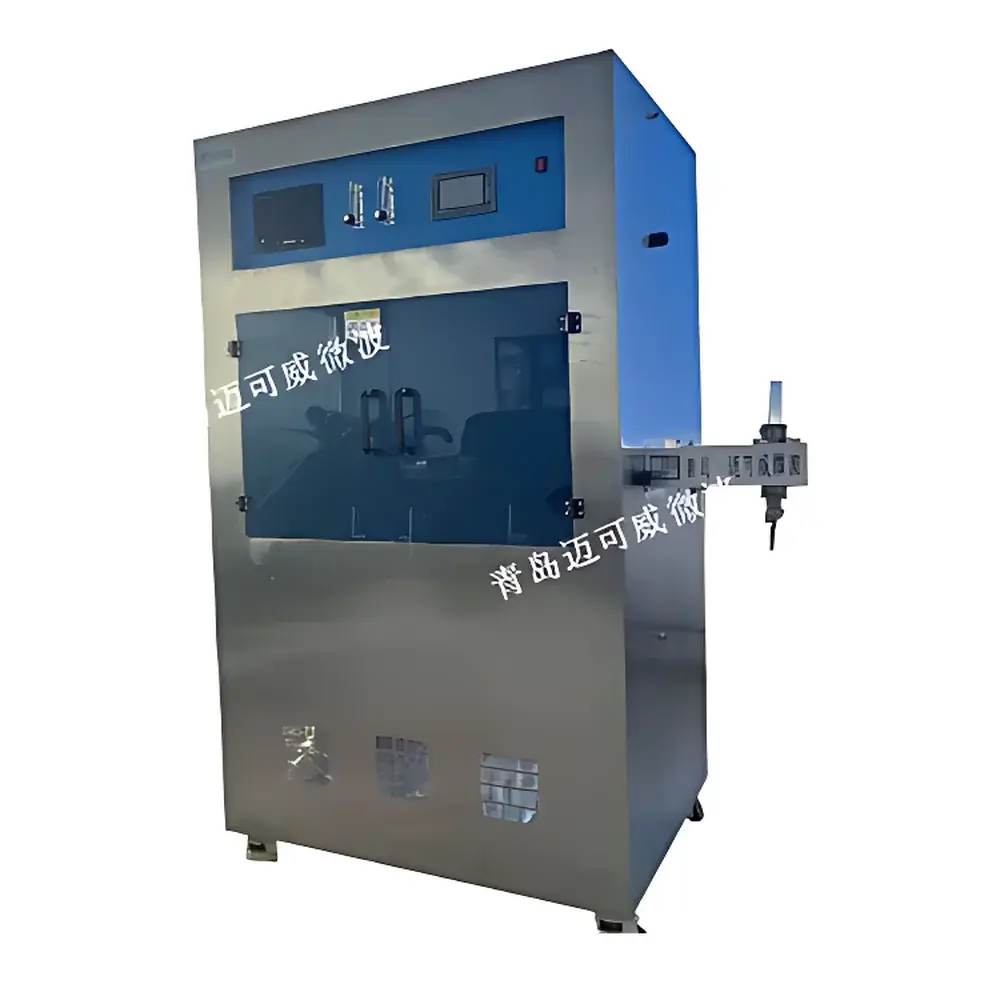
MKP-WT1FA Microwave Plasma Torch System by Makewave
| Brand | Makewave |
|---|---|
| Origin | Shandong, China |
| Manufacturer Type | Direct Manufacturer |
| Country of Origin | Domestic (China) |
| Model | MKP-WT1FA |
| RF Frequency | 2450 MHz |
| Output Power | 1000 W (continuous, non-pulsed) |
| Chamber Material | 304 Stainless Steel |
| Gas Supply | Multi-channel configurable gas inlet with mass flow control |
| Control System | PLC-based automated control with real-time parameter monitoring |
| Dimensions (W×H×D) | 1400 × 1600 × 700 mm |
| Weight | 80 kg |
| Cooling | Integrated water-cooling system |
| Safety Compliance | Microwave leakage < 5 mW/cm² (meets and exceeds GB 10436-2008) |
| Certification | ISO 9001 certified |
| Warranty | 12 months |
Overview
The MKP-WT1FA Microwave Plasma Torch System is a laboratory-scale open-configuration plasma source engineered for high-temperature material processing under controlled atmospheric conditions. Unlike enclosed plasma reactors, this system utilizes a microwave-excited, atmospheric-pressure plasma jet generated via resonant coupling of 2450 MHz electromagnetic energy into a flowing gas stream—enabling stable, non-thermal to thermal plasma operation (>1000 °C core temperature) without electrodes or consumable cathodes. The system operates on the principle of microwave-induced ionization in a quartz-based discharge zone, producing a luminous, chemically active plasma plume suitable for surface functionalization, catalytic activation, nanoparticle synthesis, waste gas cracking, and high-temperature reaction studies. Its open architecture allows direct integration with downstream reactors, gas sampling lines, or in-situ diagnostic tools—including optional optical pyrometry and real-time video observation—making it particularly valuable for process development in materials science, environmental engineering, and catalysis research.
Key Features
- Microwave excitation at 2450 MHz with continuous, non-pulsed 1000 W output—ensuring stable plasma ignition and reproducible thermal profiles
- Open-ended quartz tube plasma reaction zone with adjustable flame height and intensity control via microwave coupling optimization
- Multi-gas compatibility: supports independent mass-flow-controlled delivery of O₂, N₂, Ar, H₂, CH₄, NH₃, or custom gas mixtures for oxidative, reductive, or inert plasma chemistry
- PLC-driven automation platform enabling precise sequencing of power ramping, gas switching, dwell time, and cooling cycles
- Integrated infrared pyrometry (700–1700 °C range) with optional optical pyrometer upgrade for non-contact temperature validation
- λ/4 choke structure at plasma outlet to suppress microwave leakage (<5 mW/cm²), exceeding GB 10436-2008 safety limits
- Interlocked stainless-steel enclosure (304 grade) with automatic power cutoff upon door opening—compliant with IEC 61000-4-3 immunity requirements
- Water-cooled magnetron and cavity assembly ensuring thermal stability during extended operation (>8 h continuous duty)
Sample Compatibility & Compliance
The MKP-WT1FA accommodates solid powders, granules, thin films, fibers, and liquid aerosols introduced directly into the plasma plume via carrier gas stream or gravity-fed feeders. No fixed sample chamber volume is specified because the system employs an open-jet configuration—samples interact dynamically with the plasma column rather than residing in a static cavity. This design enables real-time treatment of moving substrates and continuous-flow reaction studies. The unit complies with ISO 9001:2015 quality management standards and meets electromagnetic compatibility (EMC) Class B requirements per CISPR 11. While not designed for GMP cleanroom deployment, its traceable calibration records, audit-ready parameter logging, and hardware interlocks support GLP-aligned experimental documentation. Optional exhaust scrubbing and tail-gas condensation modules are available for hazardous byproduct capture in compliance with local occupational health regulations (e.g., OSHA 29 CFR 1910.1200).
Software & Data Management
The embedded PLC controller logs all operational parameters—including forward/reflected microwave power, gas flow rates (SLM), pyrometer readings, and cycle timestamps—at user-defined intervals (1–60 s). Data export is supported via USB interface in CSV format for post-processing in MATLAB, Python, or LabVIEW environments. No proprietary software installation is required; human-machine interface (HMI) is accessed via a 7-inch resistive touchscreen with password-protected administrator mode. Audit trail functionality records operator ID, parameter changes, and emergency stop events—satisfying basic FDA 21 CFR Part 11 data integrity expectations for non-clinical research use. Remote monitoring via Modbus TCP is available as an add-on module for integration into centralized lab automation networks.
Applications
- Surface modification of polymers, metals, and ceramics for enhanced adhesion, hydrophilicity, or biocompatibility
- In-situ synthesis and functionalization of metal oxide nanoparticles (e.g., TiO₂, ZnO, Fe₃O₄) from volatile precursors
- Thermal cracking of halogenated hydrocarbons and VOC abatement studies
- Plasma-assisted catalyst regeneration and coke removal from spent heterogeneous catalysts
- Fundamental investigation of plasma–solid interaction kinetics under variable gas composition and power density
- Pre-treatment of carbon nanomaterials prior to composite fabrication or electrochemical electrode preparation
FAQ
What gases can be used with the MKP-WT1FA?
Ar, N₂, O₂, H₂, He, CO₂, CH₄, NH₃, and custom binary or ternary mixtures are supported via independently regulated mass flow controllers.
Is vacuum operation possible?
No—the system is designed exclusively for atmospheric-pressure operation; vacuum compatibility is not provided.
Can the plasma torch be integrated with existing fume hoods or exhaust systems?
Yes; the unit includes a standard 50-mm exhaust port compatible with common ducting and optional activated carbon or wet-scrubber modules.
What maintenance is required for long-term reliability?
Routine inspection of quartz tube integrity, magnetron cooling lines, and gas filter elements every 200 operating hours; magnetron replacement recommended after 5000 h of cumulative use.
Does the system support external triggering or synchronization with other instruments?
Yes—TTL-compatible trigger input/output ports are provided for synchronized data acquisition with spectrometers, high-speed cameras, or mass spectrometers.



