
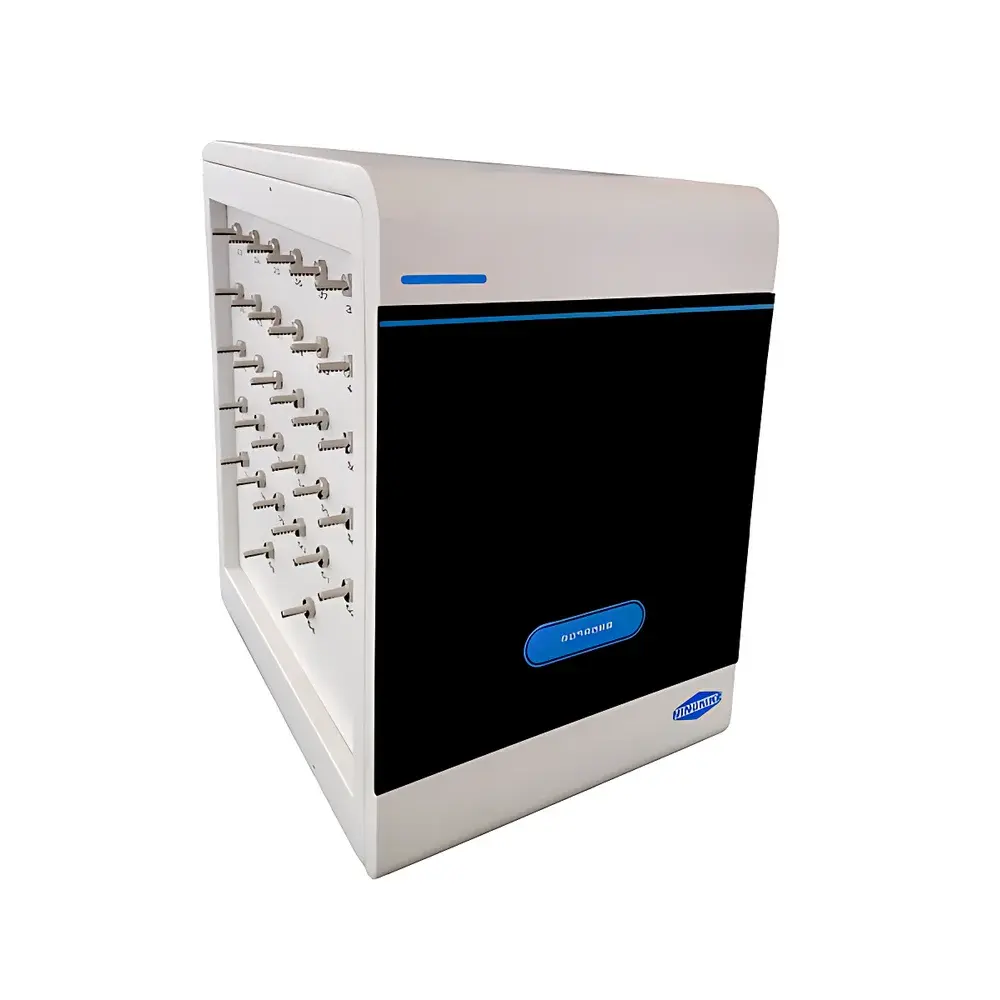
MNK MQ701-16 Fully Automated Gas Bag Autosampler
| Brand | MNK |
|---|---|
| Origin | Beijing, China |
| Model | MQ701-16 |
| Configuration | 16-position gas-tight sampling station |
| Compatibility | Agilent GC systems (native control via Agilent ChemStation/OpenLab), universal TTL/RS-232 trigger interface for cross-platform integration |
| Vacuum Source | Integrated diaphragm vacuum pump (oil-free, zero carryover) |
| Sample Path | Silanized stainless steel tubing with active sulfur resistance |
| Heating | Electrically heated transfer lines (adjustable 40–120 °C) |
| Control | PC-based software with method scheduling, audit trail, and sequence logging |
| Compliance | Designed to support GLP/GMP workflows |
Overview
The MNK MQ701-16 is a dedicated, fully automated gas bag autosampler engineered for high-throughput, reproducible introduction of gaseous samples into gas chromatography (GC) systems. It operates on a fixed-volume, pressure-balanced syringe aspiration principle—drawing sample from Tedlar® or laminated gas bags into a pre-evacuated, temperature-controlled sampling loop via an integrated oil-free diaphragm vacuum pump. Unlike purge-and-trap or thermal desorption interfaces, the MQ701-16 preserves original gas-phase composition without phase change or adsorptive loss, making it particularly suitable for volatile organic compounds (VOCs), permanent gases (e.g., O₂, N₂, CO, CH₄), hydrogen sulfide (H₂S), mercaptans, and other reactive sulfur species. Its mechanical architecture eliminates manual valve switching and operator-dependent timing, reducing inter-run variability and enabling unattended overnight operation across environmental monitoring, petrochemical QA/QC, and third-party compliance laboratories.
Key Features
- 16-position rotary carousel with indexed bag clamping mechanism—each position supports standard 1–10 L gas bags with dual-seal septum ports
- Integrated silanized stainless-steel fluid path, chemically passivated to minimize surface reactivity with acidic, oxidizing, or sulfur-containing analytes
- Electrically heated sample transfer lines (40–120 °C range, ±1 °C stability) prevent condensation of moisture, C₃+ hydrocarbons, or polar VOCs during transit
- Onboard diaphragm vacuum pump delivers consistent evacuation (<5 mbar residual pressure) without lubricant contamination or maintenance intervals
- Native bidirectional communication with Agilent ChemStation and OpenLab CDS via USB/RS-232; also supports generic TTL “Start” pulse triggering for Shimadzu, Thermo Fisher, and PerkinElmer GC platforms
- Embedded microcontroller with non-volatile memory retains method parameters, run history, and error logs—even after power interruption
Sample Compatibility & Compliance
The MQ701-16 accommodates gas matrices ranging from ambient air and stack emissions to refinery headspace and biogas. Its inert flow path meets ASTM D5504 (determination of sulfur compounds in gaseous fuels) and EPA Method TO-15 requirements for low-level VOC analysis. The absence of catalytic surfaces or polymer seals ensures compatibility with H₂S concentrations up to 10,000 ppmv without degradation. All firmware and control logic are designed to align with analytical data integrity principles: sequence files include timestamps, user IDs, and instrument state metadata; optional integration with LIMS or validated CDS environments enables full traceability per ISO/IEC 17025 and FDA 21 CFR Part 11 when paired with electronic signature modules.
Software & Data Management
The MQ701-16 is operated through a Windows-based configuration utility that supports method creation, batch sequencing, and real-time status monitoring. Each method defines bag position, heating setpoint, aspiration volume (1–50 mL adjustable), dwell time, and GC trigger delay. Software enforces parameter validation (e.g., prevents overheating if line temperature exceeds bag rating) and generates CSV-formatted run reports containing start/stop times, vacuum pressure profiles, and hardware fault codes. Audit trails record all configuration changes with user attribution and ISO 8601 timestamps. For regulated environments, the system supports export to secure network shares or direct ingestion into validated chromatography data systems with configurable field mapping.
Applications
- Continuous monitoring of landfill and wastewater treatment plant emissions per EPA Method 25A and EN 13649
- Quality control of natural gas and liquefied petroleum gas (LPG) per ISO 6974 and ASTM D1945
- Odorant tracking (e.g., tert-butyl mercaptan) in distribution networks
- Workplace exposure assessment for VOCs and acid gases in industrial hygiene studies
- Method validation and reference material analysis where matrix-matched gas standards are required
FAQ
Does the MQ701-16 require carrier gas or external vacuum sources?
No—it incorporates a self-contained diaphragm vacuum pump and requires no auxiliary gas supply or roughing pump.
Can it handle humid or particulate-laden gas samples?
Yes, provided inlet filtration (e.g., sintered stainless frit or PTFE membrane) is installed upstream; the heated lines mitigate water condensation, but liquid ingress must be prevented.
Is firmware upgradeable in the field?
Yes—updates are delivered as signed binary packages via USB stick; version history and checksum verification are logged automatically.
What is the mean time between failures (MTBF) for critical components?
Based on accelerated life testing, the vacuum pump exceeds 15,000 hours; the stepper motor drive system is rated for >500,000 positioning cycles.
How is calibration verified?
Using certified gas standards and gravimetrically prepared bag sets; the software includes a calibration verification module that compares expected vs. observed retention times and peak areas across sequential injections.
Related Products






