
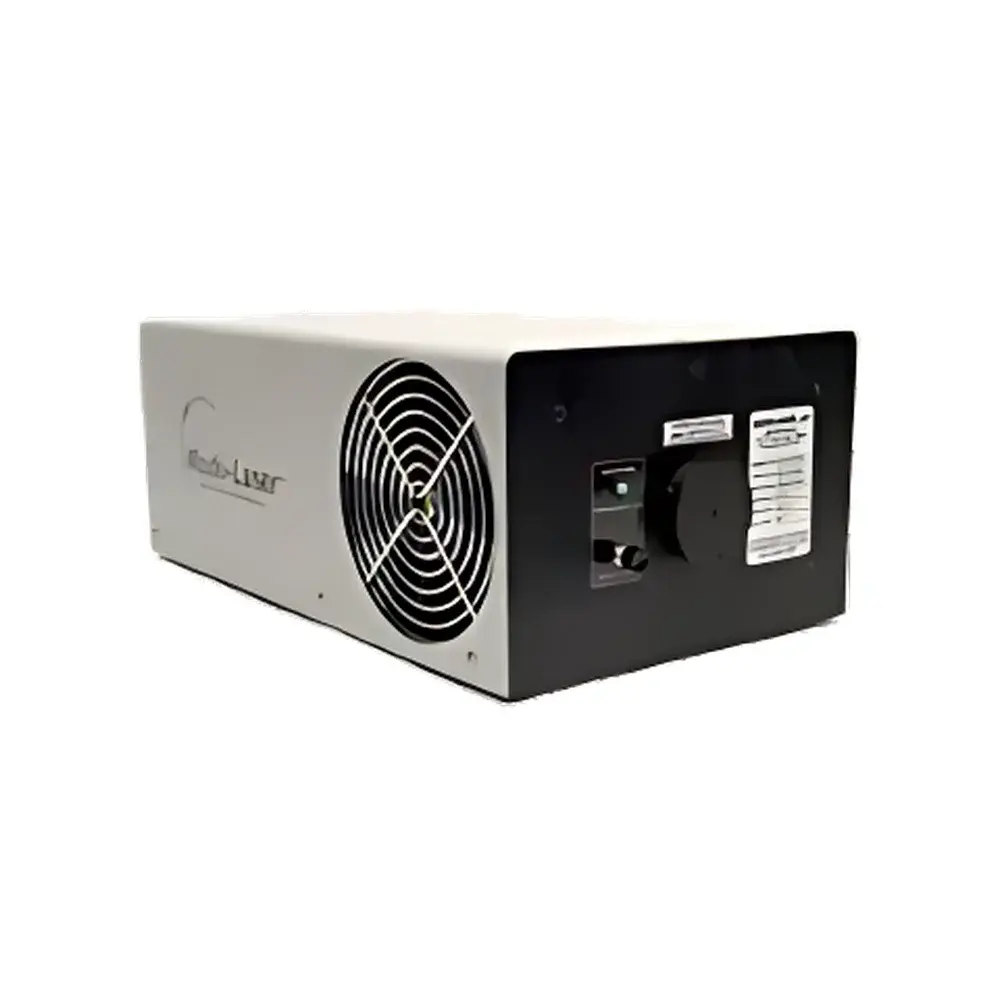
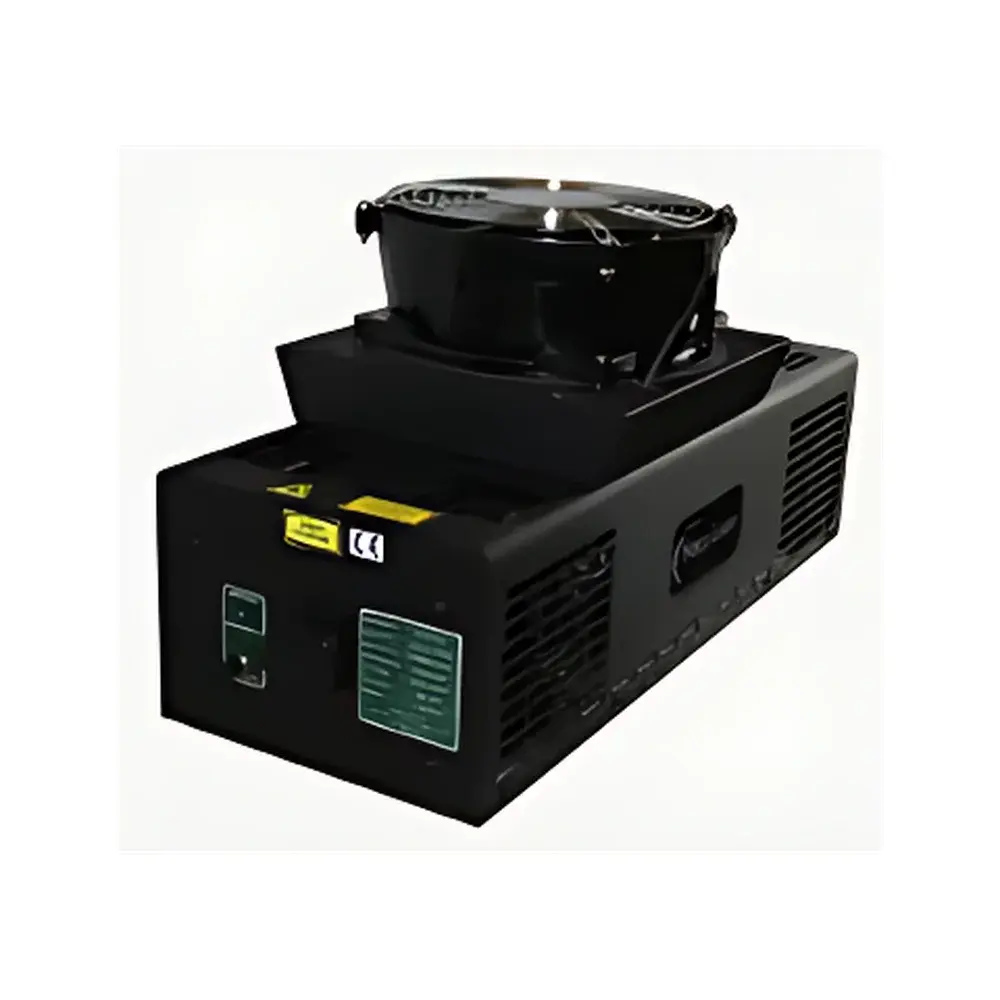
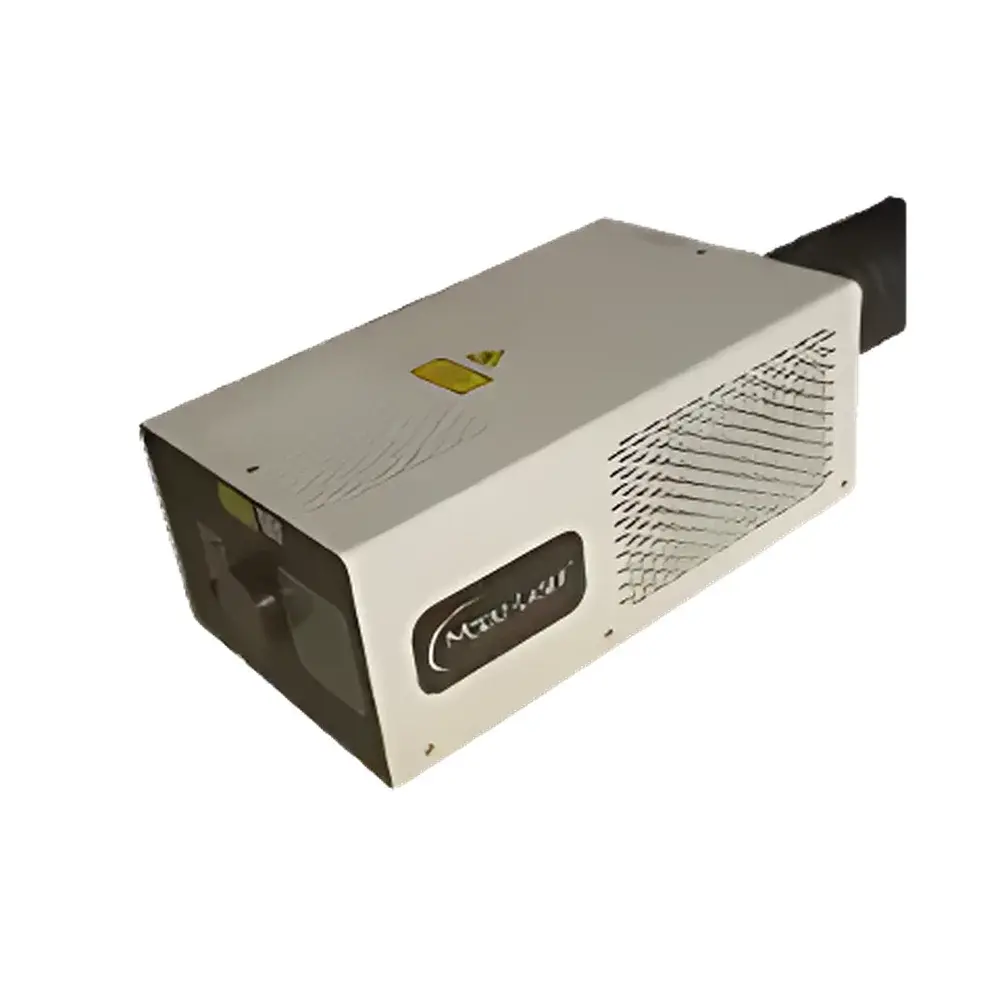
Modu-Laser Argon Ion Laser System
| Brand | Modu-Laser |
|---|---|
| Origin | USA |
| Product Type | Gas Ion Laser |
| Model Series | TEM₀₀ Continuous-Wave Argon Ion Laser |
| Wavelengths | 488 nm, 514.5 nm (single-line or multi-line output) |
| Output Power | Up to 300 mW (TEM₀₀, 488 nm) |
| Cooling | Air-cooled or Water-cooled Options |
| Beam Quality | M² < 1.1 |
| Polarization | Linear, >100:1 |
| Lifetime | ≥5,000 hours (typical) |
| Compliance | CE, RoHS, FDA 21 CFR Part 1040.10 |
Overview
The Modu-Laser Argon Ion Laser System is a high-reliability, continuous-wave (CW) gas ion laser engineered for precision spectroscopic excitation, particularly in Raman spectroscopy, confocal microscopy, and optical pumping applications. Operating on the principle of electrical discharge-induced population inversion in ionized argon gas, this laser delivers stable, narrow-linewidth emission at primary wavelengths including 488 nm (blue) and 514.5 nm (green), with optional multiline output across the visible spectrum (454.6–528.7 nm). Designed with a robust sealed-plasma tube architecture and optimized cathode-anode geometry, it achieves high temporal stability (<±1% power drift over 8 h) and low amplitude noise (<0.5% RMS), critical for quantitative spectral acquisition and long-duration imaging protocols. Unlike diode-pumped solid-state (DPSS) alternatives, argon ion lasers provide intrinsic spatial coherence and Gaussian beam profile (TEM₀₀) without external mode cleanup—making them preferred excitation sources where beam quality, spectral purity, and long-term power consistency are non-negotiable.
Key Features
- High-power TEM₀₀ output up to 300 mW at 488 nm, with M² < 1.1 and diffraction-limited focusability
- Single-wavelength or multi-line operation configurable via internal prism or external wavelength selection optics
- Air-cooled variants for benchtop integration; water-cooled models for sustained high-power operation (>150 mW)
- Integrated thermal management system ensuring ±0.1 °C coolant temperature stability
- Low-noise current regulation with active feedback loop, minimizing intensity fluctuations during spectral acquisition
- Compliant laser housing with interlock-ready safety interface (IEC 60825-1 Class IV) and key-switch enablement
- OEM-friendly mechanical and electrical interfaces—including analog modulation input (0–5 V), TTL shutter control, and RS-232/USB communication
Sample Compatibility & Compliance
This laser system is routinely deployed as an excitation source in Raman spectrometers requiring high photon flux and minimal fluorescence background—especially for aqueous biological samples, semiconductor wafers, and polymer thin films. Its 488 nm line enables efficient resonance enhancement in carotenoid, cytochrome, and nucleic acid studies, while the 514.5 nm line minimizes photodamage in live-cell imaging. The system conforms to international laser safety standards (IEC 60825-1:2014, EN 60825-1), carries CE marking for EMC and LVD directives, and meets RoHS 2011/65/EU material restrictions. For regulated environments (e.g., pharmaceutical QC labs), optional firmware supports audit-trail logging and user-access-level controls aligned with FDA 21 CFR Part 11 requirements when integrated with compliant host software.
Software & Data Management
Modu-Laser provides a cross-platform configuration utility (Windows/macOS/Linux) supporting real-time monitoring of tube current, cathode voltage, coolant temperature, and output power via calibrated photodiode feedback. All operational parameters—including setpoints, runtime hours, and fault logs—are timestamped and exportable in CSV/JSON format. When interfaced with third-party spectroscopy platforms (e.g., Ocean Insight, Horiba LabSpec, Renishaw WiRE), the laser synchronizes via TTL trigger or software API (RESTful endpoints with JSON payload), enabling automated wavelength/power ramping during spectral mapping. Firmware updates preserve calibration integrity and are validated against NIST-traceable reference measurements prior to release.
Applications
- Raman spectroscopy: Primary excitation source for benchtop and portable systems targeting chemical identification, crystallinity analysis, and stress/strain mapping in materials science
- Confocal and super-resolution microscopy (STED, PALM): Stable 488 nm output enables precise fluorophore activation and depletion with sub-200 nm lateral resolution
- Ophthalmic photocoagulation: Clinically validated 514.5 nm delivery for diabetic retinopathy treatment under ISO 15004-2 ophthalmic laser safety guidelines
- Photolithography alignment: High-coherence visible output used in mask aligner illumination subsystems for microfabrication
- Laser seeding: Low-phase-noise CW output serves as master oscillator in tunable OPO and ultrafast amplifier chains
- Flow cytometry and particle image velocimetry (PIV): Uniform beam profile ensures reproducible scattering signal calibration across instrument fleets
FAQ
What is the typical lifetime of the plasma tube under standard operating conditions?
Rated minimum operational life is 5,000 hours at rated current and proper cooling; actual lifetime often exceeds 8,000 hours with conservative current derating and stable thermal management.
Can the laser be integrated into a GLP-compliant laboratory workflow?
Yes—when paired with validated host software, it supports electronic signatures, change control logs, and audit trails per FDA 21 CFR Part 11 and ISO/IEC 17025 requirements.
Is remote power modulation supported?
Analog (0–5 V) and TTL (0–5 V, 1 µs rise time) modulation inputs are standard; modulation bandwidth exceeds 10 kHz for dynamic spectroscopic scanning.
Does Modu-Laser offer OEM customization beyond wavelength selection?
Yes—including custom beam delivery optics, integrated dichroic combiners for multi-laser systems, mechanical footprint adaptation, and firmware-level protocol tailoring for embedded control architectures.
How does air-cooled performance compare to water-cooled units at 488 nm?
Air-cooled models deliver up to 120 mW at 488 nm with passive thermal stabilization; water-cooled versions sustain ≥250 mW with <0.3 °C coolant temperature variation over 24 h.




