
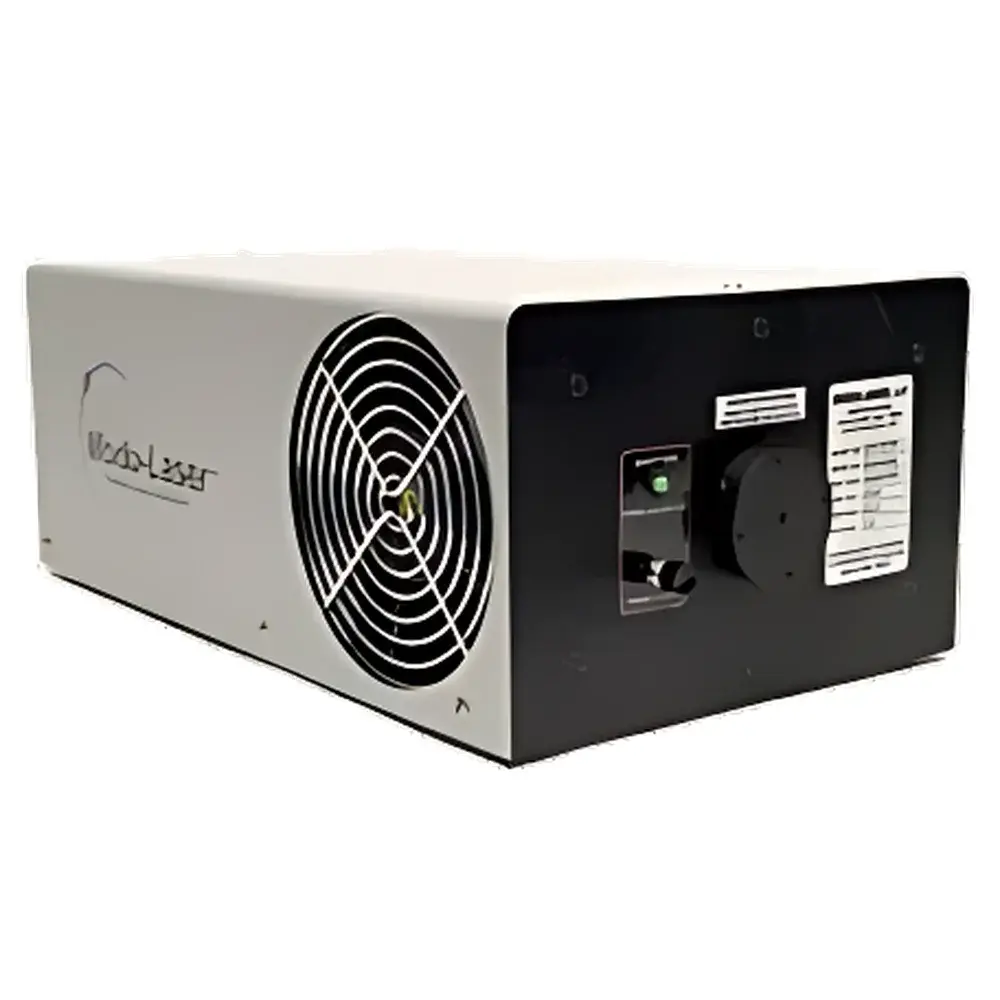
Modu-Laser Stellar-Pro 457-10 Argon Ion Laser System
| Wavelength | 457.9 nm (single-line) |
|---|---|
| Output Power | 10 mW (TEM₀₀) |
| Beam Diameter | 0.65 mm |
| Beam Divergence | 0.95 mrad |
| Pointing Stability | <30 µrad |
| Power Drift (after warm-up) | <±1% |
| Intensity Noise | <1% RMS |
| Polarization Ratio | >250:1 |
| Warm-up Time | 5 min |
| Input Voltage/Frequency | 100–265 VAC, 50–60 Hz |
| Power Consumption | <1500 W |
| Weight | 6.4 kg |
| Origin | USA |
| Configuration | Integrated sealed-tube laser head + embedded power supply |
| Compliance | CE, RoHS, FDA 21 CFR Part 1040.10 (Laser Product Safety) |
Overview
The Modu-Laser Stellar-Pro 457-10 is a compact, air-cooled argon ion laser system engineered for precision optical applications requiring stable, single-wavelength visible emission at 457.9 nm. Unlike traditional water-cooled argon ion lasers, the Stellar-Pro series employs a hermetically sealed plasma tube with optimized bore geometry and low-threshold discharge characteristics, enabling reliable TEM₀₀ operation without external chillers or complex vacuum infrastructure. Its core architecture follows classical DC-excited ion laser physics: argon gas is ionized within a quartz plasma tube under high-current discharge, generating population inversion between specific ionic energy levels—here, the 4p⁴5s → 4p⁴4d transition yields the dominant 457.9 nm blue line. The integrated, digitally regulated power supply ensures precise current control (<0.05% ripple), minimizing thermal drift and mode instability. Designed for laboratory integration rather than standalone benchtop use, the system delivers high beam quality (M² < 1.1), low pointing error, and rapid thermal stabilization—critical for interferometry, fluorescence excitation, holography, and alignment metrology.
Key Features
- Monolithic design integrating sealed argon plasma tube and intelligent power supply in a single 6.4 kg chassis—reducing footprint by >40% versus conventional air-cooled competitors
- Stable TEM₀₀ output with beam diameter of 0.65 mm (1/e²) and divergence ≤0.95 mrad, optimized for coupling into single-mode fibers and scanning optics
- Pointing stability <30 µrad over 8 hours, achieved via thermally symmetric mechanical layout and low-CTE mounting substrates
- Digital current regulation with active feedback loop ensures power drift <±1% after 5-minute warm-up, meeting ISO 11146 beam parameter repeatability requirements
- Polarization ratio >250:1 (linear, horizontal), verified per ISO 15367-2, enabling polarization-sensitive measurements without external waveplates
- Universal AC input (100–265 VAC, 50–60 Hz) with active PFC circuitry; peak power draw <1500 W during lasing, compliant with IEC 61000-3-2 Class A harmonic limits
Sample Compatibility & Compliance
The Stellar-Pro 457-10 is compatible with standard optomechanical interfaces (e.g., SM1-threaded mounts, Ø25.4 mm kinematic bases) and supports direct integration into OEM instruments including confocal microscopes, Raman spectrometers, and particle image velocimetry (PIV) systems. Its 457.9 nm output aligns with common fluorophore excitation bands (e.g., DAPI, Alexa Fluor 405, and quantum dot absorption edges), making it suitable for life science instrumentation under GLP-compliant workflows. The system complies with international laser safety standards: IEC 60825-1:2014 (Class 3B), FDA 21 CFR Part 1040.10 (U.S. variance accepted), and EN 60825-1:2014. Built-in interlock circuitry (IEC 61508 SIL2-rated) supports integration into safety-critical industrial control architectures.
Software & Data Management
While the Stellar-Pro 457-10 operates as a stand-alone analog device, its power supply includes RS-232 and USB-C digital interfaces supporting ASCII command protocol (SCPI subset) for remote monitoring and control. Compatible with LabVIEW™, MATLAB® Instrument Control Toolbox, and Python (pySerial), it enables automated power ramping, runtime logging, and failure-event timestamping. All operational parameters—including discharge current, cathode temperature (via embedded thermistor), and interlock status—are accessible in real time. Audit trails generated during operation satisfy FDA 21 CFR Part 11 requirements when deployed with validated third-party data acquisition software featuring electronic signatures and change history logging.
Applications
- Fluorescence microscopy: Excitation of blue-emitting dyes and genetically encoded probes in fixed and live-cell imaging platforms
- Holographic interferometry: Coherent illumination source for displacement and strain mapping in materials testing
- Spectroscopic calibration: Primary wavelength reference for UV-Vis spectrophotometers and monochromator validation (NIST-traceable 457.9 nm line)
- Laser guide star simulation: Compact visible source for adaptive optics test benches in astronomical instrumentation labs
- Optical alignment and metrology: High-directionality beam for straightness verification in CNC machine tool calibration
- Undergraduate optics laboratories: Robust teaching platform for laser physics experiments including mode analysis, polarization studies, and coherence length measurement
FAQ
Is the Stellar-Pro 457-10 compatible with standard optical tables and breadboards?
Yes—it features four M4 threaded mounting holes on the baseplate conforming to ISO 8015 geometric tolerancing, enabling rigid kinematic mounting without adapter plates.
Does the laser require periodic gas refills or tube replacement?
No—the sealed plasma tube is rated for ≥10,000 hours of operation under nominal current conditions; no user-serviceable consumables are required.
Can the output power be modulated externally?
Yes—via 0–5 V analog input (TTL-compatible) with bandwidth up to 10 kHz, supporting intensity modulation for lock-in detection or pulsed illumination schemes.
What cooling method does the system employ?
Forced-air convection using dual-ball-bearing fans with redundant thermal cutoff; no liquid coolant or external heat exchanger is needed.
Is factory recalibration available?
Yes—Modu-Laser offers NIST-traceable power and wavelength calibration services annually, documented per ISO/IEC 17025:2017 requirements.





