
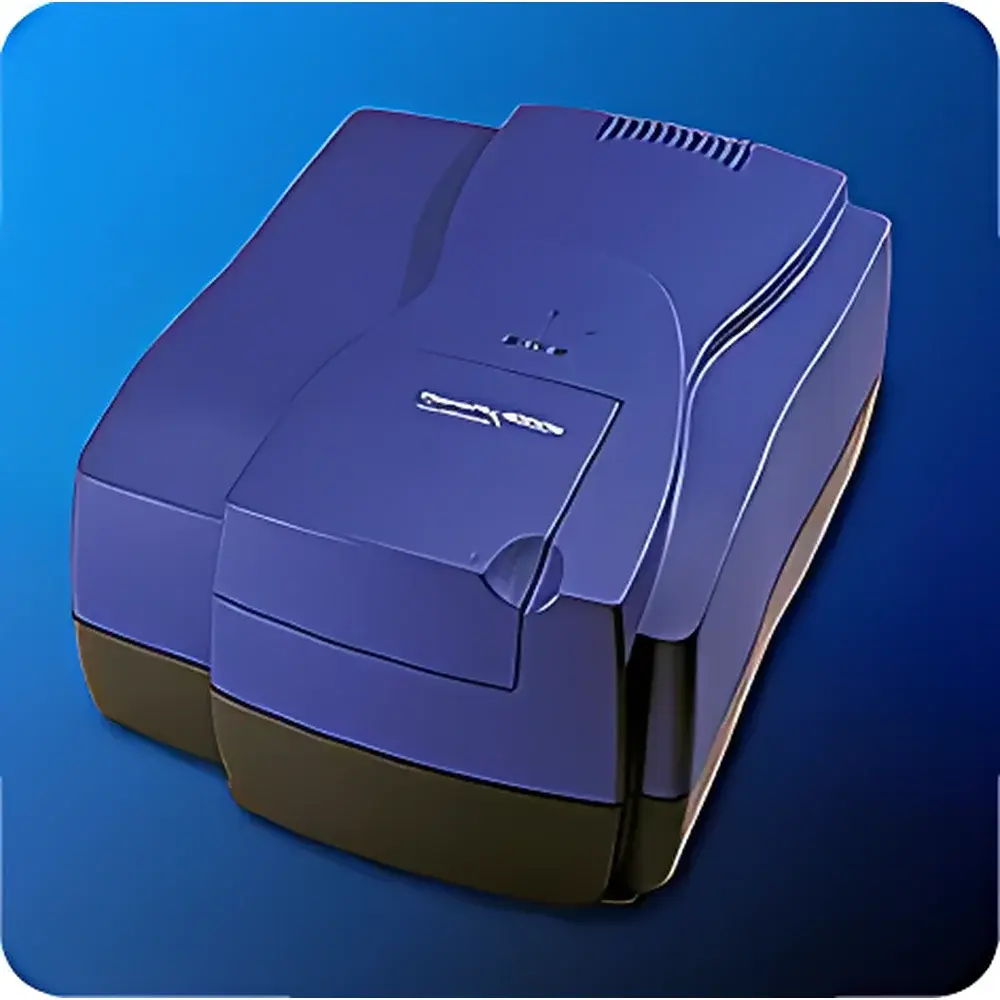
Molecular Devices GenePix 4000B Microarray Scanner
| Brand | Molecular Devices |
|---|---|
| Origin | USA |
| Manufacturer Type | Original Equipment Manufacturer (OEM) |
| Product Category | Imported Instrument |
| Model | GenePix 4000B |
| Instrument Type | Microarray Scanning System |
| Laser Configuration | Dual-laser (635 nm & 532 nm), Simultaneous Excitation and Detection |
| Resolution Range | 5–100 µm adjustable |
| Scan Speed | ~6.5 min per slide at 10 µm resolution (dual-channel) |
| Optical Path | Non-confocal epifluorescence |
| PMT Auto-balancing | Yes, real-time channel normalization |
| Focus Adjustment | Motorized Z-axis with manual override |
| Laser Power Control | Digitally tunable per channel |
| Calibration | Built-in NIST-traceable performance verification protocol |
| Software Integration | Native compatibility with GenePix Pro 7.x and Acuity 5.x |
Overview
The Molecular Devices GenePix 4000B Microarray Scanner is a high-precision, non-confocal epifluorescence imaging system engineered for quantitative, reproducible detection of fluorescence-labeled biomolecular interactions on solid-phase microarrays. Unlike confocal-based scanners optimized for thick-sectioned tissue or 3D specimens, the GenePix 4000B employs a wide-field optical architecture specifically designed for planar substrates—glass slides, nitrocellulose membranes, and polymer-coated chips—where uniform illumination and consistent signal capture across heterogeneous surface topographies are critical. Its dual-laser excitation (532 nm and 635 nm) enables simultaneous acquisition of two spectral channels without mechanical filter switching or sequential scanning delays, thereby eliminating temporal drift between channels and preserving true ratiometric fidelity essential for comparative hybridization experiments (e.g., cDNA two-color arrays). The system’s motorized focus control and digitally adjustable laser power allow precise optimization for variable substrate geometries—including raised membrane surfaces and recessed in-situ synthesized arrays—ensuring pixel-level signal stability and minimizing focal plane-induced intensity variance.
Key Features
- Dual-wavelength simultaneous scanning: Independent 532 nm and 635 nm lasers operate concurrently, enabling real-time ratio calculation and eliminating inter-channel time lag artifacts.
- Adjustable resolution from 5 to 100 µm: User-selectable pixel size balances spatial detail with file size and scan duration; factory-verified capability to resolve features ≤5 µm under standardized calibration conditions.
- Auto-PMT gain balancing: Integrated feedback loop dynamically optimizes photomultiplier tube gain per channel during acquisition, ensuring optimal dynamic range utilization and cross-channel signal equivalence without manual intervention.
- Motorized Z-axis focus with manual override: Compensates for slide warpage, membrane curvature, or embedded array depth variation, maintaining consistent signal-to-noise across non-planar substrates.
- NIST-traceable performance verification: Onboard calibration routines validate scanner linearity, uniformity, sensitivity, and wavelength accuracy—supporting GLP-compliant documentation and instrument qualification per ISO/IEC 17025 requirements.
- Non-confocal optical design: Maximizes photon collection efficiency on flat or moderately uneven surfaces while avoiding the shallow depth-of-field limitations inherent to confocal systems when applied to standard microarray formats.
Sample Compatibility & Compliance
The GenePix 4000B supports broad substrate compatibility—including glass slides (amine-, aldehyde-, or epoxy-coated), nylon and nitrocellulose membranes, hydrogel-based chips, and custom-printed oligonucleotide or antibody arrays. Its adaptive focus and tunable laser energy accommodate both high-intensity Cy5/Cy3 signals and low-abundance probes labeled with Alexa Fluor or IRDye dyes. The system meets essential regulatory expectations for life science instrumentation: data integrity safeguards align with FDA 21 CFR Part 11 principles (audit trail, electronic signature support via GenePix Pro), and its hardware calibration framework supports IQ/OQ/PQ validation protocols required in clinical research and pharmaceutical development environments. All optical components undergo batch-certified stability testing to ensure <±2% signal drift over 8-hour continuous operation.
Software & Data Management
The GenePix 4000B operates natively with GenePix Pro 7.x—the industry-standard acquisition and primary analysis platform for microarray data. It provides one-click calibration, automated grid alignment, spot quality flagging, background subtraction algorithms (morphological opening, local neighborhood), and MIAME-compliant export (GPR, GAL, TXT). Optional Acuity 5.x extends functionality into secondary analysis: hierarchical clustering, principal component analysis (PCA), ANOVA-based differential expression, and relational database integration (MySQL/PostgreSQL). Both applications enforce version-controlled processing pipelines, full audit logging of parameter changes, and encrypted project archives compliant with institutional data governance policies.
Applications
The GenePix 4000B serves as a foundational imaging platform in academic genomics, translational medicine, and biopharmaceutical QC labs. Typical use cases include: genome-wide expression profiling (two-color cDNA and single-channel oligo arrays), miRNA expression screening, ChIP-on-chip binding site mapping, comparative genomic hybridization (CGH), antibody microarray-based cytokine profiling, and glycan array characterization. Its proven track record—cited in over 5,800 peer-reviewed publications—reflects robustness across diverse experimental designs, including longitudinal studies requiring multi-site, multi-instrument data harmonization.
FAQ
Does the GenePix 4000B support third-party microarray formats?
Yes—it accepts standard 25 × 76 mm microscope slides and accommodates custom grid layouts via user-defined GAL files.
How is laser stability maintained during extended scanning sessions?
Each laser incorporates an internal photodiode feedback circuit that monitors output intensity in real time and compensates for thermal drift within ±1.5% over 12 hours.
Can scan parameters be saved and reused across instruments?
Yes—GenePix Pro stores complete acquisition protocols (resolution, PMT settings, laser power, focus offset) as reusable .gpp files, enabling cross-platform method transfer and lab-wide standardization.
Is remote monitoring or unattended operation supported?
The scanner integrates with Windows-based network environments; scheduled scans and email alerts for completion/error states are configurable through GenePix Pro’s job queue manager.
What documentation is provided for regulatory submissions?
Molecular Devices supplies a comprehensive Instrument Qualification Package (IQP), including Factory Acceptance Test (FAT) reports, calibration certificates, and software validation summaries aligned with GxP expectations.
Related Products



