
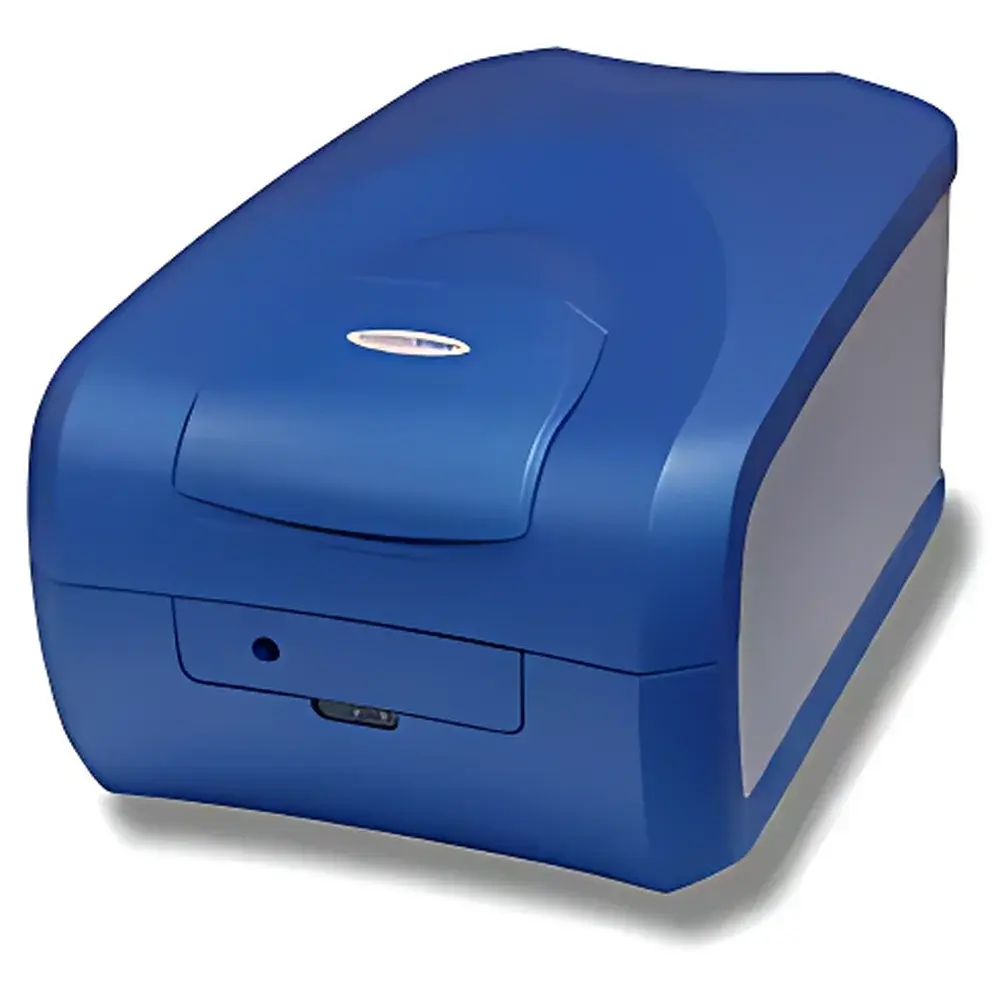
Molecular Devices GenePix 4200AL High-Performance Microarray Scanner
| Brand | Molecular Devices |
|---|---|
| Origin | USA |
| Manufacturer Type | Original Equipment Manufacturer (OEM) |
| Product Category | Imported Instrument |
| Model | GenePix 4200AL |
| Instrument Type | Microarray Scanning System |
| Laser Sources | 635 nm (red), 532 nm (green), optional 488 nm (blue), optional 594 nm (yellow) |
| Excitation Source | Solid-state diode lasers (integrated, air-cooled) |
| Emission Filter Wheel | Motorized, 16-position, tool-free filter exchange |
| Laser Power Adjustment | 5–100% continuous, per-channel |
| Scan Modes | Single-pass and multi-pass (re-scan) per channel |
| Sample Format | Standard microscope slide (1" × 3") |
| Loading Method | Manual single-slide loading |
| Physical Footprint | Compact benchtop design (W × D × H: 43.2 × 45.7 × 20.3 cm) |
| Compliance | CE-marked, RoHS-compliant, designed for ISO/IEC 17025-aligned laboratory environments |
Overview
The Molecular Devices GenePix 4200AL is a high-resolution, dual- or quad-color microarray scanner engineered for quantitative fluorescence imaging of DNA, protein, tissue, and cell-based microarrays. It operates on the principle of confocal laser-induced fluorescence detection: discrete solid-state lasers excite fluorophore-labeled targets immobilized on planar substrates, while precisely aligned emission filters and high-sensitivity photomultiplier tubes (PMTs) collect wavelength-specific signals with minimal crosstalk. Unlike scanning systems relying on external water-cooled gas lasers, the GenePix 4200AL integrates all excitation sources internally—eliminating alignment drift, reducing thermal noise, and enabling stable long-term operation in standard laboratory environments without auxiliary cooling infrastructure. Its optical architecture supports pixel-level signal calibration and spatial uniformity correction across the full 75 × 25 mm scan field, ensuring reproducible intensity quantification essential for differential expression analysis, biomarker validation, and translational assay development.
Key Features
- Four-wavelength excitation capability: Standard 635 nm (red) and 532 nm (green) diode lasers; optional 488 nm (blue) and 594 nm (yellow) lasers—each with dedicated, user-replaceable emission filters.
- Motorized 16-position emission filter wheel: Enables rapid, repeatable filter changes without tools or realignment; compatible with industry-standard 25 mm diameter interference filters.
- Digitally controlled laser power: Adjustable from 5% to 100% in 1% increments per channel—optimizing signal-to-noise ratio for low-abundance targets or high-background substrates.
- Multi-pass scanning mode: Allows repeated acquisition of the same slide at identical or varying PMT gain settings—supporting dynamic range extension and artifact verification.
- Benchtop compactness: Occupies <0.2 m² footprint; no external laser enclosures, chillers, or vibration isolation required.
- Firmware-upgradable platform: Supports field-installable laser modules and calibration updates via secure USB interface.
Sample Compatibility & Compliance
The GenePix 4200AL accommodates standard 1″ × 3″ glass microscope slides—including coated, uncoated, and polymer-based substrates—as well as tissue microarrays (TMAs), cell microarrays, and reverse-phase protein arrays (RPPAs). Its optical path is optimized for common cyanine dyes (Cy3, Cy5), Alexa Fluor® conjugates, and proprietary fluorophores emitting between 490 nm and 720 nm. The system complies with IEC 61000-6-3 (EMC emissions) and IEC 61000-6-2 (immunity), carries CE marking for use in EU laboratories, and adheres to RoHS 2011/65/EU material restrictions. While not certified for clinical diagnostics under FDA 21 CFR Part 820, its data acquisition and logging architecture supports GLP/GMP-aligned workflows when paired with validated GenePix Pro software v7.x or later—including audit trail generation, electronic signatures (per 21 CFR Part 11 configuration), and instrument calibration history tracking.
Software & Data Management
Controlled exclusively by GenePix Pro software (v7.5+), the GenePix 4200AL delivers integrated image acquisition, gridding, spot finding, background subtraction, and ratio-based quantification. The software supports MIAME-compliant metadata embedding, batch processing of multi-slide experiments, and export to standard formats (TIFF, JPEG2000, GPR, TXT) for downstream statistical analysis in R/Bioconductor, Partek Flow®, or Spotfire. Raw image data are stored with embedded acquisition parameters (laser power, PMT gain, scan resolution, filter ID), enabling retrospective reprocessing without re-scanning. All software updates, calibration protocols, and technical documentation are distributed via Molecular Devices’ secure customer portal—requiring valid maintenance contract credentials for download.
Applications
- Transcriptomics: Two- and four-color competitive hybridization for gene expression profiling across human, murine, and model organism genomes.
- Epigenetics: ChIP-on-chip and MeDIP-chip assays using antibody- or methyl-binding domain-coupled fluorophores.
- Proteomics: Antibody microarray screening for cytokine panels, phosphoprotein signaling cascades, and autoantibody profiling.
- Pathology research: Quantitative fluorescence imaging of formalin-fixed paraffin-embedded (FFPE) tissue sections on TMAs.
- Assay development: Validation of novel fluorescent probes, surface chemistries, and labeling chemistries under controlled excitation/emission conditions.
FAQ
Is the GenePix 4200AL suitable for clinical diagnostic use?
No—it is designated for research use only (RUO) and is not cleared or approved by the FDA or other regulatory bodies for diagnostic applications.
Can third-party emission filters be installed in the 16-position wheel?
Yes, provided they conform to standard 25 mm diameter, 3 mm thickness, and M25.5 × 0.75 thread specifications—and are verified for spectral transmission compatibility with the selected laser wavelengths.
What is the minimum detectable signal level (in RFU) for Cy5 under standard operating conditions?
Detection sensitivity is assay-dependent and influenced by probe labeling efficiency, hybridization yield, and background; typical limit-of-detection ranges from 10–50 RFU per pixel in optimized DNA microarray workflows.
Does the system support automated slide loading?
No—the GenePix 4200AL uses manual single-slide insertion; high-throughput automation requires upgrading to the GenePix 4400A platform with robotic loader option.
How often must the internal laser alignment be verified?
Under normal usage (≤8 hrs/day, ambient temperature 18–25°C), alignment verification is recommended every 12 months—or following any physical relocation or impact event—using the included calibration slide and GenePix Pro Alignment Wizard.




