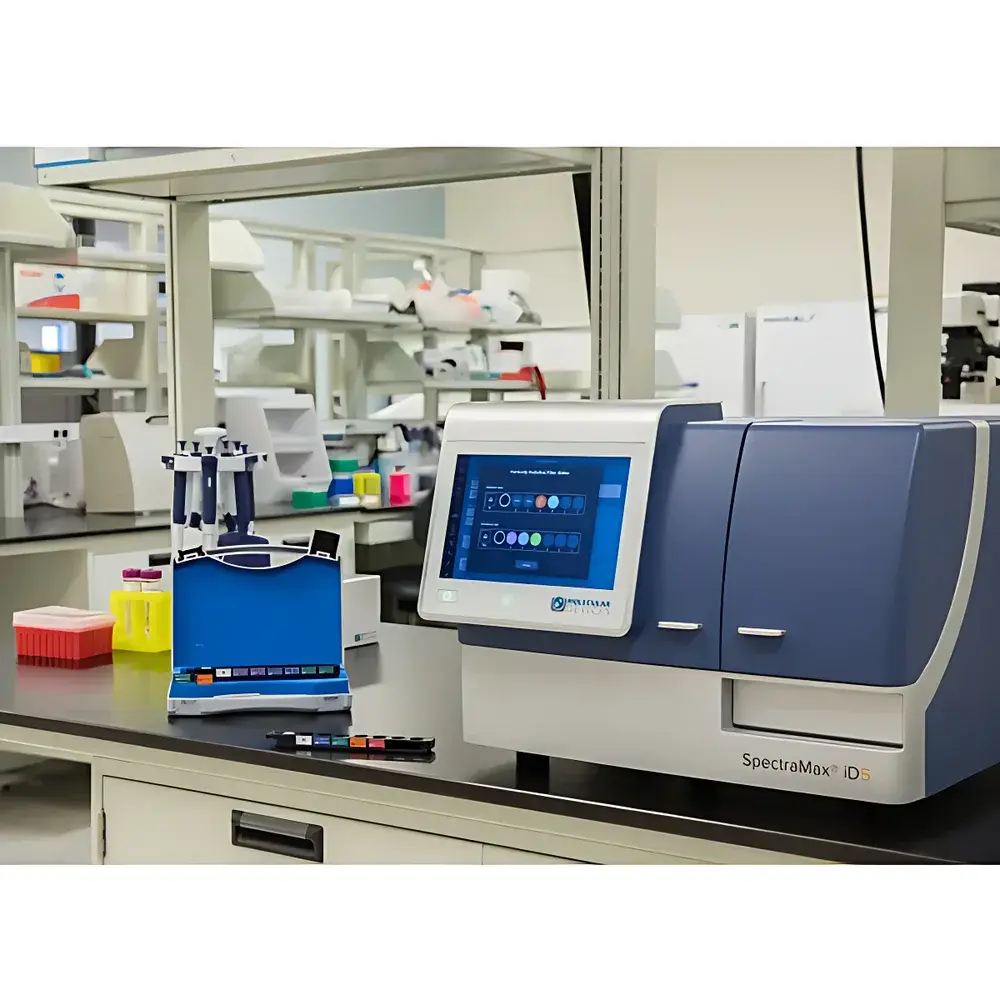
Molecular Devices SpectraMax iD5 Multimode Microplate Reader
| Brand | Molecular Devices |
|---|---|
| Origin | Shanghai, China |
| Model | SpectraMax iD5 |
| Detection Modes | Absorbance, Fluorescence (including TRF, FP), Luminescence (top/bottom), TR-FRET, HTRF, BRET, Dual-Luciferase (with injectors) |
| Wavelength Range | 230–1000 nm |
| Absorbance Range | 0–4 OD |
| Absorbance Linearity | ±0.010 OD or ±1.0% (0–3.0 OD) |
| Detector | –5°C Cooled Photomultiplier Tube (PMT) and UV-Enhanced Silicon Photodiode |
| Wavelength Scanning Speed | 30 sec per scan |
| Temperature Control | Ambient to 66°C |
| Shaking Modes | Linear, Orbital, Double-Orbital |
| Plate Formats | 6–384-well, including Western blot membranes |
| Optical System | Hybrid Quad-Grating + Filter-Based Pathway |
| Scan Density | Up to 20 × 20 points per well |
| Software | SoftMax Pro 7 with GxP Compliance (21 CFR Part 11, GLP/GMP audit trail) |
Overview
The Molecular Devices SpectraMax iD5 Multimode Microplate Reader is a high-performance, fully integrated benchtop detection platform engineered for precision, flexibility, and regulatory compliance in modern life science laboratories. Utilizing a hybrid optical architecture—combining quad-monochromator grating technology with interchangeable filter-based pathways—the iD5 delivers exceptional signal-to-noise performance across absorbance, fluorescence intensity (FI), time-resolved fluorescence (TRF), fluorescence polarization (FP), bioluminescence (BL), chemiluminescence (CL), and advanced proximity assays including TR-FRET and HTRF. Its dual-detector configuration—featuring a –5°C thermoelectrically cooled photomultiplier tube (PMT) for ultra-low-noise fluorescence and luminescence detection, and a UV-enhanced silicon photodiode optimized for broad-spectrum absorbance measurements—ensures robust dynamic range and reproducibility across diverse assay formats. Designed for seamless integration into regulated environments, the iD5 supports end-to-end traceability from acquisition through analysis, meeting core requirements of FDA 21 CFR Part 11, GLP, and GMP workflows.
Key Features
- Hybrid optical path: Selectable grating- or filter-based detection enables optimal excitation/emission selection—particularly advantageous for near-infrared (NIR) and red-shifted assays, where proprietary IR-optimized filters deliver up to 40× higher sensitivity versus conventional monochromator systems.
- NFC-enabled filter recognition: Integrated near-field communication automatically identifies installed filters by embedded tag, verifying spectral parameters and physical position on the filter slider—eliminating manual configuration errors and accelerating protocol setup.
- SmartInject™ dual-injector system: Precision-engineered for low dead volume (10 µL), anti-drip protection, and synchronized reagent delivery across all wells; ensures uniform mixing kinetics critical for flash-type luminescent assays (e.g., ATP quantitation, Dual-Luciferase reporter assays).
- Western blot scanning capability: With optional Enhanced TRF module, the iD5 performs quantitative digital imaging of europium-labeled membranes—leveraging TRF’s long decay lifetime to suppress autofluorescence and enable repeated, high-fidelity scans without signal photobleaching.
- Intuitive 10.1-inch capacitive touchscreen interface: Runs embedded SoftMax Touch software—supporting template-driven assay setup, real-time monitoring, interactive tutorials, and PIN/NFC-authenticated user accounts with role-based access control.
- Temperature-controlled incubation and shaking: Programmable thermal regulation from ambient to 66°C, combined with linear, orbital, or dual-orbital shaking—enabling kinetic enzyme assays, cell-based functional studies, and temperature-sensitive binding experiments.
Sample Compatibility & Compliance
The SpectraMax iD5 accommodates standard microplate formats (6–384-well), opaque and clear-bottom plates, and specialized substrates including nitrocellulose and PVDF membranes for Western blot quantification. Its optical design supports top- and bottom-read luminescence, essential for heterogeneous cell-based assays and membrane-bound targets. The instrument meets international standards for analytical instrumentation validation, including ISO/IEC 17025 principles for measurement uncertainty and traceability. When operated with SoftMax Pro GxP software, it fulfills electronic record and signature requirements under 21 CFR Part 11—including secure user authentication, immutable audit trails, electronic signatures for review/approval, and configurable permission hierarchies. Built-in IQ/OQ documentation templates, pre-validated curve-fitting algorithms (4PL, 5PL, linear, log-log, power, double-log), and OQ test datasets streamline laboratory qualification processes per GxP and ISO 9001 frameworks.
Software & Data Management
SoftMax Pro 7 serves as the unified data acquisition, analysis, and reporting engine—compatible both with the onboard touchscreen and external Windows workstations. Its GxP-compliant version implements full audit trail logging for every data modification event, including operator ID, timestamp, action type (e.g., parameter change, curve fit adjustment), and pre-/post-value states. QuickSync technology enables automatic, network-transparent data push to designated network locations or USB storage—bypassing manual file transfer while preserving metadata integrity. Data export options include CSV, Excel, PDF reports, and XML-formatted results compatible with LIMS and ELN systems. Validation toolkits support installation qualification (IQ), operational qualification (OQ), and performance qualification (PQ) documentation generation, including printable IQ/OQ protocols and traceable calibration logs.
Applications
The iD5 supports a comprehensive spectrum of life science applications: ELISA and immunoassay quantification (absorbance at 450 nm); nucleic acid and protein concentration determination (A260/A280); kinase activity profiling via ADP-Glo™ or fluorescence polarization; calcium flux assays using ratiometric dyes (e.g., Fura-2); reporter gene analysis (luciferase, GFP, Renilla); high-content cell viability screening (resazurin, MTT); HTRF-based cytokine detection; TR-FRET assays for protein-protein interactions; and label-free or labeled Western blot densitometry. Its extended wavelength range (230–1000 nm) and NIR-optimized optics make it especially suited for red-shifted probes used in oxidative stress assays (e.g., Amplex Red), deep-tissue mimetic models, and multiplexed immunodetection.
FAQ
Does the SpectraMax iD5 support bottom-read luminescence for cell-based assays?
Yes—it provides selectable top- and bottom-read modes for luminescence detection, enabling optimal signal capture from adherent cells or membrane-bound targets.
Can the iD5 perform kinetic measurements over extended time periods?
Yes—its thermal control (up to 66°C), programmable shaking, and lock-screen functionality ensure uninterrupted long-term kinetic runs, with data continuously logged to internal SSD storage.
Is SoftMax Pro GxP software included with the instrument?
SoftMax Pro 7 is supplied standard; the GxP-compliant module is available as an optional licensed add-on, configured during initial system setup to enforce electronic signature workflows and audit trail generation.
What validation support is provided for regulated laboratories?
Molecular Devices supplies IQ/OQ documentation packages, pre-validated curve-fitting algorithms, and OQ test datasets aligned with USP and ASTM E2500 guidelines—facilitating rapid qualification under GLP or GMP conditions.
How does the NFC filter recognition improve assay reproducibility?
By eliminating manual filter selection errors and ensuring precise alignment verification, NFC reduces inter-operator variability and supports consistent spectral configuration across multi-user environments.