
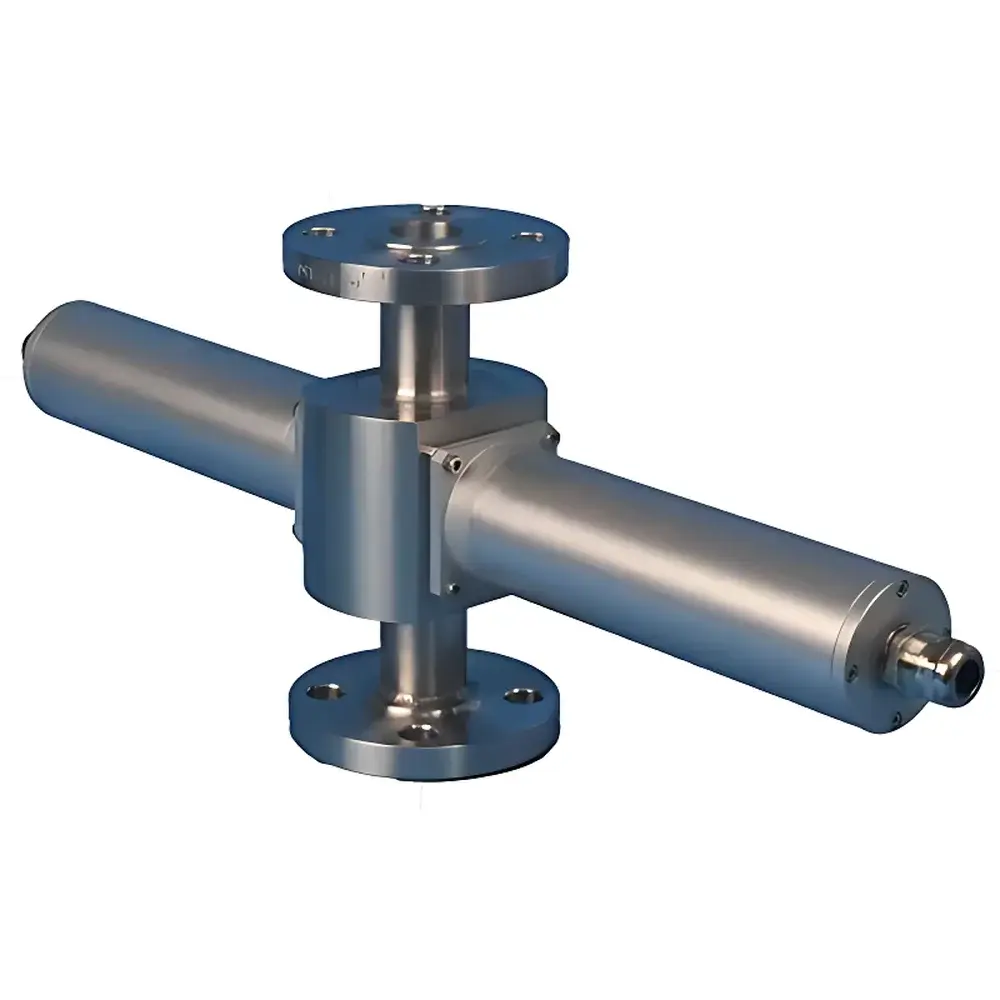
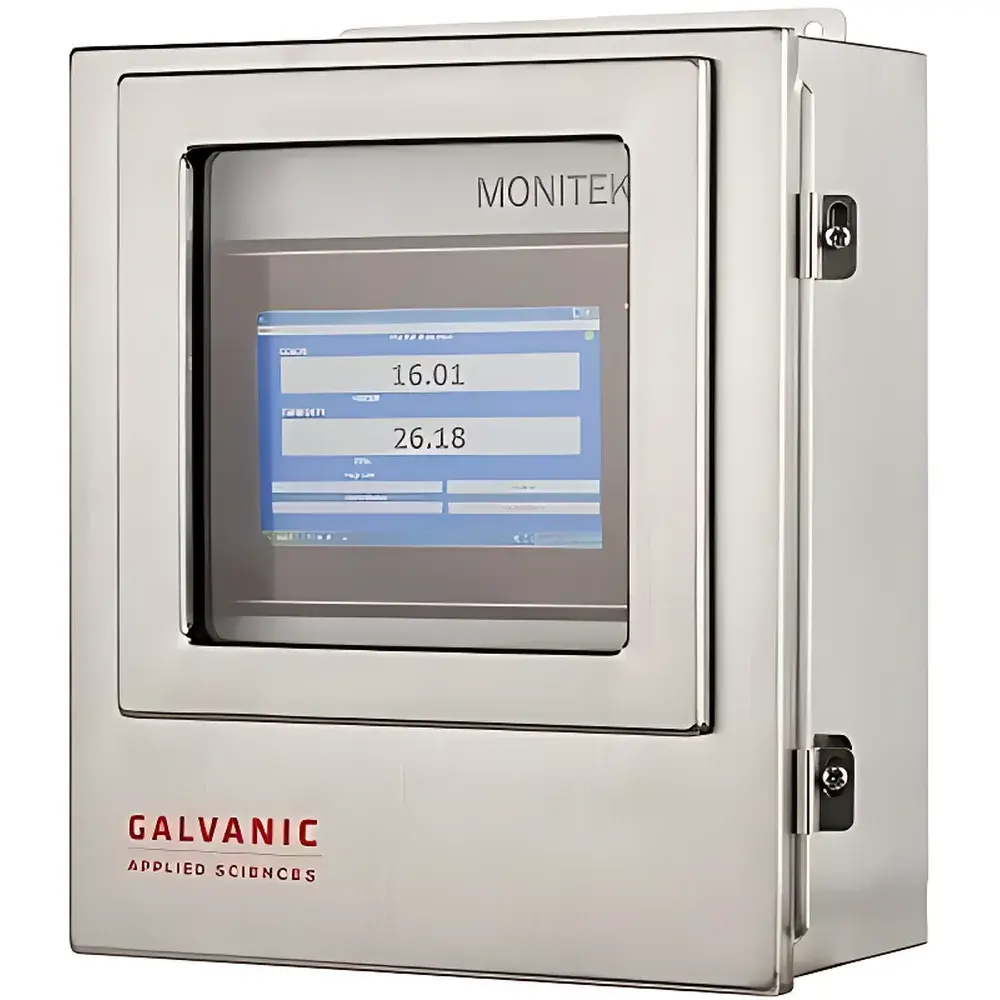
Monitek MoniTurb-F Online Turbidimeter
| Brand | Galvanic |
|---|---|
| Origin | USA |
| Type | In-line Process Turbidimeter |
| Model | MoniTurb-F |
| Measurement Range | 0–500 NTU |
| Resolution | ±2% of full scale |
| Accuracy | ±0.5% of full scale |
| Operating Ambient Temperature | −10 °C to +60 °C |
| Process Temperature | up to 140 °C |
| Process Pressure | up to 220 psi (15 bar) at ambient temperature |
| Wetted Materials | 316L stainless steel (1.4404) standard, customizable |
| Optical Path Length | pipe-diameter-dependent |
| Cable Length | up to 100 m |
| Enclosure Rating | NEMA 4X / IP66 |
| Hazardous Area Options | Class I, Div. 1 |
| Output Interface | Compatible with Monitek® Messenger transmitter |
| Detection Principle | 12° forward scatter photometry |
| Optional Configurations | MoniTurb-S (90° side scatter), MoniTurb-FS (dual-angle scatter) |
| Calibration Interval | 12 months |
| Color Compensation | Yes |
| Optional Air/Water Jet Cleaning System | Available |
| Process Connections | DIN, ANSI, SMS, NPT, APV, TH, Tri-Clamp |
| Units Supported | NTU, JTU, AU, EBC, ppm, g/L, % concentration |
Overview
The Monitek MoniTurb-F Online Turbidimeter is an industrial-grade in-line turbidity sensor engineered for continuous, real-time monitoring of suspended solids in liquid process streams. It operates on the principle of 12° forward scatter photometry—illuminating the sample with a collimated near-infrared or visible light beam and detecting scattered light at a precise 12° angle relative to the incident beam. This geometry provides high sensitivity to fine particles (sub-micron to ~10 µm) while minimizing interference from color absorption and large particulates that dominate 90° side-scatter measurements. Unlike laboratory benchtop turbidimeters relying on static cuvettes, the MoniTurb-F is designed for direct insertion into pressurized pipelines—enabling true process-integrated measurement without bypass loops or sample conditioning. Its optical architecture is optimized for long-term stability under dynamic flow conditions, with thermal compensation and drift-reduction algorithms embedded in the signal processing chain. The system comprises the MoniTurb-F sensor and the Monitek® Messenger transmitter, which performs analog (4–20 mA) and digital (HART, Modbus RTU/ASCII) output conversion, diagnostics, and configuration management.
Key Features
- 12° forward scatter detection—optimized for correlation with mass-based concentration (e.g., mg/L, ppm) in low-to-medium turbidity applications (0–500 NTU)
- Dual-angle capability via optional MoniTurb-FS variant—simultaneous acquisition of forward and 90° side-scatter signals for enhanced particle size distribution insight
- NEMA 4X / IP66-rated housing—suitable for outdoor, washdown, and high-humidity environments
- Hazardous area certification—available for Class I, Div. 1 (NEC) and ATEX/IECEx Zone 1 & Zone 2 installations, with intrinsically safe cabling options up to 100 m
- Modular wetted materials—standard 316L stainless steel (1.4404); custom options include Hastelloy®, titanium, or fluoropolymer-coated variants for aggressive chemical exposure
- Flexible process integration—compatible with DIN, ANSI, SMS, NPT, APV, TH, and Tri-Clamp sanitary fittings across pipe diameters from 10 mm to 100 mm (½″ to 4″)
- Integrated color compensation algorithm—reduces spectral bias caused by chromophores in colored liquids (e.g., humic acids in wastewater, dyes in process streams)
- Optional automated cleaning—pneumatic or hydraulic jet systems prevent fouling in high-solids or biofilm-prone applications
- 12-month calibration interval—validated per ASTM D6508 and ISO 7027-1 requirements for process turbidimeters
Sample Compatibility & Compliance
The MoniTurb-F is validated for use across a broad spectrum of aqueous and non-aqueous process fluids—including potable water, activated sludge effluent, clarified process water, chemical reaction mixtures, pulp suspensions, fermentation broths, and beverage intermediates. It maintains accuracy under variable flow velocities (0.3–3 m/s recommended), pressure fluctuations (up to 15 bar), and elevated temperatures (up to 140 °C). Regulatory compliance includes adherence to US EPA Method 180.1 principles for turbidity measurement, alignment with ISO 7027-1 (2016) for optical design and performance verification, and compatibility with FDA 21 CFR Part 11 data integrity requirements when paired with Messenger’s audit-trail-enabled firmware. The system supports GLP/GMP-aligned operation through configurable user access levels, electronic signature support, and tamper-evident calibration logs.
Software & Data Management
The Monitek® Messenger transmitter serves as the central interface for configuration, diagnostics, and data export. Firmware supports HART 7 and Modbus RTU/ASCII protocols for seamless integration into DCS, SCADA, and MES platforms. Local configuration is performed via a backlit LCD keypad or Bluetooth-enabled mobile app (Monitek Connect™). All measurement data—including raw scatter intensity, compensated turbidity, temperature, and diagnostic flags—are timestamped and stored in non-volatile memory. The Messenger provides real-time alarm thresholds (high/low, rate-of-change), trend logging (configurable intervals from 1 sec to 1 hr), and CSV export via microSD card or USB-C. Audit trails record all parameter changes, calibration events, and user logins—meeting traceability requirements for pharmaceutical and food-grade validation protocols.
Applications
- Drinking water treatment—monitoring coagulation efficiency, filter performance, and final disinfection clarity
- Wastewater clarification—tracking secondary settling basin overflow, membrane bioreactor (MBR) integrity, and tertiary filtration
- Chemical manufacturing—controlling precipitation reactions, catalyst recovery, and solvent purity checks
- Pulp & paper—measuring fiber consistency in stock lines and white water recirculation loops
- Biopharmaceutical upstream processing—real-time biomass estimation in fermenters and cell culture harvest streams
- Beverage production—verifying juice clarification, beer chill haze, and bottled water sterility assurance
- Ultrafiltration & nanofiltration—detecting membrane breach or fouling onset via sudden turbidity spikes
- Oily water separation—quantifying dispersed oil droplets in produced water or coolant emulsions
FAQ
What is the difference between MoniTurb-F and MoniTurb-S?
The MoniTurb-F uses 12° forward scatter for optimal sensitivity to fine particles and mass concentration correlation; the MoniTurb-S employs 90° side scatter per ISO 7027-1, better suited for larger particles and regulatory compliance in drinking water applications.
Can the MoniTurb-F be used in high-pressure steam condensate lines?
Yes—when equipped with high-temperature quartz optics and 316L SS body, it is rated for continuous operation up to 140 °C and 15 bar; thermal shielding and cooling jackets are available for extreme duty cycles.
Does the system support automatic zero and span calibration?
No—calibration is performed manually using certified NTU standards (e.g., Formazin or AMCO AEPA); however, the Messenger stores calibration coefficients and validates drift against reference values during routine diagnostics.
Is color compensation active during all measurements?
Yes—dual-wavelength (e.g., 650 nm and 850 nm) LED sources enable real-time absorption correction, reducing error from yellow/brown coloration without requiring separate color analyzers.
How is sensor fouling mitigated in viscous or sticky process streams?
An optional air-pulse or water-jet cleaning module can be triggered on timer, turbidity threshold, or external PLC command—integrated directly into the sensor housing with no moving parts or consumables.




