
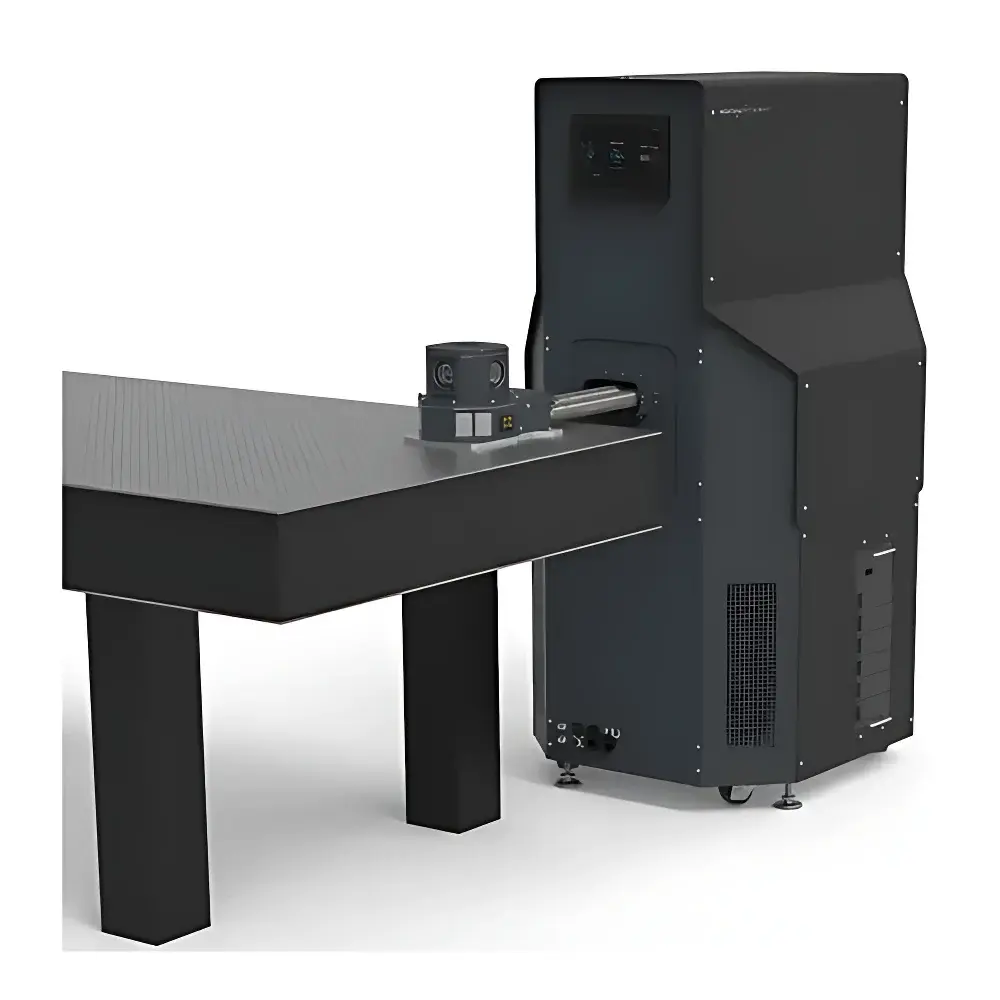
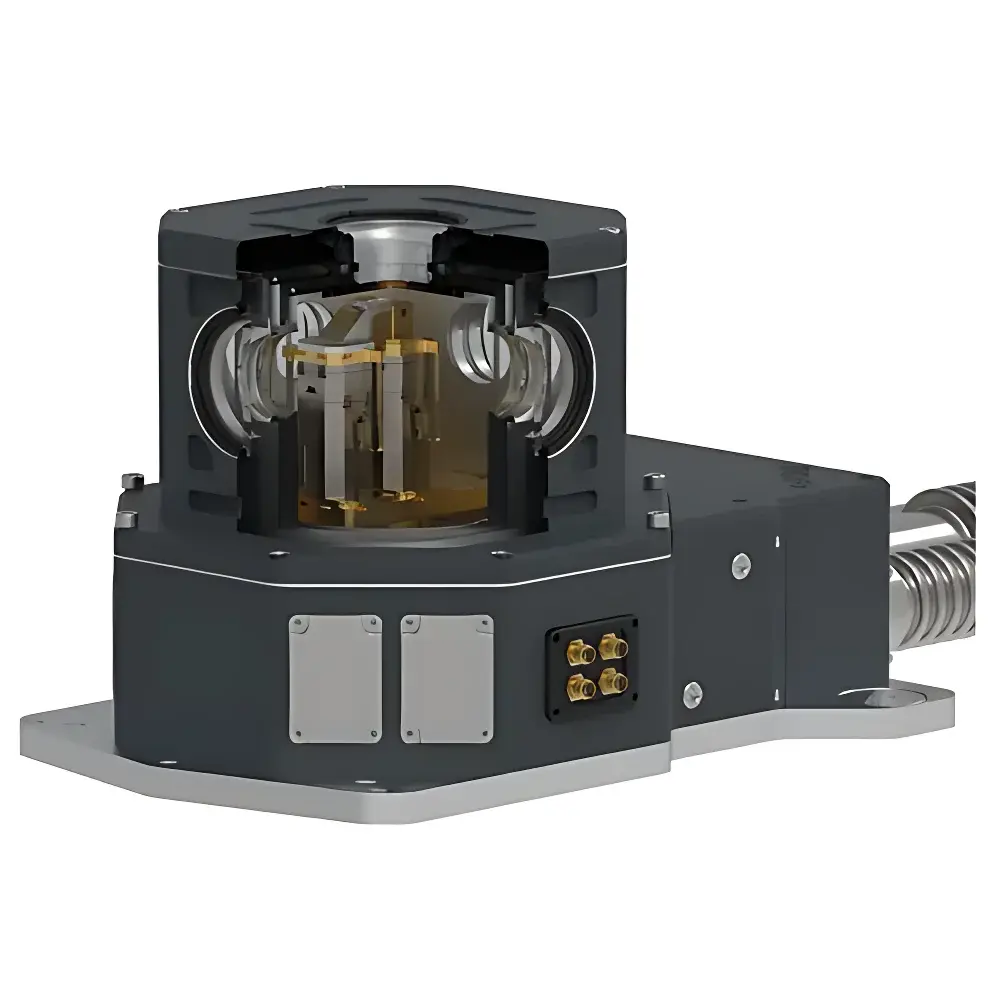
Montana Instruments Cryostation XP Series Ultra-Precise Multi-Functional Helium-Free Optical Cryogenic Thermostat
| Brand | Montana Instruments |
|---|---|
| Origin | USA |
| Model | XP Series |
| Temperature Range | 1.7 K – 350 K |
| Temperature Stability | <2 mK (peak-to-peak at 1.7 K), <200 mK (1.7–15 K), <50 mK (15–350 K) |
| Vibration Stability | <20 nm (peak-to-peak, horizontal at sample stage) |
| Base Cooling Power | >20 mW at 1.7 K |
| Sample Space | Φ92 mm × 92 mm |
| Optical Access | 3 standard windows (2 side + 1 top |
| upgradable to 4-side), field angles | 30° / 80° / 120° |
| Electrical Interfaces | 25 DC leads pre-routed to annular PCB around sample stage |
| RF Interfaces | 2 standard coaxial (upgradable to 4) |
| Vacuum Performance | <5.5 × 10⁻⁸ Torr |
| Cool-down Time | ~12 h to 1.7 K |
| Warm-up Time | ~2 h |
| Integrated Control | Touchscreen HMI + API-enabled software (Python, MATLAB, LabVIEW, C compatible) |
Overview
The Montana Instruments Cryostation XP Series represents a paradigm shift in cryogenic optical experimentation—delivering sub-2 K operation without liquid helium while preserving the mechanical stability, optical accessibility, and experimental flexibility required for cutting-edge quantum photonics and nanoscale spectroscopy. Engineered on a closed-cycle pulse-tube refrigeration architecture with proprietary helium recondensation and micro-cryostat thermal management, the XP platform bridges the performance gap between traditional wet (liquid He) and dry (Gifford-McMahon or pulse-tube only) systems. Its core innovation lies in the integration of a high-efficiency helium recirculation loop, a dual-stage thermal shielding strategy, and a vibration-isolated sample stage anchored via passive damping mounts—enabling <20 nm peak-to-peak mechanical stability at base temperature. Unlike conventional cryostats requiring complex infrastructure (e.g., chilled water, three-phase power, or external compressors), the XP operates from a single 220 V AC source and eliminates all consumables. Designed explicitly for quantum information science, single-emitter spectroscopy, cavity quantum electrodynamics (cQED), and ultra-low-noise photonic characterization, it delivers a turnkey solution compliant with GLP-aligned lab workflows and scalable for multi-user facility deployment.
Key Features
- True helium-free operation: Fully sealed helium circuit with automatic recondensation—zero liquid helium handling, refills, or boil-off losses.
- Extended low-temperature range: Stable base temperature of 1.7 K with active stabilization across 1.7–350 K, enabling access to quantum ground-state regimes inaccessible to standard 3.2 K systems.
- Optimized optical integration: Three standard optical ports (2 lateral + 1 top), configurable for 30°, 80°, or 120° field angles; customizable window materials (CaF₂, UV-fused silica, sapphire, ZnSe) for UV–MIR transmission.
- High thermal margin: >20 mW cooling power at 1.7 K supports complex experimental payloads—including RF wiring, fiber feedthroughs, MEMS actuators, and integrated nano-positioners—without compromising base temperature.
- Modular electrical & RF interfacing: 25 pre-routed DC lines terminated on an annular PCB surrounding the sample stage; dual standard SMA RF ports (expandable to four); optional RF panels, gas inlets, and custom feedthroughs.
- Intuitive dual-mode control: Local touchscreen HMI for rapid setup and monitoring; full remote API support (RESTful endpoints and native drivers for Python, MATLAB, LabVIEW, and C) enabling seamless integration into automated test sequences and data acquisition frameworks.
Sample Compatibility & Compliance
The XP Series accommodates diverse sample geometries and mounting requirements through its Φ92 mm × 92 mm internal sample volume and interchangeable cold-finger configurations—including flat, raised, and recessed sample stages. A modular isolation-based sample exchange mechanism enables rapid (<15 min) warm-insertion without breaking vacuum or warming the entire system—a critical capability for high-throughput quantum device screening. All thermal interfaces use calibrated Cernox™ sensors (two channels: sample stage base and direct sample contact) traceable to NIST standards. The system meets ISO 14644-1 Class 5 cleanroom compatibility for optical chamber integrity and conforms to IEC 61000-6-3 (EMC emission) and IEC 61000-6-2 (immunity) standards. Vacuum integrity is verified per ASTM E595 outgassing specifications, ensuring low hydrocarbon background for sensitive photoluminescence and Raman measurements. Data logging includes full audit trail functionality supporting FDA 21 CFR Part 11 compliance when paired with validated third-party LIMS or ELN platforms.
Software & Data Management
Montana Instruments’ CryoConsole™ software provides real-time visualization of temperature gradients, compressor status, vacuum pressure, and sensor health—all synchronized with user-defined experiment timelines. Raw sensor data (16-bit resolution, 10 Hz sampling) is exported in HDF5 format with embedded metadata (timestamps, setpoints, PID parameters, alarm logs). The open API exposes all hardware controls—including ramp rate definition, hold profiles, and interlock overrides—allowing users to embed cryostat sequencing within broader automation pipelines (e.g., quantum dot spectral tuning loops or cavity resonance tracking). Integration with National Instruments DAQmx, Keysight PathWave, and Quantum Design QDClient ensures interoperability in multi-instrument labs. All firmware updates are delivered over secure HTTPS with SHA-256 signature verification, and configuration backups support version-controlled repository storage.
Applications
- Quantum Information Science: Coherent control and readout of spin qubits (NV centers, SiV, SnV), superconducting transmon characterization, and microwave-to-optical transduction experiments.
- Single-Photon Source Development: Spectral filtering, lifetime mapping, and Hanbury Brown–Twiss interferometry on quantum dots, WSe₂ monolayers, and defect centers under magnetic field.
- Ultra-Low-Temperature Photoluminescence: Resolving fine-structure splitting, exciton–phonon coupling, and many-body correlations in 2D materials and van der Waals heterostructures.
- Cavity Quantum Electrodynamics: High-finesse microcavity alignment and Purcell enhancement quantification with NA >0.6 free-space collection enabled by short working distance optics.
- Nanoscale Thermometry & Transport: Simultaneous electrical transport (4-probe DC/AC), magneto-transport, and local thermometry using integrated Pt and Cernox sensors.
FAQ
Does the XP Series require liquid nitrogen or external chillers?
No. It operates as a fully self-contained system using only 220 V AC single-phase power. No LN₂, water cooling, or auxiliary chillers are needed.
Can I upgrade my existing Cryostation to XP specifications?
No. The XP Series features a fundamentally redesigned cold head, thermal architecture, and control electronics. Upgrades are not supported; migration requires a new system installation.
What vacuum pumping strategy does the XP employ?
A hybrid turbomolecular + ion pump combination achieves and maintains <5.5 × 10⁻⁸ Torr. The ion pump remains powered during operation to suppress regrowth and maintain ultra-high vacuum integrity during extended low-temperature runs.
Is remote operation supported for unattended overnight experiments?
Yes. Full TCP/IP-based remote control is available via Ethernet. Users can configure automated cooldown/warm-up cycles, trigger data logging upon reaching setpoints, and receive email/SMS alerts for system faults or temperature deviations.
How is vibration isolation achieved at the sample stage?
Mechanical decoupling is implemented via a three-stage passive damping system: (1) elastomeric mounts between compressor and chassis, (2) tuned-mass absorbers on the cold head support structure, and (3) kinematic flexure suspension of the sample stage itself—measured to deliver <20 nm peak-to-peak displacement at 1.7 K.



