
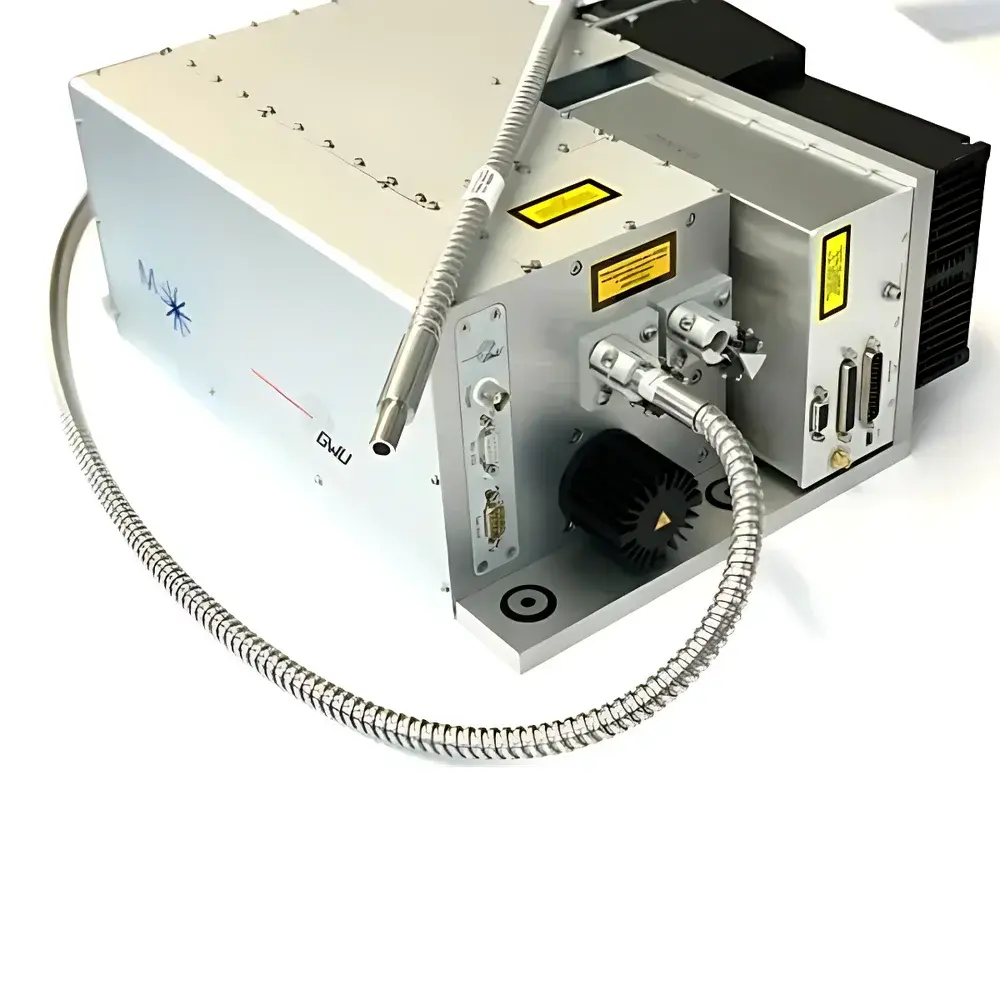
Montfort MONTFORT-nsOPO Series Compact Tunable Nanosecond Optical Parametric Oscillator Laser System
| Brand | Montfort |
|---|---|
| Origin | Austria |
| Manufacturer Type | Authorized Distributor |
| Origin Category | Imported |
| Pricing | Upon Request |
Overview
The Montfort MONTFORT-nsOPO Series is a fully integrated, air-cooled, rack-mountable (19″) tunable nanosecond optical parametric oscillator (OPO) laser system engineered for high-reliability field-deployable and laboratory-based applications requiring precise, wavelength-flexible pulsed excitation. Based on robust Nd:YAG pump technology and intracavity OPO design, the system delivers >20 mJ pulse energy at peak tuning wavelengths (e.g., 690 nm) with an 8 ns FWHM pulse duration and <5 M² beam quality (at 1064 nm). Its core architecture leverages two decades of semiconductor-pumped solid-state (DPSS) laser development expertise from the founding team of High Q Lasers—ensuring stable, low-jitter (<1 ns RMS) synchronization between pump and signal/idler outputs. Unlike modular OPO configurations requiring external drivers, chillers, or alignment-sensitive optics, the MONTFORT-nsOPO integrates all electronics, thermal management, and optical path into a single compact chassis (~346 × 414 × 167 mm³, ~16 kg), enabling seamless integration into mobile platforms, portable imaging systems, and space-constrained instrumentation.
Key Features
- Fully self-contained design: Integrated driver electronics, air-cooling system, and optical head—no external power supplies, chillers, or alignment tools required.
- Wide tunability: Continuous spectral coverage from 660 nm to 1300 nm (signal + idler) via motorized OPO crystal angle tuning; simultaneous dual-output capability (tunable OPO + residual 1064 nm).
- Field-ready operation: 24 VDC input compatibility, low power consumption, and ruggedized mechanical packaging optimized for vibration resistance and thermal stability in ambient ranges of 15–30°C (storage).
- Precision timing interface: TTL-compatible trigger output with <1 ns RMS jitter relative to emitted pulse, supporting time-resolved detection schemes including time-of-flight LIDAR and gated photoacoustic acquisition.
- Digital control architecture: RS232 and USB interfaces with Windows-compatible GUI software (Windows 10+); supports remote wavelength selection, repetition rate setting (20 Hz fixed), and pulse enable/disable commands.
- Flexible delivery options: Standard fiber-bundle-coupled output port (customizable fiber configuration) and optional free-space output ports (#1 for tunable OPO, #2 for 1064 nm).
Sample Compatibility & Compliance
The MONTFORT-nsOPO is designed for use with standard optical components rated for nanosecond pulsed operation at 1064 nm and OPO wavelengths (660–1300 nm), including fused silica lenses, dichroic mirrors, and broadband photodetectors. Its pulse energy profile and temporal characteristics comply with safety standards IEC 60825-1:2014 (Class 4 laser product) when operated within specified enclosure and interlock configurations. While not certified under FDA 21 CFR Part 11, the system’s deterministic digital command protocol and hardware-triggered emission support traceable experimental workflows compatible with GLP/GMP-aligned research environments. It meets electromagnetic compatibility requirements per EN 55032:2015 and EN 55035:2017 for industrial scientific equipment.
Software & Data Management
The included Windows-based GUI provides intuitive control over wavelength selection (via calibrated OPO crystal angle mapping), pulse enable/disable status, and real-time monitoring of internal diagnostics (e.g., pump diode current, temperature sensors, interlock status). All user commands are logged with timestamps, enabling reproducible experiment setup and audit trail generation. The software exports configuration files (.xml) for version-controlled parameter archiving and supports third-party integration via ASCII command set (e.g., “WAVELENGTH=780”, “TRIGGER=ON”) over serial or USB virtual COM port. No proprietary runtime or license server is required—installation is standalone and compatible with virtualized lab computing environments.
Applications
- Photoacoustic Imaging (PAI): Enables multispectral PA tomography in preclinical and translational research—e.g., hemoglobin oxygenation mapping in murine brain, liver, and kidney; sentinel lymph node detection at 12 mm depth; and radiopharmaceutical localization in soft tissue.
- LIDAR & Remote Sensing: Serves as a compact, eye-safe (1064 nm + OPO-shifted) source for atmospheric backscatter profiling, aerosol characterization, and differential absorption LIDAR (DIAL) in field-deployable platforms.
- Nonlinear Optics & THz Generation: Provides synchronized pump pulses for optical rectification in ZnTe or DAST crystals, enabling time-domain THz spectroscopy setups without complex amplifier chains.
- Ultrafast Spectroscopy: Functions as a tunable excitation source for transient absorption, fluorescence upconversion, and pump-probe studies across the visible-NIR range.
- Optical Damage Threshold Testing: Delivers calibrated, high-peak-power nanosecond pulses for ISO 21254-compliant laser-induced damage threshold (LIDT) evaluation of coatings, crystals, and thin-film devices.
- Seed Source for Picosecond Amplifiers: Supplies spectrally narrow, low-jitter pulses suitable for injection seeding of regenerative amplifiers or OPCPA front-ends.
FAQ
Is the MONTFORT-nsOPO compliant with FDA 21 CFR Part 11 for regulated laboratories?
No—this instrument is intended for research use only and does not include electronic signature, audit trail, or role-based access controls required by Part 11. However, its deterministic command logging and timestamped configuration export support manual compliance documentation.
Can the OPO wavelength be tuned continuously during operation?
Yes—motorized crystal rotation enables continuous tuning across 660–1300 nm without manual realignment; full scan takes <60 seconds depending on step resolution.
What is the maximum pulse energy available at 1064 nm?
>100 mJ is delivered at the dedicated 1064 nm free-space port (#2), independent of OPO output level.
Does the system support external triggering of individual pulses?
Yes—the device accepts TTL-level external trigger signals and maintains <1 ns RMS jitter relative to output pulse emission.
Is fiber coupling included as standard?
A fiber-bundle-coupled output is provided as standard; however, the fiber type, NA, core diameter, and connector are customized per customer specification and quoted separately.




