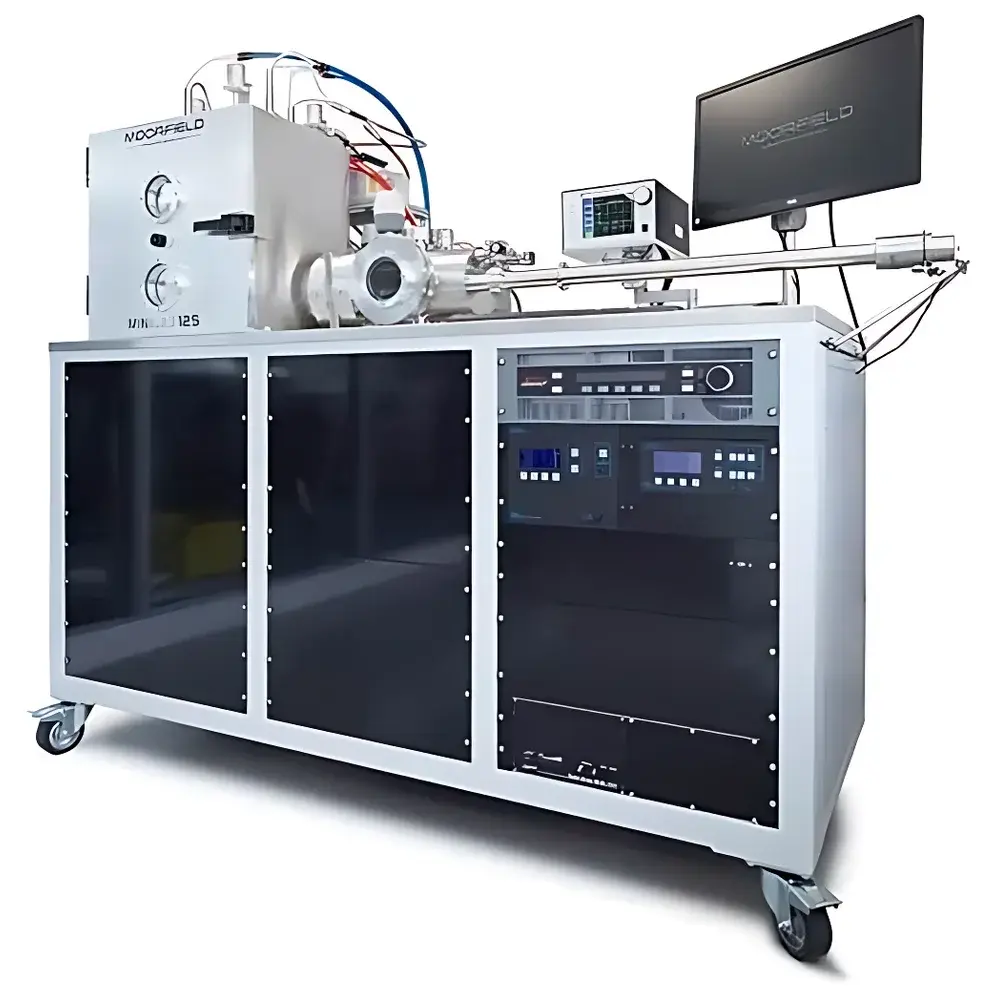
Moorfield MiniLab Series High-Precision Thin Film Deposition & Processing System
| Brand | Moorfield |
|---|---|
| Origin | UK |
| Model | MiniLab |
| Vacuum Base Pressure | 5×10⁻⁷ mbar |
| Maximum Substrate Diameter | 11 inches |
| Deposition Techniques | Thermal Evaporation, Low-Temperature Organic Evaporation, Magnetron Sputtering, Electron Beam Evaporation |
| Chamber Configurations | Front-Loading Box, Top-Hinged Bell Jar, Glovebox-Compatible Dual-Door, Tall-Aspect-Ratio Vertical |
| Compliance | ISO 9001–Certified Manufacturing, GLP-Ready Architecture, FDA 21 CFR Part 11–Compatible Software Options Available |
Overview
The Moorfield MiniLab Series is a family of modular, high-vacuum physical vapor deposition (PVD) systems engineered for precision thin film synthesis in academic research, materials development, and pilot-scale manufacturing environments. Based on robust UHV-compatible stainless steel vacuum architecture and optimized gas dynamics, the MiniLab platform implements multiple complementary PVD techniques—including resistive thermal evaporation, low-temperature organic evaporation, DC/RF magnetron sputtering, and electron beam evaporation—within a single, reconfigurable chamber framework. Each system operates at a base pressure of ≤5×10⁻⁷ mbar, ensuring minimal residual gas contamination during film growth and enabling reproducible stoichiometry control for oxides, nitrides, metals, and molecular organic layers. Designed for flexibility without compromise, the MiniLab series supports substrate diameters up to 11 inches (279 mm), with optional heating, rotation, biasing, Z-shift, planetary motion, and shadow masking—all integrated into a compact footprint suitable for cleanroom or shared lab spaces.
Key Features
- Modular vacuum chamber design with interchangeable configurations: front-loading box (MiniLab 060/080/090/125), top-hinged bell jar (MiniLab 026), and dual-door glovebox-integrated layout (MiniLab 090)
- UHV-capable stainless steel vacuum chamber with all-metal seals and bake-out capability; base pressure ≤5×10⁻⁷ mbar achieved using turbomolecular pumping backed by dry scroll or diaphragm pumps
- Multi-source compatibility: simultaneous integration of thermal evaporation sources (W, Mo, Ta filaments), low-temperature organic evaporators (crucible-based, temperature-controlled to ±0.5 °C), magnetron sputter targets (up to 3-inch diameter), and electron beam guns (10 kW max power)
- Advanced sample stage options: heated (up to 600 °C), rotating (0–30 rpm, programmable), biased (±200 V DC/RF), vertically adjustable (Z-shift ±25 mm), and planetary motion for uniform large-area coating
- Full process automation support via optional LabVIEW-based control suite with real-time thickness monitoring (quartz crystal microbalance), pressure regulation, source power sequencing, and recipe-driven deposition cycles
- Glovebox integration certified: MiniLab 026 and 090 models meet ISO 14644 Class 5 cleanroom interface standards and are routinely deployed in inert-atmosphere synthesis labs for air-sensitive perovskites, alkali metals, and organometallics
Sample Compatibility & Compliance
The MiniLab platform accommodates substrates ranging from 10 mm wafers to 11-inch (279 mm) circular or rectangular carriers—including silicon, glass, quartz, flexible polymer foils, and ceramic tiles. All chamber variants comply with CE marking requirements and adhere to IEC 61000-6-2/6-4 electromagnetic compatibility standards. Vacuum components meet ASTM F2782 specifications for ultra-high-vacuum elastomer-free sealing. When equipped with optional audit-trail-enabled software, the system satisfies GLP and GMP documentation requirements per ISO/IEC 17025 and FDA 21 CFR Part 11 for regulated R&D workflows. Deposition processes are traceable to ISO 14040 (life cycle assessment) and ASTM F1509 (thin film thickness measurement by quartz crystal microbalance) standards.
Software & Data Management
MiniLab systems ship with Moorfield’s proprietary ControlSuite™ software—a Windows-based, multi-threaded application built on LabVIEW Real-Time and SQL Server Express. It provides synchronized control of vacuum gauges, mass flow controllers, power supplies, stage actuators, and in-situ sensors. All user actions, parameter changes, alarm events, and sensor readings are timestamped and stored in encrypted binary logs with optional CSV export. Audit trail functionality includes operator login tracking, electronic signature capture, and immutable record retention—fully compliant with FDA 21 CFR Part 11 when configured with PKI certificate authentication. Remote monitoring via secure HTTPS API enables integration into centralized laboratory information management systems (LIMS) and digital twin platforms.
Applications
- Perovskite solar cell fabrication: sequential thermal evaporation of organic HTLs (e.g., spiro-OMeTAD) and inorganic ETLs (e.g., NiOₓ), followed by sputtered metal electrodes under inert atmosphere
- Quantum dot optoelectronics: co-evaporation of CdSe/ZnS core-shell structures with precise stoichiometric control and thickness gradients
- Flexible electronics: low-temperature deposition of Ag nanowire networks and transparent conductive oxides (ITO, AZO) onto PET substrates
- Magnetic multilayer research: RF sputtering of CoFeB/MgO/Ta stacks for spin-transfer torque studies
- MEMS packaging: hermetic sealing via e-beam deposited Al or TiW diffusion barriers
- Photonic device prototyping: high-uniformity SiO₂/TiO₂ quarter-wave stacks for anti-reflective and high-reflectance coatings
FAQ
What vacuum level can the MiniLab achieve, and how is it maintained?
All MiniLab configurations reach a base pressure of ≤5×10⁻⁷ mbar using a combination of turbomolecular pumping and cryo-trapping. Chamber bake-out capability (up to 120 °C) ensures long-term stability and low outgassing rates.
Can the MiniLab be integrated with an existing glovebox?
Yes—MiniLab 026 and MiniLab 090 are specifically engineered for seamless glovebox integration, featuring dual-door access, inert-gas purged feedthroughs, and flange-mounted transfer ports compliant with standard glovebox docking interfaces.
Is electron beam evaporation supported across all MiniLab models?
Electron beam evaporation is available on MiniLab 060, 080, 090, and 125. MiniLab 026 supports only thermal and sputter deposition due to geometric constraints.
How is film thickness monitored during deposition?
Standard configuration includes a water-cooled quartz crystal microbalance (QCM) with ±0.1 Å resolution and drift-compensated calibration. Optional in-situ ellipsometry and optical monitoring modules are available for real-time refractive index and thickness feedback.
Does Moorfield provide installation, training, and service support outside the UK?
Yes—Moorfield partners with authorized regional distributors and maintains a global field service network. Installation, commissioning, and operator training are included with all systems, with extended warranty and remote diagnostics support available.