
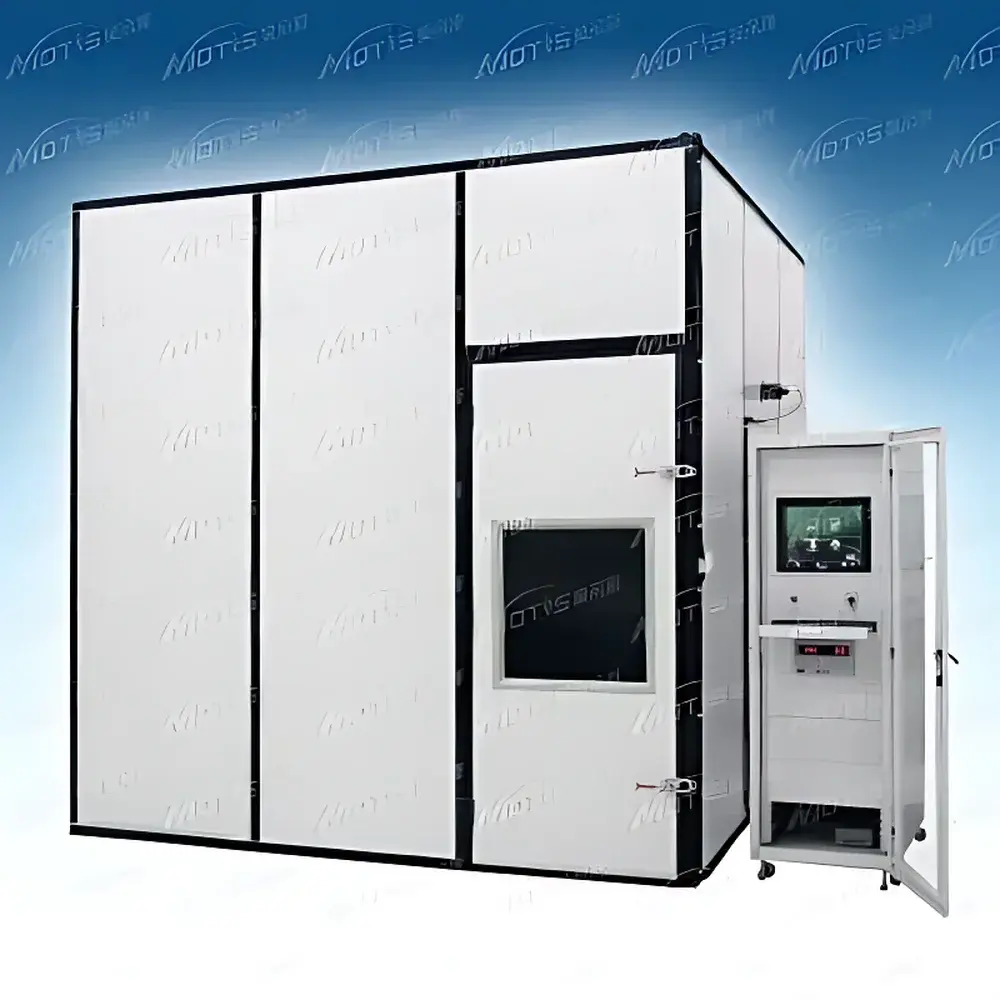
MOTIS 3MC 27 m³ Cable Smoke Density Chamber
| Brand | MOTIS |
|---|---|
| Origin | Jiangsu, China |
| Model | 3MC |
| Chamber Volume | 27 m³ (3000 mm × 3000 mm × 3000 mm) |
| Compliance | IEC 61034, BS 6853, GB/T 17651.1–2 |
| Light Source | 2896 K tungsten halogen lamp with constant-current driver |
| Detector | Cosine-corrected silicon photodiode with color filter |
| Optical Resolution | 0.01% transmittance |
| Exhaust | Top-mounted centrifugal fan |
| Ignition | Remote-controlled surface igniter |
| Sample Support | Stainless steel alcohol tray and adjustable cable test stand |
| Data System | Integrated industrial touchscreen PC with thermal printer |
| Chamber Lining | PTFE-coated SUS 304 stainless steel interior |
| Viewing | Dual-side tempered glass ports and front observation window |
| Air Balance | Bottom perimeter ventilation openings |
Overview
The MOTIS 3MC 27 m³ Cable Smoke Density Chamber is a purpose-engineered optical combustion testing system designed to quantify smoke obscuration generated during the controlled burning of electric cables, optical fiber cables, and related insulating materials. It operates on the principle of light attenuation—measuring the reduction in luminous transmittance through a defined smoke column—as specified in internationally recognized fire safety standards including IEC 61034-1&2, BS 6853 Annex C, and GB/T 17651.1–2. During test execution, a standardized flame source ignites the specimen inside the sealed chamber; evolving smoke attenuates a calibrated 2896 K broadband light beam traversing the chamber’s central optical path. The system continuously records real-time transmittance (%T), computes minimum transmittance (Tmin), and determines the time-to-Tmin, enabling quantitative assessment of smoke generation kinetics and peak obscuration severity. This data directly informs fire risk modeling, material selection for confined-space applications (e.g., rail transit, aircraft, data centers), and regulatory compliance documentation.
Key Features
- 27 m³ test volume (3000 mm × 3000 mm × 3000 mm internal dimensions) ensures representative smoke dispersion and meets volumetric requirements of all referenced standards.
- PTFE-coated SUS 304 stainless steel interior lining provides long-term resistance to acidic combustion byproducts (e.g., HCl, SO₂, HF), eliminating corrosion-induced reflectivity artifacts and ensuring measurement stability across repeated cycles.
- Dual optical access ports with high-transmission tempered glass enable precise alignment of a 2896 K tungsten-halogen lamp (constant-current driven for spectral and intensity stability) and a cosine-corrected silicon photodiode detector with integrated CIE photopic filter—optimized for human-eye spectral response (V(λ)).
- Integrated axial fan at chamber base ensures homogeneous smoke distribution prior to optical measurement, minimizing stratification effects and improving repeatability (RSD < 3% per ASTM E662 interlaboratory studies).
- Top-mounted centrifugal exhaust system rapidly clears residual smoke post-test, supporting high-throughput lab operation while maintaining safe ambient conditions.
- Remote-controlled surface igniter eliminates operator exposure to radiant heat and toxic effluents during ignition phase—supporting OSHA 1910.120 and ISO 13571 safe work practices.
- Modular stainless steel test fixture accommodates vertical or horizontal cable configurations up to 1.5 m length, with adjustable clamping and standardized ethanol-fueled ignition tray per IEC 61034-2 Annex A.
Sample Compatibility & Compliance
The 3MC chamber supports rigid and flexible low-smoke zero-halogen (LSZH), PVC, PE, XLPE, and fluoropolymer-insulated cables and optical fiber assemblies. Specimens are mounted per standard orientation (vertical trunking or horizontal tray layout) and ignited under defined airflow and fuel conditions. All hardware, optical calibration protocols, and data acquisition routines are validated against IEC 61034-1 Clause 7 (optical system verification), IEC 61034-2 Annex B (chamber conditioning), and GB/T 17651.2 Section 6 (test procedure fidelity). The system’s f₁ mismatch (≤4%) and linearity (±1%) satisfy the photometric accuracy thresholds required for accredited testing laboratories operating under ISO/IEC 17025:2017. Documentation includes NIST-traceable lamp calibration certificates and factory-verified detector responsivity reports.
Software & Data Management
Embedded industrial-grade Windows OS touchscreen PC executes proprietary smoke density acquisition software compliant with GLP data integrity principles. Software logs timestamped transmittance curves, calculates Tmin, tTmin, and average smoke density (ASD) per IEC 61034-2, and exports CSV/Excel reports with full audit trail—including user ID, calibration status, environmental readings (ambient T/RH), and instrument configuration parameters. Optional 21 CFR Part 11 module provides electronic signatures, role-based access control, and immutable record archiving for pharmaceutical or aerospace QA environments. Thermal printer output delivers immediate hard-copy test reports with chamber ID, test date, specimen ID, and pass/fail status relative to client-defined smoke density thresholds (e.g., Tmin ≥ 60% for LSZH compliance).
Applications
- Fire safety qualification of power and communication cables for mass transit rolling stock (EN 45545-2 HL3), marine vessels (IMO FTP Code), and underground infrastructure (NFPA 130).
- R&D screening of novel polymer formulations for reduced smoke toxicity and opacity—correlating optical density with CO yield and particulate size distribution (via optional laser scattering add-on).
- Quality assurance testing in cable manufacturing facilities seeking UL 1685, CSA C22.2 No. 0.3, or CE marking under Construction Products Regulation (CPR) Euroclass B2ca/s1,d0 requirements.
- Third-party certification testing for notified bodies (e.g., SGS, TÜV Rheinland, Intertek) performing EN 50399 or IEC 60332-3 series evaluations.
- Academic research on flame inhibition mechanisms, char layer formation dynamics, and nano-additive effects on smoke suppression kinetics.
FAQ
What standards does the MOTIS 3MC chamber fully support?
IEC 61034-1 & -2, BS 6853 Annex C, GB/T 17651.1–2, and EN 50399 (with appropriate ancillary gas analysis modules).
Is the optical system factory-calibrated and traceable?
Yes—lamp spectral output and detector responsivity are certified against NIST-traceable standards; annual recalibration is recommended per ISO/IEC 17025.
Can the chamber be integrated into an existing fire test laboratory LIMS?
Yes—the system supports OPC UA and Modbus TCP protocols for bidirectional data exchange with laboratory information management systems.
What maintenance is required for long-term optical accuracy?
Quarterly inspection of PTFE coating integrity, biannual cleaning of optical windows with spectroscopic-grade solvents, and annual photodiode dark-current verification.
Does the system include validation documentation for ISO/IEC 17025 accreditation?
Yes—delivery package includes Installation Qualification (IQ), Operational Qualification (OQ), and Performance Qualification (PQ) protocols aligned with ILAC G8:2023 guidelines.



