
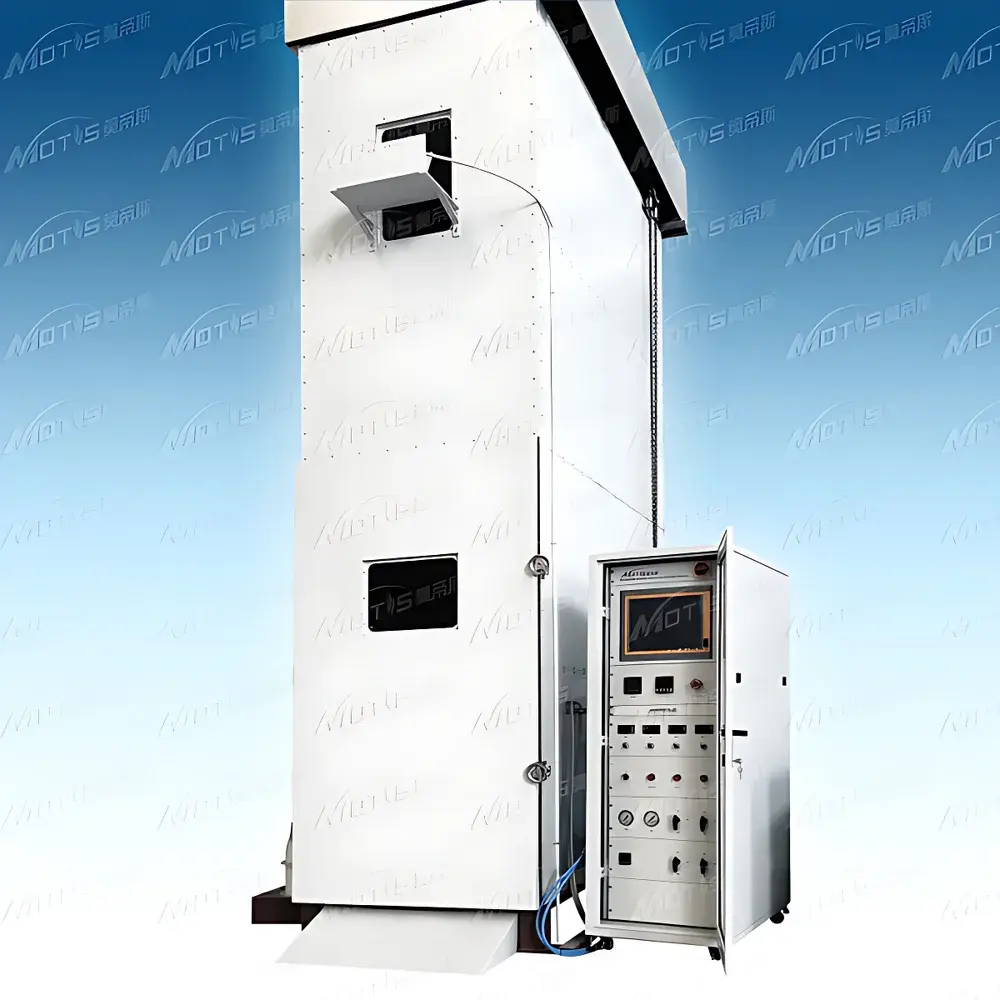
MOTIS BCFT Vertical Tray Flame Spread Test Chamber for Bundled Wires and Cables
| Brand | MOTIS |
|---|---|
| Origin | Jiangsu, China |
| Model | BCFT |
| Compliance | IEC 60332-3-10, -21, -22, -23, -24, -25 |
| Chamber Dimensions (W×D×H) | 1000±100 × 2000±100 × 4000±100 mm |
| Steel Ladder Height | 3500 mm |
| Standard Ladder Width | 500 mm |
| Wide Ladder Width | 800 mm |
| Burner Flame Zone | 257 mm (L) × 4.5 mm (W) |
| Burner Type | Propane ribbon burner with Venturi mixer |
| Orifice Spacing | 3.2 mm |
| Observation Window | 5 mm fire-resistant glass |
| Intake Opening | 800±20 × 400±10 mm |
| Exhaust Opening | 300±30 × 1000±100 mm |
| Thermal Insulation | Floor-mounted refractory lining |
| Flame Arrestor | Integrated propane flame-stop cylinder |
| Gas/Air Compensation | Automated pressure- and temperature-compensated mass flow control via PC interface |
| Data Logging | Fully automated PC-based acquisition of ignition time, flame propagation height, char length, self-extinguishing time, and gas flow parameters |
Overview
The MOTIS BCFT Vertical Tray Flame Spread Test Chamber is a rigorously engineered apparatus designed to evaluate the flame propagation resistance of vertically installed bundles of electric cables, optical fiber cables, and related insulated wiring systems under standardized fire exposure conditions. It operates in strict accordance with the full suite of IEC 60332-3 series standards—including Parts 10 (test apparatus specification), 21 (Category A F/R), 22 (Category A), 23 (Category B), 24 (Category C), and 25 (Category D)—which define test methodology, specimen configuration, burner geometry, gas flow calibration, and pass/fail criteria for vertical flame spread in cable trays. The system employs a precisely dimensioned ribbon-type propane burner equipped with a Venturi mixing chamber to ensure stoichiometric air–fuel blending and repeatable thermal flux distribution across the defined 257 mm × 4.5 mm combustion zone. Flame behavior is assessed through direct visual observation and quantitative measurement of char length, upward flame travel distance, self-extinguishing duration, and post-test residue integrity—parameters directly linked to fire safety engineering requirements in building infrastructure, rail transit, data centers, and energy distribution networks.
Key Features
- Structural chamber fabricated from high-grade stainless steel with dimensional tolerance ±100 mm (W×D×H: 1000 × 2000 × 4000 mm), ensuring long-term thermal stability and corrosion resistance during repeated high-temperature cycles
- Dual-ladder support configuration: standard 500 mm wide × 3500 mm tall steel ladder and optional wide 800 mm × 3500 mm ladder, both conforming to IEC 60332-3 mechanical specifications for bundle support rigidity and airflow interaction
- Integrated flame arrestor cylinder mounted upstream of the burner head, preventing propane backflash and eliminating risk of uncontrolled ignition during gas commissioning or transient pressure events
- Automated gas and air mass flow regulation system with real-time temperature and pressure compensation—calibrated to maintain consistent heat release rate (HRR) regardless of ambient fluctuations per IEC 60332-3-21 Annex B
- Fire-rated observation window composed of 5 mm thick ceramic-reinforced borosilicate glass, rated for continuous exposure up to 800 °C and compliant with EN 1364-1 for structural fire resistance viewing panels
- Thermally insulated chamber floor using low-conductivity refractory ceramic fiber board (≤0.12 W/m·K at 600 °C), minimizing conductive heat feedback to the specimen base and preserving test boundary conditions
- Modular exhaust and intake apertures (300±30 × 1000±100 mm top exhaust; 800±20 × 400±10 mm lower front intake) engineered to sustain laminar vertical draft flow matching the 0.2–0.3 m/s nominal velocity specified in IEC 60332-3-10 Clause 7.3
Sample Compatibility & Compliance
The BCFT chamber accommodates bundled cable configurations ranging from small-diameter instrumentation cables (e.g., 2×0.5 mm²) to large power distribution assemblies (up to 3×400 mm² Cu or equivalent cross-sectional area), provided specimens are mounted on standardized steel ladders per IEC 60332-3-22 through -25. All test procedures align with internationally recognized regulatory frameworks: IEC 60332-3 series (primary compliance basis), UL 1685 (for North American cable listings when adapted with supplementary documentation), and EN 50399 (European harmonized method for fire performance classification). The system supports full traceability required under ISO/IEC 17025 accredited laboratory environments—including audit-ready calibration records for gas flow meters, thermocouples, and timing circuits—and meets foundational requirements for GLP-compliant test execution per OECD Principles of Good Laboratory Practice.
Software & Data Management
Control and data acquisition are managed via a dedicated Windows-based software platform that interfaces with industrial-grade PLCs and calibrated mass flow controllers. The software performs synchronized logging of burner gas pressure, air inlet temperature, chamber ambient temperature (via multiple Class A Pt100 sensors), ignition timing, flame front progression (manually annotated or semi-automated via high-contrast video timestamping), and self-extinguishing interval. Export formats include CSV, PDF test reports with digital signatures, and XML files compatible with LIMS integration. Audit trails record all user actions, parameter modifications, and calibration events in accordance with FDA 21 CFR Part 11 principles—including electronic signature capability, role-based access control, and immutable log history.
Applications
This test chamber serves as a core verification tool for cable manufacturers validating flame-retardant jacket formulations (e.g., LSZH, halogen-free EPR, silicone rubber, or cross-linked polyolefin compounds); third-party certification bodies conducting type approval testing for CE marking (EN 50575), UKCA, or CCC certification; and end-user engineering departments specifying fire-safe cabling for critical infrastructure—such as subway signaling systems, hospital emergency power feeds, nuclear facility instrumentation loops, and offshore oil & gas platforms. Its design enables comparative evaluation of material aging effects (post-thermal cycling or UV exposure) on flame propagation behavior, supporting R&D efforts in next-generation low-smoke, zero-halogen (LSZH) and intumescent cable technologies.
FAQ
Which IEC standards does the BCFT fully support?
The BCFT complies with IEC 60332-3-10 (apparatus requirements), -21 (A F/R class), -22 (A class), -23 (B class), -24 (C class), and -25 (D class) without hardware modification.
Can the system be used for non-IEC test protocols such as UL 1685 or GB/T 18380.3?
Yes—minor procedural adjustments and ladder loading configurations allow adaptation to UL 1685 (vertical tray) and GB/T 18380.3 (Chinese national equivalent), though formal validation per those standards requires documented deviation assessment.
Is calibration certification included with delivery?
Each unit ships with factory calibration certificates for gas flow controllers, temperature sensors, and timing modules, traceable to NIM (China National Institute of Metrology) or equivalent national metrology institutes.
What electrical supply and ventilation requirements apply?
The chamber requires a 220 VAC ±10 %, 50 Hz single-phase supply (10 A minimum) and connection to a dedicated exhaust duct capable of handling ≥1.2 m³/s volumetric flow at 200 °C sustained temperature.
Does the software support multi-language UI and automated report generation?
The control software provides English and Simplified Chinese language options and generates fully customizable PDF test reports with embedded digital signatures, lab header, and configurable pass/fail logic per selected standard clause.



