
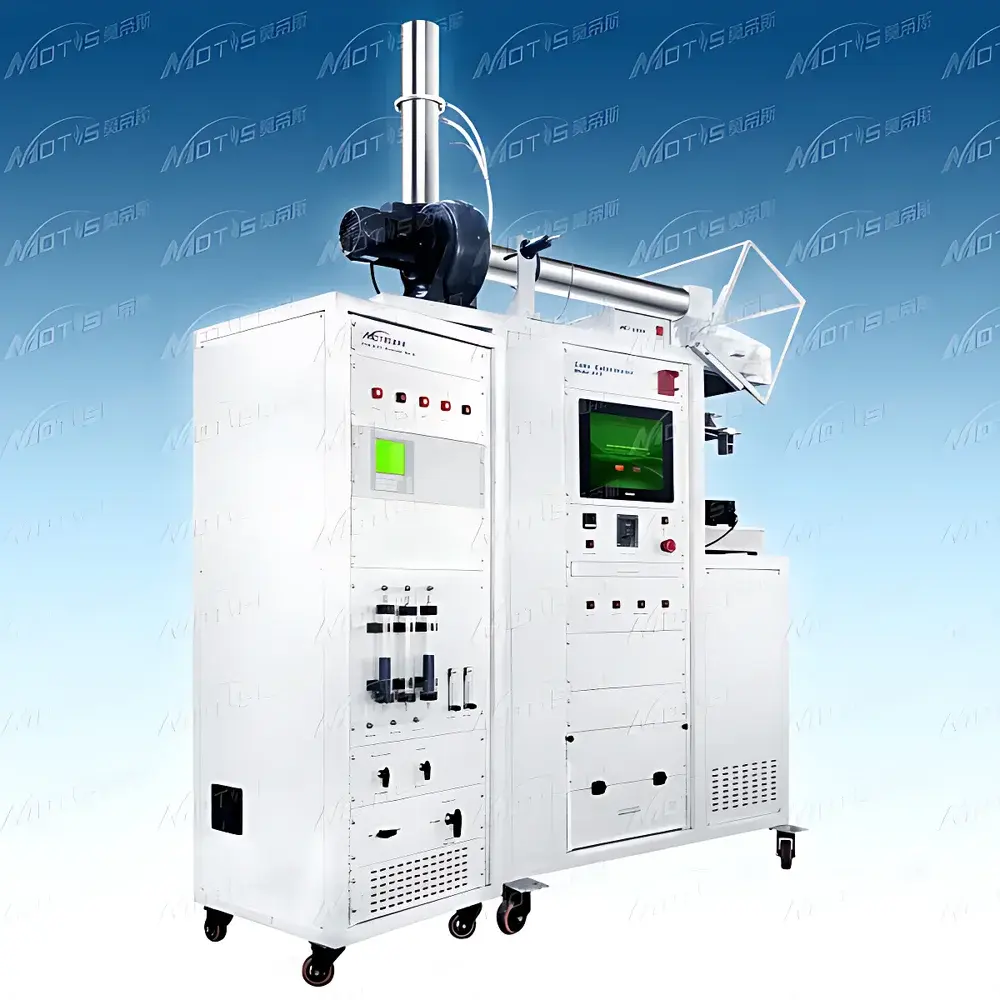
MOTIS CCT- Cone Calorimeter
| Brand | MOTIS |
|---|---|
| Origin | Jiangsu, China |
| Manufacturer Type | Authorized Distributor |
| Country of Origin | China |
| Model | CCT- |
| Pricing | Upon Request |
| Standards Compliance | ISO 5660-1 & -2, ASTM E1354, GB/T 16172, BS 476-15 |
| Heating Source | 5 kW Conical Radiant Heater (0–100 kW/m²) |
| Sample Capacity | 100 mm × 100 mm × 50 mm |
| Mass Measurement Range | 0–2000 g (0.1 g resolution) |
| Oxygen Analyzer | Paramagnetic, 0–25% O₂, T₉₀ < 1.5 s, drift < 0.5%/month |
| CO/CO₂ Analyzers | NDIR, CO: 0–1%, CO₂: 0–10% |
| Smoke Measurement | He-Ne Laser (0.5 mW), dual photodiode detection |
| Exhaust Flow Control | 0–50 g/s (0.1 g/s resolution), sharp-edged orifice (Ø57 ±1 mm) |
| Heat Flux Calibration | NIST-traceable water-cooled foil heat flux meter (0–100 kW/m², ±3% accuracy, ±0.5% repeatability) |
| C-Factor Calibration | Integrated brass burner with automated gas flow control (1/3/5 kW), real-time C-factor calculation per ISO 5660-1 Annex B |
| Data Acquisition | Synchronized multi-channel sampling (O₂, CO, CO₂, ΔP, thermocouples, load cell, laser extinction) |
| Software | Windows-based, CFR Part 11-compliant audit trail, Excel report export, sensor delay compensation, C-factor logging, and full GLP/GMP-ready calibration management |
Overview
The MOTIS CCT- Cone Calorimeter is a research-grade fire testing instrument engineered for precise, repeatable quantification of material combustion behavior under controlled radiant exposure. It operates on the oxygen consumption calorimetry principle—first established by V. Babrauskas at NIST in 1982—where the heat release rate (HRR) is derived from the mass flow rate and oxygen depletion of the combustion effluent. This method is grounded in the empirically validated relationship that most common organic solids release approximately 13.1 MJ/kg of heat per kilogram of oxygen consumed (±5%), as reported by Huggett (1980). Unlike small-scale flammability tests (e.g., UL 94, LOI), the cone calorimeter replicates key fire dynamics—including piloted ignition, flaming combustion, and post-flashover decay—with high fidelity to large-scale fire scenarios. Its output parameters form the scientific foundation for fire modeling (e.g., CFAST, FDS), regulatory compliance assessments, and flame-retardant formulation development.
Key Features
- Modular cabinet architecture: Separated test frame and 19-inch analysis cabinet enable flexible integration with large-scale heat release rate (HRR) systems or standalone operation.
- Integrated control interface: Embedded 17-inch industrial touchscreen PC running real-time Windows OS for system configuration, test execution, and live parameter monitoring.
- High-stability conical heater: 5 kW radiant source delivering uniform incident flux (0–100 kW/m²) across a 50 mm × 50 mm central zone (±2% spatial uniformity); PID-controlled with horizontal/vertical orientation capability.
- NIST-traceable metrology: Water-cooled foil heat flux meter (12.5 mm blackened target, ±3% accuracy), calibrated against national standards; portable chiller eliminates dependency on municipal water supply.
- Multi-gas analysis suite: Paramagnetic O₂ sensor (0–25%, <1.5 s response), dual NDIR analyzers for CO (0–1%) and CO₂ (0–10%), all with documented linearity and long-term stability (<0.5% monthly drift).
- Laser-based smoke measurement: 0.5 mW He-Ne source coupled with primary/auxiliary photodiodes to determine specific optical density (SOD) and derive smoke production rate (SPR) and specific extinction area (SEA).
- ISO 5660-compliant exhaust train: Sharp-edged orifice (Ø57 ±1 mm) located 350 mm upstream of fan inlet; volumetric flow regulated from 0–50 g/s (0.1 g/s resolution); ring sampler with 12 equidistant ports positioned 685 mm below hood.
- Automated C-factor calibration: Integrated brass burner with programmable gas flow (1/3/5 kW steps); software computes and logs C-factor per ISO 5660-1 Annex B, enforcing acceptance criteria (0.035–0.045; ≤5% deviation between consecutive calibrations).
Sample Compatibility & Compliance
The CCT- accommodates specimens up to 100 mm × 100 mm × 50 mm in dimension, mounted on a precision load cell (0–2000 g, 0.1 g resolution) for continuous mass loss rate (MLR) tracking. Specimen holders are compatible with standard insulation backing (e.g., mineral wool) and optional quartz sand bedding per ISO 5660-1. All critical subsystems—including oxygen analysis, exhaust flow measurement, thermocouple placement (1.6 mm sheathed type K, installed 100 mm above orifice), and laser alignment—conform strictly to the geometric, temporal, and metrological requirements of ISO 5660-1 & -2, ASTM E1354, GB/T 16172, and BS 476-15. The system supports both piloted and non-piloted ignition protocols, with a safety-integrated spark igniter (10 kV) featuring automatic positioning and fail-safe cutoff.
Software & Data Management
The proprietary MOTIS FireTest™ software provides full lifecycle data governance compliant with FDA 21 CFR Part 11 and GLP/GMP principles. It includes role-based user access control, electronic signatures, immutable audit trails, and versioned calibration records. Sensor calibration routines support single- or two-point linearization for O₂, CO, CO₂, differential pressure, laser extinction, and load cell inputs. The software automatically compensates for signal transport delays among gas analyzers and flow sensors to ensure time-synchronized HRR computation. Real-time status dashboards display operational health of all subsystems (e.g., O₂ baseline stability, laser power output, thermocouple integrity). Test reports are generated in native Excel format with embedded plots (HRR vs. time, MLR vs. time, SPR vs. time), tabulated summary statistics (TTI, pkHRR, THR, EHC, SEA, CO yield), and metadata export (calibration dates, operator ID, ambient conditions). Historical C-factor logs enable longitudinal performance trending and preventive maintenance scheduling.
Applications
The CCT- delivers quantitative fire performance data essential for polymer science, building product certification, transportation material qualification, and fire safety engineering. Key use cases include: comparative evaluation of halogen-free vs. brominated flame retardants in polyolefins; validation of intumescent coating efficacy under varying heat fluxes; determination of critical heat flux (CHF) for ignition resistance in upholstered furniture foams; correlation of cone-derived HRR profiles with room-corner fire test outcomes (e.g., NFPA 265); generation of input parameters for computational fluid dynamics (CFD) fire models; and toxic gas yield assessment (CO, CO₂) under standardized ventilation conditions. Its ability to decouple thermal decomposition kinetics (via MLR) from gas-phase combustion efficiency (via EHC) makes it indispensable for mechanistic studies of flame inhibition pathways.
FAQ
What standards does the MOTIS CCT- fully comply with?
The system meets the mechanical, metrological, and procedural requirements of ISO 5660-1 & -2 (2015/2016), ASTM E1354 (2023), GB/T 16172 (2007), and BS 476-15 (1992), including mandatory tolerances for heater uniformity, exhaust flow measurement, and gas analyzer specifications.
Is the C-factor calibration automated?
Yes—the software controls gas flow to the brass calibration burner at user-selectable power levels (1 kW, 3 kW, or 5 kW), acquires real-time O₂ and flow data, calculates instantaneous C-factor per ISO 5660-1 Annex B, and validates results against the 0.035–0.045 acceptance window with automatic pass/fail flagging.
Can the system be used for toxicity screening?
While the base configuration measures CO and CO₂ yields quantitatively, full toxic gas speciation (e.g., HCN, HCl, SO₂) requires optional add-ons such as FTIR or GC-MS coupling via the standardized exhaust gas sampling port and conditioning train (cold trap, moisture/CO₂ scrubbers).
What is the recommended maintenance interval for the oxygen analyzer?
Paramagnetic O₂ sensors require quarterly zero/span verification using certified gas mixtures; annual factory recalibration is advised to maintain traceability to NIST SRM 2621a. Drift monitoring is integrated into the software’s calibration log dashboard.
Does the system support unattended overnight testing?
Yes—robust thermal management (water-cooled heat flux meter, active exhaust cooling), redundant safety interlocks (temperature over-limit, flame-out detection, gas leak shutoff), and watchdog-timed data acquisition ensure reliable long-duration runs up to 60 minutes, typical for char-forming polymers.



