
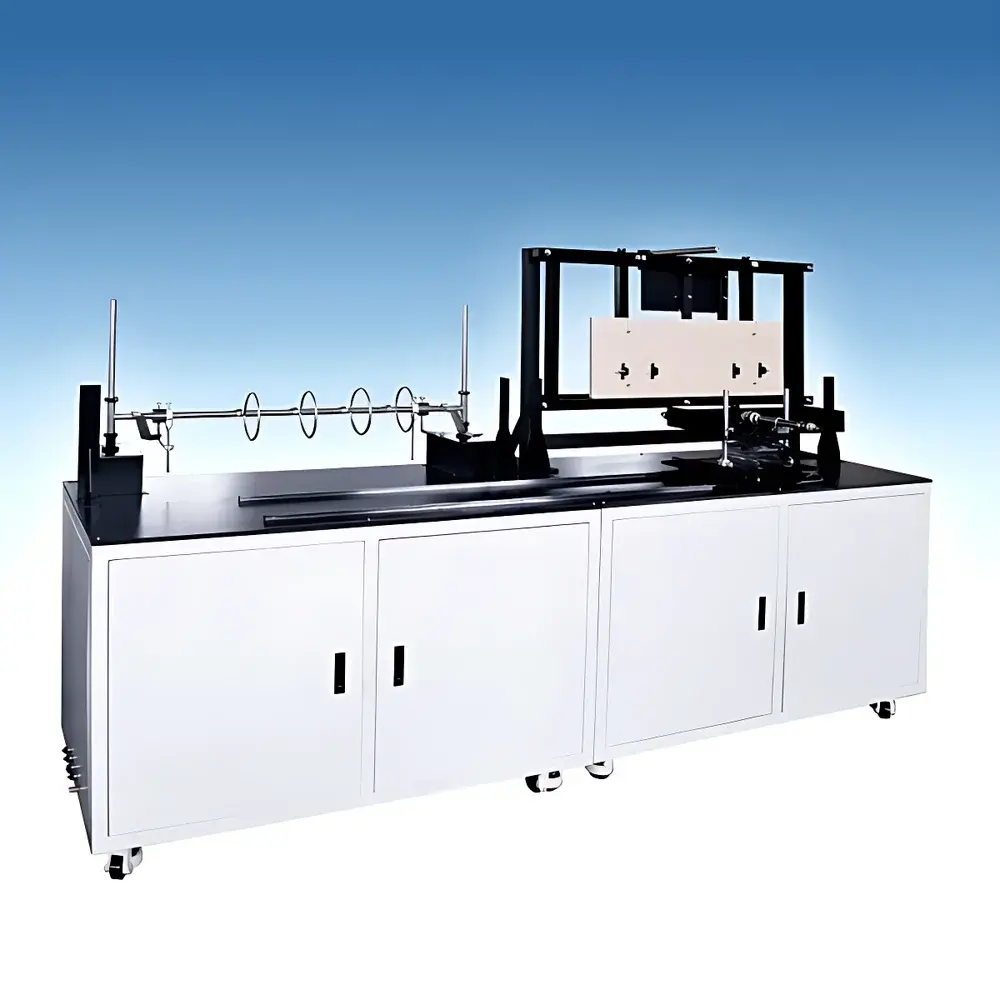
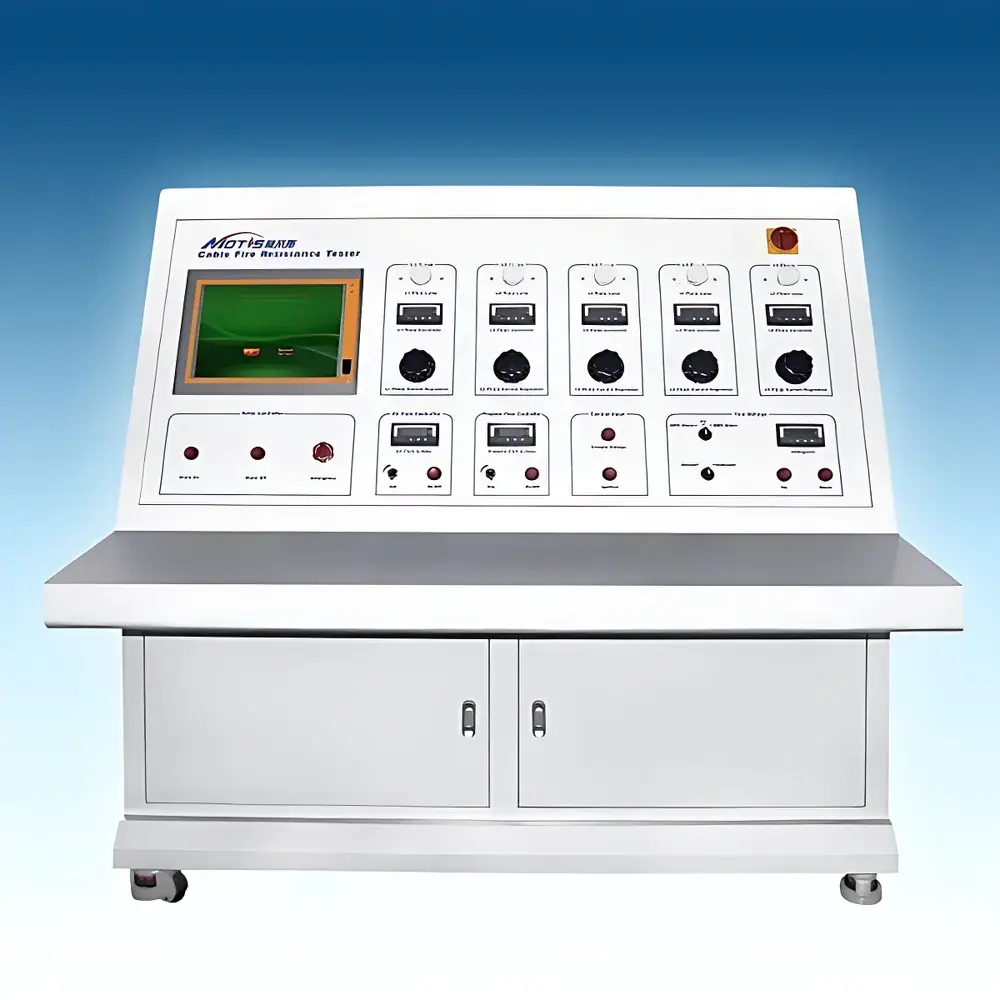
MOTIS CFRW Fire Resistance and Water Spray Test Chamber for Cables
| Brand | MOTIS |
|---|---|
| Model | CFRW |
| Application | Fire resistance testing of low-voltage power cables (≤ 0.6/1.0 kV) |
| Standard Compliance | GB/T 19216.11 |
| Ignition Source | AGF propane ribbon burner (500 mm length, 15 mm nominal width, triple-row 1.32 mm orifices) |
| Temperature Calibration | Omega 1.5 mm armored thermocouple |
| Gas Control | Imported mass flow controllers (accuracy ≥ ±1.5%) |
| Air-Gas Mixing | Venturi-type premix system |
| Voltage Control | Programmable AC supply (computer-settable, panel-adjustable) |
| Continuity Monitoring | 0.25 A test current per conductor, LED + software-based real-time circuit integrity detection |
| Data Acquisition | Digital multimeters (current resolution 0.001 A), time-synchronized voltage/current curve logging |
| Safety Protection | D-II type fuse (2 A, GB 13539.5 compliant), imported miniature circuit breakers |
| Software Features | Pre-test parameter entry (cable spec, standard selection, max duration), automated flame stabilization protocol, calibration report generation (≥10 min thermal soak), audit-ready database storage, GLP-compliant reporting |
Overview
The MOTIS CFRW Fire Resistance and Water Spray Test Chamber is an engineered solution for evaluating the circuit integrity of low-voltage power cables (rated ≤ 0.6/1.0 kV) under simultaneous fire exposure and water spray conditions—per GB/T 19216.11, the Chinese national implementation of IEC 60331-21. The system operates on the principle of controlled flame impingement followed by simulated emergency water suppression, enabling quantitative assessment of whether a cable maintains electrical continuity during and after severe thermal stress. Unlike generic combustion chambers, the CFRW integrates calibrated thermal delivery, precision gas–air stoichiometry control, real-time electrical continuity monitoring, and traceable data acquisition in a single validated platform. Its design conforms to the mechanical and metrological requirements specified in Clause 6 of GB/T 19216.11, including sample support geometry (dual 150 mm-diameter grounded metal rings spaced 300 mm apart), fixed-end clamping, and horizontal alignment of insulated conductors. The chamber supports both steady-state flame exposure at 750 °C or 950 °C and post-fire water spray application, replicating real-world fire brigade intervention scenarios in building wiring systems.
Key Features
- AGF-certified propane ribbon burner (500 mm × 15 mm) with triple-row 1.32 mm orifices (±5% dimensional tolerance) and pilot flame stabilization ports—ensuring reproducible flame geometry and thermal flux distribution.
- Imported high-accuracy mass flow controllers (±1.5% reading) for independent regulation of propane and combustion air, coupled with a Venturi premix manifold to guarantee consistent stoichiometric ratio and flame stability across test durations.
- Omega 1.5 mm armored thermocouple for ISO/IEC 17025-aligned burner temperature calibration; software-enforced 10-minute thermal soak prior to test initiation, with automated differential temperature analysis and calibration certificate generation.
- Dual-mode voltage control: computer-defined setpoint (0–1000 V AC) with manual fine-tuning via front-panel encoder—enabling precise compliance with GB/T 19216.11’s requirement for uninterrupted rated voltage application during fire exposure.
- Real-time continuity verification at 0.25 A per conductor using isolated LED indicators and synchronized digital acquisition (0.001 A resolution); automatic alarm triggering upon open-circuit detection with timestamped event logging.
- Integrated protection architecture: GB 13539.5-compliant D-II fuses (2 A), imported miniature circuit breakers per test channel, and galvanically isolated secondary instrumentation—meeting functional safety requirements for Class I electrical testing environments.
Sample Compatibility & Compliance
The CFRW accommodates single-core and multi-core cables up to 40 mm outer diameter, including PVC, LSZH, XLPE, and mineral-insulated types. Sample mounting follows strict geometric constraints: horizontal orientation, fixed anchoring at one end, free suspension over two grounded 150 mm-diameter stainless steel rings (10 ± 2 mm rod stock), and full conductor termination at both ends. All metallic fixtures are bonded to earth potential per IEC 61000-5-2. The system is validated for compliance with GB/T 19216.11, which references IEC 60331-21 for fire resistance classification (e.g., Category A, B, C). While not certified to UL 2196 or EN 50200 out-of-the-box, its modular burner, data architecture, and calibration traceability allow third-party validation for those standards upon customer-requested configuration review and documentation package extension.
Software & Data Management
The embedded Windows-based control software provides full GLP/GMP-aligned test lifecycle management. Prior to testing, users input laboratory metadata, cable construction details (conductor count, insulation type, nominal cross-section), selected standard (GB/T 19216.11 default), maximum exposure time, and pass/fail criteria (e.g., minimum continuity duration). During operation, the software logs synchronized voltage, current, burner temperature, propane flow, and air flow at 1 Hz resolution. All raw datasets are stored in encrypted SQLite databases with SHA-256 hash integrity verification. Calibration reports—including thermocouple drift analysis, flow controller linearity verification, and flame temperature uniformity maps—are auto-generated and digitally signed. Export options include PDF test reports (with embedded curves), CSV time-series data, and XML files compatible with LIMS integration. Audit trails record user login, parameter changes, calibration events, and alarm activations—fully compliant with FDA 21 CFR Part 11 electronic record requirements when deployed on validated IT infrastructure.
Applications
- Verification of fire-resistance claims for building service cables in high-risk occupancies (hospitals, data centers, transit hubs).
- Quality assurance testing during cable manufacturing and incoming goods inspection for OEMs and EPC contractors.
- Development and validation of novel fire-retardant insulation compounds and intumescent jacketing systems.
- Third-party certification body testing per CNAS-accredited procedures (CNAS-CL01:2018).
- Research into thermal degradation kinetics of polymer dielectrics under combined flame/water stress.
FAQ
What standards does the CFRW explicitly support?
The system is fully configured and factory-validated for GB/T 19216.11 (IEC 60331-21 equivalent). Optional firmware and documentation packages are available for EN 50200 and UL 2196 compliance validation.
Can the chamber perform water spray testing independently of flame exposure?
Yes—the water spray subsystem operates independently with programmable onset timing, duration, and flow rate, enabling sequential or concurrent fire-and-spray protocols as required by specific test clauses.
Is remote monitoring and control supported?
Standard Ethernet TCP/IP communication enables remote status viewing and basic command execution (start/stop/pause) via secure HTTPS interface; full remote operation requires optional VNC-enabled industrial PC upgrade.
How is calibration traceability maintained?
All critical sensors (thermocouples, flow meters, voltage/current transducers) are supplied with NIST-traceable calibration certificates; software enforces periodic recalibration intervals and archives all historical calibration records with digital signatures.
What maintenance intervals are recommended?
Burner nozzle inspection every 50 test cycles; thermocouple replacement every 12 months or after 200 h cumulative exposure >800 °C; mass flow controller recalibration annually or after any physical impact to the gas train.



