
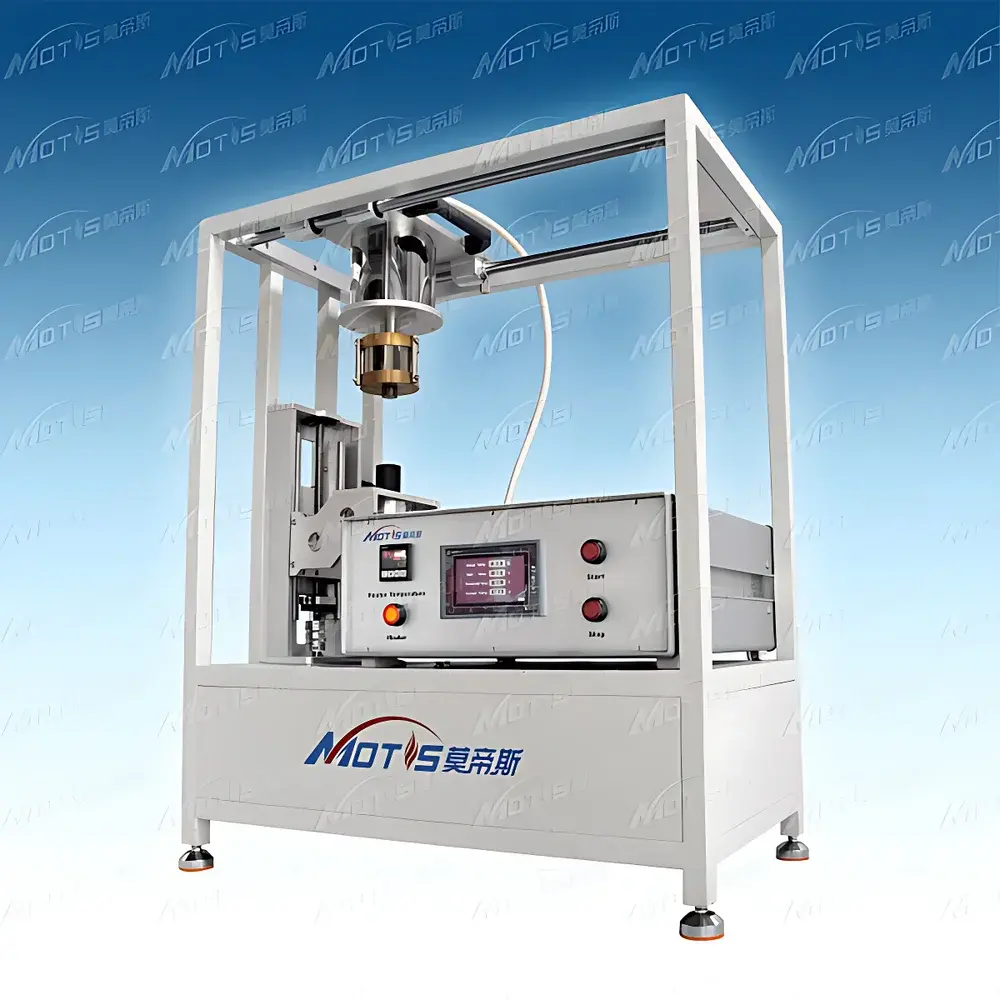
MOTIS CHT Contact Heat Transfer Performance Tester
| Brand | MOTIS |
|---|---|
| Origin | Jiangsu, China |
| Model | CHT |
| Heating Range | Ambient to 500 °C |
| Contact Force | 49 N |
| Contact Velocity | 5 mm/s |
| Heating Element Diameter | 25.2 ± 0.05 mm |
| Calorimeter Probe Diameter | 25.0 ± 0.05 mm, Depth: 5.0 ± 0.02 mm |
| Temperature Measurement Range | ≥ 500 °C |
| Test Parameter Output | Contact temperature, start time, threshold time (time to +10 °C rise), termination temperature |
| Compliance | EN 702, ISO 9151, AQ 6103–2007 |
| Power Supply | 220 V, 50 Hz |
| Operating Environment | 20 ± 2 °C, 65 ± 5 % RH |
| Dimensions | 600 × 250 × 650 mm (D × W × H) |
Overview
The MOTIS CHT Contact Heat Transfer Performance Tester is a precision-engineered instrument designed for quantitative evaluation of thermal protective performance in personal protective equipment (PPE), specifically heat-resistant gloves and fabrics used in welding, foundry, and high-temperature industrial applications. It operates on the principle of controlled contact heat transfer under standardized mechanical loading, measuring the time required for a thermally insulated sample to experience a defined temperature rise (ΔT = +10 °C) when pressed against a heated cylindrical probe at a constant force and velocity. This threshold time—defined as the elapsed duration from initial contact until the calorimetric sensor beneath the specimen registers a 10 °C increase above baseline—is the primary metric for comparative assessment of material thermal resistance. The system conforms rigorously to internationally recognized test protocols including EN 702 (Protective clothing — Protection against heat — Determination of contact heat transmission), ISO 9151 (Clothing for protection against heat and flame — Determination of heat transmission on exposure to contact heat), and the Chinese occupational safety standard AQ 6103–2007 (Test method for contact heat resistance of welder’s protective gloves). Its design prioritizes repeatability, operator safety, and traceable calibration through integrated PLC-based control and real-time thermal monitoring.
Key Features
- High-stability metallic heating element with precise diameter tolerance (25.2 ± 0.05 mm) and programmable temperature range from ambient to 500 °C, calibrated and verified per ASTM E230/E230M requirements.
- Integrated calorimetric probe with nominal dimensions of 25.0 ± 0.05 mm (diameter) × 5.0 ± 0.02 mm (depth), rated for continuous operation up to ≥500 °C and equipped with Class A RTD or thin-film thermocouple sensing.
- Electromechanical actuation system delivering consistent 49 N contact force at 5 mm/s approach velocity, with servo-controlled vertical motion enabling automated probe descent, dwell, and retraction.
- Horizontally adjustable heating platform facilitating safe, repeatable specimen placement while minimizing operator exposure to thermal hazards during loading.
- Industrial-grade PLC controller with embedded data logging, capturing timestamped values for contact temperature, start time, threshold time, termination temperature, and real-time thermal profile at user-defined intervals.
- Backlit LCD interface providing immediate visual feedback of system status, setpoints, active test parameters, and pass/fail indicators aligned with EN/ISO/AQ acceptance criteria.
Sample Compatibility & Compliance
The CHT tester accommodates flat, flexible specimens up to 150 mm × 150 mm, including multi-layer woven/nonwoven textiles, coated leathers, and composite glove liners. Specimen thickness is unrestricted within the mechanical travel limits of the calorimeter assembly (max. 25 mm clearance). All test procedures adhere strictly to the geometric, thermal, and mechanical boundary conditions specified in EN 702 Annex A, ISO 9151 Clause 6, and AQ 6103–2007 Section 5. Calibration verification is supported by NIST-traceable reference materials and documented in accordance with ISO/IEC 17025:2017 requirements for testing laboratories. The instrument supports audit-ready reporting for GLP-compliant environments, with optional timestamped electronic records compatible with FDA 21 CFR Part 11–enabled software extensions.
Software & Data Management
While the base configuration utilizes embedded PLC logic for autonomous test execution and local display, optional PC-based software (MOTIS ThermalLab v3.x) provides extended functionality including automated report generation (PDF/CSV), multi-test statistical analysis (mean, SD, CV%), trend charting over time, and configurable pass/fail thresholds per standard. Data files include metadata such as operator ID, environmental readings (recorded via optional external温湿度 sensor), calibration certificate IDs, and digital signatures. Exported datasets are structured to align with LIMS integration protocols and support traceability across QA/QC workflows in certified PPE manufacturing facilities.
Applications
- Performance validation of welder’s gloves per AQ 6103–2007 and ISO 9151 for occupational certification.
- R&D screening of novel insulative fibers, aerogel composites, and phase-change material (PCM)-integrated textiles.
- Quality conformance testing in production batches of fire-retardant workwear and foundry aprons.
- Comparative benchmarking of thermal barrier efficiency across competing supplier materials under identical test conditions.
- Supporting technical documentation for CE marking submissions under EU PPE Regulation (EU) 2016/425, particularly for Category III heat-protection devices.
FAQ
What standards does the CHT tester fully support?
EN 702, ISO 9151, and AQ 6103–2007 — all implemented with hardware geometry, force application, and thermal response parameters validated against original standard specifications.
Is the threshold time measurement fully automated?
Yes. The PLC detects the exact moment the calorimeter signal crosses the +10 °C ΔT threshold relative to pre-contact baseline and logs the corresponding timestamp without manual intervention.
Can the instrument be integrated into a laboratory network for centralized data management?
With the optional ThermalLab software and Ethernet-enabled controller module, raw test data, reports, and calibration logs can be exported to shared drives or pushed to SQL-based LIMS platforms.
What maintenance is required to ensure long-term measurement accuracy?
Annual verification of heating element temperature uniformity, force transducer calibration (traceable to national standards), and calorimeter probe response time using certified reference samples is recommended per ISO/IEC 17025 clause 6.5.
Does the system include provisions for environmental monitoring during testing?
The base unit assumes controlled lab conditions per ISO 9151 (20 ± 2 °C, 65 ± 5 % RH); optional external温湿度 sensors with digital output can be connected to log ambient data alongside thermal test records.



