
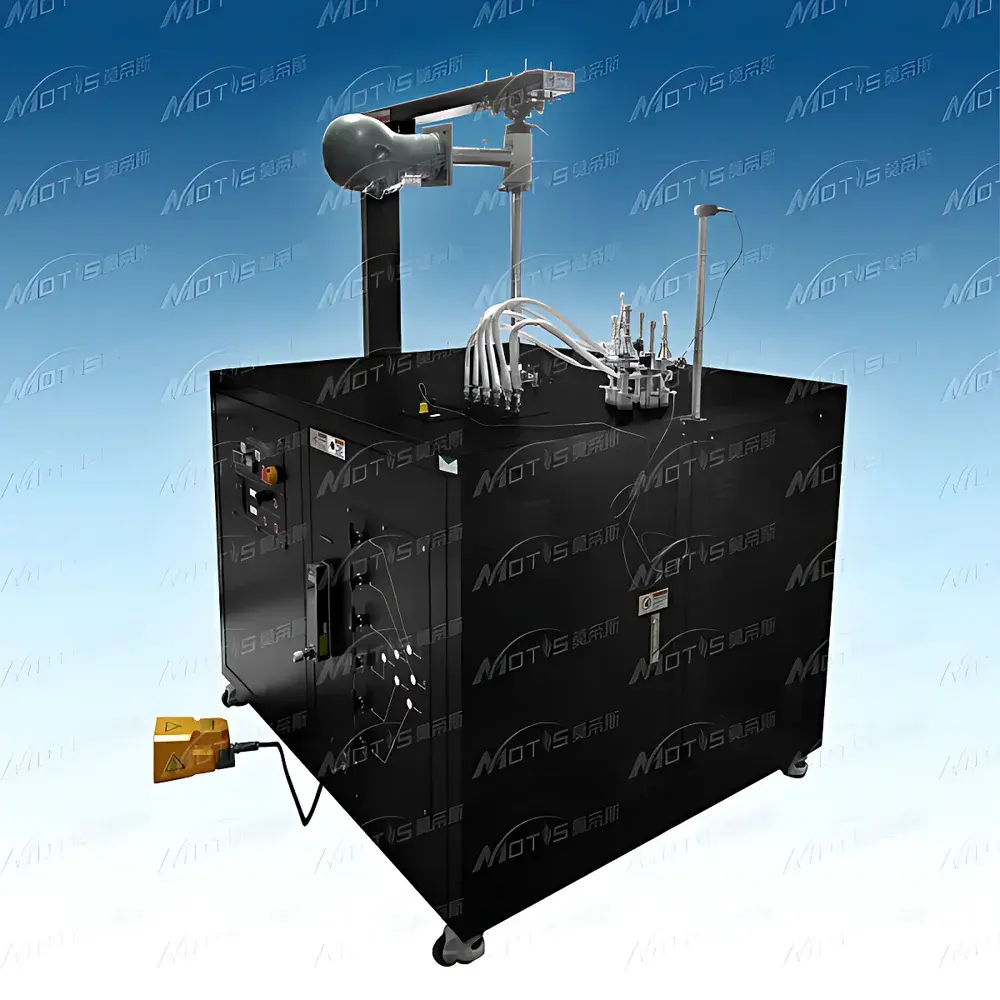
MOTIS FFM Full-Facepiece Combustion Tester
| Brand | MOTIS |
|---|---|
| Origin | Jiangsu, China |
| Manufacturer Type | Authorized Distributor |
| Country of Origin | China |
| Model | FFM |
| Pricing | Available Upon Request |
| Test Standard Compliance | GB/T 16556–2007, EN 136 |
| Simulated Head | Metallic anthropomorphic head (rotatable) |
| Thermocouple | K-type, positioned 250 mm above burner tip, range 950 ± 50 °C |
| Burners | 6 × TEKLU-type adjustable-height burners |
| Gas Flow Control | Mass flow meter with digital display |
| Supply Pressure Range | 10–50 kPa |
| Safety Features | Flame flashback arrestor |
| Dimensions (W×D×H) | 1000 × 650 × 1300 mm |
Overview
The MOTIS FFM Full-Facepiece Combustion Tester is a purpose-built test apparatus engineered for evaluating the flame resistance and thermal stability of critical components in self-contained open-circuit compressed air breathing apparatus (SCBA). Designed in strict alignment with internationally recognized respiratory protective equipment standards—including GB/T 16556–2007 and EN 136—the system enables standardized exposure of full-face masks, inhalation/exhalation hoses, medium-pressure tubing, demand valves, harness straps, and buckle assemblies to controlled, reproducible flame environments. Its operational principle centers on calibrated radiant and convective heat flux delivery via six independently height-adjustable TEKLU burners, simulating realistic thermal insult scenarios encountered during emergency firefighting or industrial fire exposure. The metallic anthropomorphic head—rotatable to replicate multiple wearing angles—ensures anatomically representative positioning of the facepiece during ignition assessment, while integrated K-type thermocouples provide real-time temperature validation at the designated reference plane (250 mm above burner apex), maintaining traceable thermal boundary conditions per test protocol.
Key Features
- Rotatable metallic anthropomorphic head assembly enabling compliance with angular orientation requirements specified in EN 136 Clause 4.12 and GB/T 16556–2007 Section 6.4.2.
- Six TEKLU-type combustion nozzles, each with independent vertical adjustment to ensure precise flame impingement geometry across diverse component geometries.
- Digital mass flow metering system for propane or butane fuel supply, delivering quantifiable, repeatable gas flow rates with resolution ≤ 0.1 L/min and full-scale accuracy ±1.5% of reading.
- Regulated fuel pressure control (10–50 kPa) via precision diaphragm regulators, ensuring stable laminar flame characteristics throughout test duration.
- Integrated flame flashback arrestor meeting ISO 22867:2012 requirements, mitigating risk of uncontrolled upstream ignition during high-flow or transient pressure events.
- Thermocouple monitoring system with K-type sensors mounted at standardized elevation (250 mm above burner tip), providing continuous temperature verification within ±50 °C tolerance band around 950 °C nominal setpoint.
- Rigid welded steel frame with powder-coated finish, dimensioned at 1000 mm (W) × 650 mm (D) × 1300 mm (H), designed for floor-standing laboratory integration and long-term mechanical stability under thermal cycling.
Sample Compatibility & Compliance
The FFM tester accommodates full-face respirator assemblies—including molded silicone or thermoplastic elastomer facepieces, corrugated PVC or polyurethane breathing hoses (inner diameter 19–25 mm), nylon or polyester harness webbing (width 30–50 mm), and injection-molded polymer buckles. All fixtures are non-reactive and thermally inert, preventing interference with combustion behavior. The system supports testing of both complete SCBA configurations and individual subcomponents, facilitating root-cause analysis of flame propagation pathways. It fully satisfies the mandatory flame resistance evaluation clauses in EN 136:2022 (Clause 4.12, “Flame Resistance of Facepiece”) and GB/T 16556–2007 (Section 6.4, “Fire Resistance Test”), including pass/fail criteria related to afterflame time ≤ 5 s, afterglow time ≤ 15 s, and absence of molten drip ignition. Documentation output supports GLP-compliant reporting and internal audit readiness.
Software & Data Management
While the FFM operates as a hardware-dominant benchtop system without embedded microprocessor control, it integrates seamlessly with third-party data acquisition platforms via analog voltage outputs from thermocouples and optional digital I/O modules. Temperature readings are compatible with National Instruments DAQ systems, Keysight 34972A loggers, or LabVIEW-based custom interfaces. All calibration records—including thermocouple NIST-traceable certificates, mass flow meter verification reports, and pressure regulator calibration logs—are maintained in accordance with ISO/IEC 17025:2017 requirements. Audit trails for test execution—including operator ID, date/time stamp, sample ID, burner configuration, and raw thermal data—can be exported in CSV or PDF format to support FDA 21 CFR Part 11–aligned electronic record retention where required.
Applications
- Pre-market validation of SCBA facepieces and harness materials against national and European regulatory mandates.
- Comparative flame resistance benchmarking of alternative elastomers (e.g., fluoroelastomers vs. silicone) used in high-temperature face seal designs.
- Root-cause failure analysis following field-reported thermal degradation incidents in firefighting PPE.
- Supporting ISO 15537:2003-based ergonomic safety assessments where thermal load distribution across facial anatomy is modeled.
- Qualification testing for military CBRN respirators requiring extended flame exposure resilience beyond civil standards.
- In-house R&D screening of novel flame-retardant textile weaves for harness strap reinforcement layers.
FAQ
What standards does the FFM tester explicitly support?
It is configured and validated for GB/T 16556–2007 and EN 136:2022, with physical layout and burner specifications matching the dimensional and thermal parameters defined in Annex B of EN 136.
Can the system accommodate non-standard respirator geometries?
Yes—the rotatable head mount and modular burner array allow adaptation to oversized or asymmetric facepieces, provided minimum clearance distances (per EN 136 Clause 4.12.3) are maintained during setup.
Is third-party certification available for the test apparatus itself?
MOTIS provides factory calibration certificates for all metrological subsystems; UKAS-accredited verification can be arranged through authorized calibration partners upon request.
What fuel types are compatible with the TEKLU burners?
Propane (EN 589) and butane (EN 1861) are the primary fuels; mixed hydrocarbon blends may be used if vapor pressure and Wobbe index remain within burner design limits (10–50 kPa supply pressure range).
How frequently must thermocouples be recalibrated?
Per ISO/IEC 17025, K-type thermocouples used for compliance testing should be verified before each test series and recalibrated at intervals not exceeding 12 months—or after any mechanical shock or thermal overload event.



