
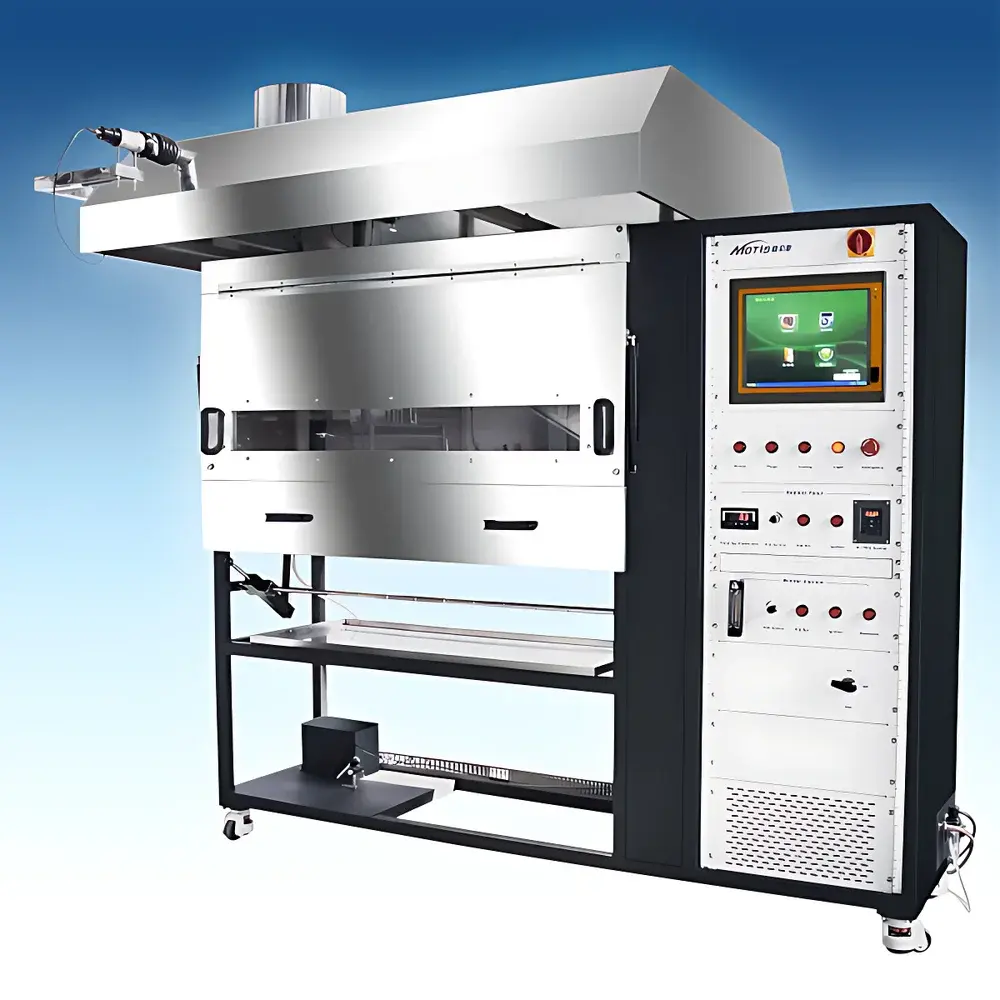
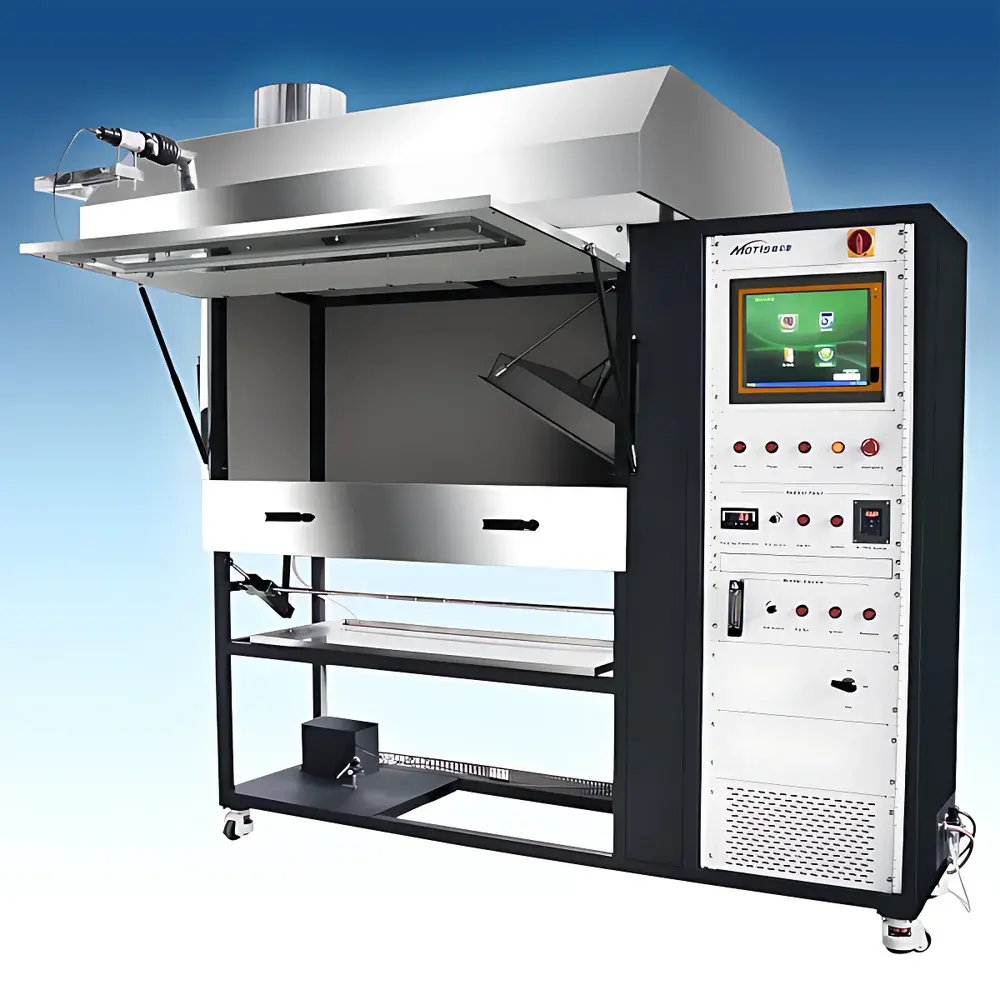
MOTIS FPR Floor Covering Radiant Panel Test Apparatus
| Brand | MOTIS |
|---|---|
| Origin | Jiangsu, China |
| Model | FPR |
| Standards Compliance | ISO 9239-1, ASTM E648, GB/T 11785 |
| Radiation Panel | 300 mm × 450 mm porous ceramic, mounted at 30° angle |
| Heat Flux Range | 0–50 kW/m² (water-cooled thermopile) |
| Thermopile Accuracy | <2% |
| Response Time | 0.2 s |
| Light Source | Tungsten filament lamp, 2900 ± 100 K |
| Photodetector | Silicon photodiode |
| Smoke Measurement | Transmittance-based optical density (OD), real-time DAQ via 15″ touchscreen PC |
| Air Supply | Integrated variable-frequency blower with Venturi gas-air mixer and flashback arrestor |
| Ignition | Pneumatically actuated T-shaped burner (propane) |
| Safety | Flame-out detection via thermal probe, automatic gas shutoff |
| Calibration | Motorized lift stage for thermopile positioning |
| Sample Holders | 3 stainless steel fixtures |
| Temperature Monitoring | Chimney thermocouple, chamber thermocouple, infrared radiometer for panel surface temperature |
| Software | Dedicated DAQ platform with synchronized heat flux, smoke density, transmittance, airflow, and time-stamped flame spread tracking |
Overview
The MOTIS FPR Floor Covering Radiant Panel Test Apparatus is a fully integrated, standards-compliant combustion test system engineered to determine the critical radiant flux (CRF) of floor coverings—including carpets, resilient tiles, and insulation materials—under controlled radiant and piloted ignition conditions. It operates in strict accordance with ISO 9239-1 (Reaction to fire tests — Floorings — Part 1: Determination of the burning behaviour using a radiant heat source), ASTM E648 (Standard Test Method for Critical Radiant Flux of Floor Covering Systems Using a Radiant Heat Energy Source), and GB/T 11785 (Fire performance of building materials — Test method for critical radiant flux of floor covering systems). The apparatus employs a calibrated porous ceramic radiant panel inclined at 30° to generate a spatially uniform, decaying radiant heat flux profile across the specimen surface. Simultaneous measurement of optical smoke density—via a collimated 2900 K tungsten lamp and silicon photodiode—is performed along the longitudinal axis of the test chamber, enabling real-time calculation of specific optical density (Ds) per ASTM E662 and ISO 5659-2 protocols. This dual-parameter output (CRF and smoke development) supports comprehensive fire hazard assessment for building code compliance, product certification (e.g., UL, CE, CCC), and material development R&D.
Key Features
- Integrated variable-frequency blower system replaces external compressors, ensuring continuous, pulse-free air supply to the radiant panel and burner—eliminating pressure fluctuations that compromise flame stability and radiant flux reproducibility.
- Water-cooled MEDTHERM thermopile (0–50 kW/m² range, <2% accuracy, 0.2 s response time) with self-contained recirculating chiller—no external water hookups required, reducing installation complexity and improving lab safety.
- Motorized thermopile lift mechanism enables precise, repeatable positioning over all calibration orifices on the NIST-traceable multi-hole reference plate—ensuring full-field radiant flux validation per ISO 9239-1 Annex B.
- Automated shutter assembly positioned directly in front of the silicon photodiode allows software-controlled 0% and 100% transmittance calibration without manual lamp shutdown, minimizing thermal drift and enhancing inter-test repeatability.
- Stainless steel test chamber with front-access door, calcium silicate lining (rated to 1200°C), and overhead stainless steel exhaust hood ensures structural integrity, thermal containment, and long-term corrosion resistance during repeated high-heat exposure.
- Pneumatic T-shaped propane burner with digital mass flow control and needle-valve height adjustment delivers consistent piloted ignition energy while maintaining flame geometry across test cycles.
- Real-time safety interlocks include thermal-probe flame monitoring, automatic gas cutoff upon flameout, integrated flashback arrestor, and dual thermocouple monitoring (chamber and chimney) with software alarm thresholds.
Sample Compatibility & Compliance
The FPR accommodates standard specimens measuring 1050 mm × 225 mm (per ISO 9239-1), mounted on specified substrate boards (e.g., gypsum board, plywood) to simulate installed conditions. It supports testing of heterogeneous composites—including carpet-backing laminates, rubber flooring, vinyl composition tile (VCT), cork underlay, and mineral wool insulation—provided they meet dimensional and mounting requirements. All hardware, calibration procedures, and data acquisition logic are designed to satisfy regulatory audit requirements under ISO/IEC 17025, ASTM E178, and GLP frameworks. The system’s software logs all calibration events, operator actions, environmental parameters (airflow, ambient temperature), and raw sensor outputs with timestamped, non-editable records—supporting traceability for FDA 21 CFR Part 11–aligned environments where applicable.
Software & Data Management
The embedded 15-inch industrial touchscreen PC runs proprietary DAQ software compliant with IEC 61508 SIL 2 functional safety principles. The interface displays synchronized real-time plots of heat flux (kW/m²), optical transmittance (%), specific optical density (Ds), airflow velocity (m/s), and chamber temperature (°C). All curves are time-aligned with flame spread distance markers triggered via footswitch input—enabling direct correlation between radiant flux decay, ignition delay, and lateral flame propagation rate. Calibration data (thermopile offset, shutter transmission, lamp intensity drift) is stored in encrypted binary files with SHA-256 checksums. Export options include CSV (for Excel or MATLAB post-processing) and PDF test reports containing signature fields, instrument ID, calibration certificate references, and pass/fail determination against CRF thresholds (e.g., ≥2.5 kW/m² for Class 1 floorings per NFPA 253).
Applications
- Fire performance qualification of commercial and residential floor coverings for LEED, BREEAM, and local building code submissions.
- Comparative evaluation of flame-retardant additives, intumescent backings, and polymer matrix modifications in R&D laboratories.
- Third-party certification testing per UL 1081 (carpets), EN 13501-1 (fire classification), and AS/NZS 1530.3 (Australian/New Zealand standards).
- Root-cause analysis of smoke toxicity drivers by correlating Ds curves with evolved gas analysis (when coupled with FTIR or GC-MS downstream).
- Validation of computational fluid dynamics (CFD) fire models requiring boundary-condition inputs derived from radiant panel test data.
FAQ
What standards does the FPR fully support out-of-the-box?
ISO 9239-1, ASTM E648, and GB/T 11785—hardware configuration, calibration routines, and reporting templates are pre-configured to these methods.
Is external cooling water required for the thermopile?
No—the system includes a sealed, recirculating chiller unit with temperature stabilization circuitry; no tap water or facility coolant connections are needed.
Can the software generate audit-ready test reports?
Yes—reports include electronic signatures, calibration traceability metadata, raw data timestamps, and pass/fail determinations aligned with regulatory thresholds.
How is flame spread distance measured during testing?
Via operator-triggered footswitch; the software records exact time stamps and overlays distance markers on the smoke density and heat flux plots.
Does the system support automated recalibration between tests?
The thermopile and optical path can be revalidated using the motorized lift and shutter sequence—full recalibration is recommended before each test series per ISO 9239-1 Section 7.3.



