
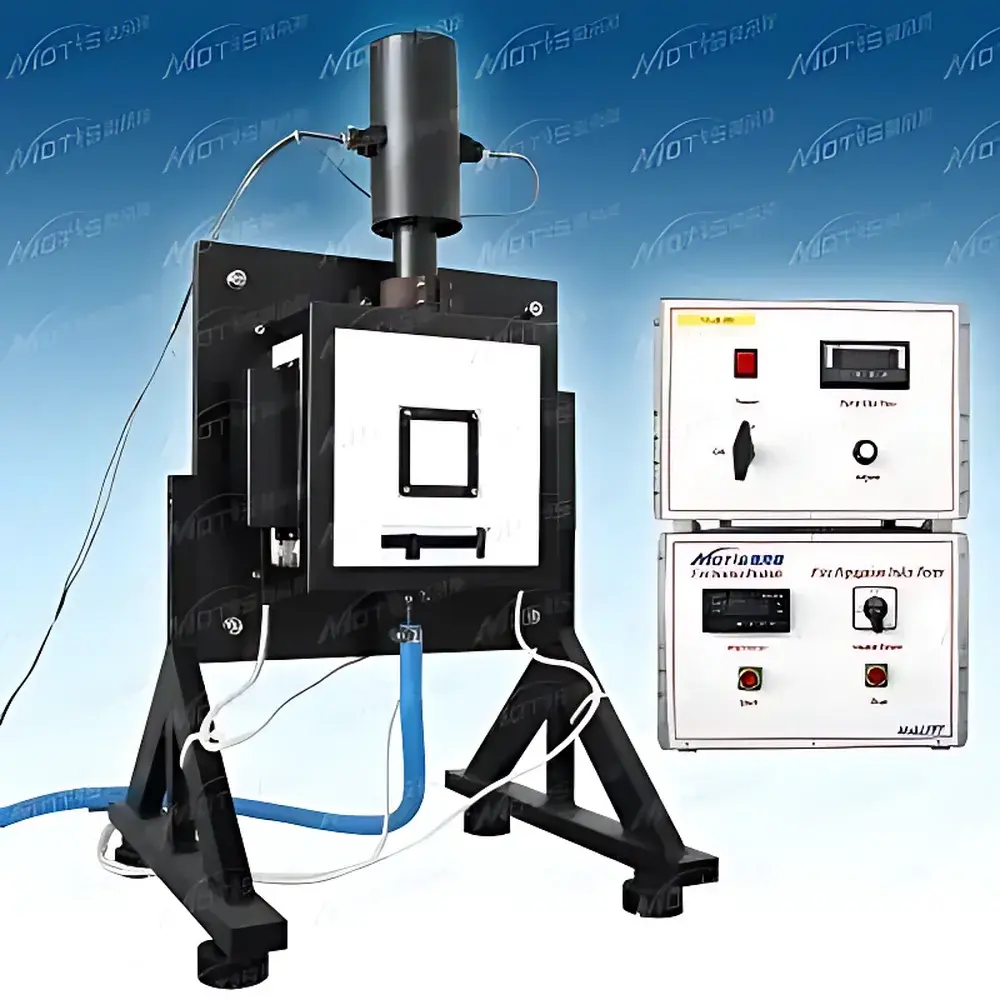
MOTIS FPT Flame Propagation Index Tester
| Brand | MOTIS |
|---|---|
| Origin | Shanghai, China |
| Model | FPT |
| Compliance | BS 476-6:2009+A1:2009 |
| Heating Source | Dual 1000 W quartz radiant heaters + T-type gas burner |
| Power Control | Automated time-programmed output (530 J/s initial → 1800 W at 2 min 45 s → 1500 W at 5 min) |
| Temperature Monitoring | T-type thermocouples measuring ΔT between flue gas and ambient air |
| Data Acquisition | Real-time logging with automated I-index calculation per BS 476-6 Annex B |
| Sample Holders | Three stainless-steel-clad configurations for wall/ceiling linings |
| Combustion Chamber Lining | Calcium silicate board |
| Structural Frame | Stainless steel support chassis |
| Reporting | ASTM/ISO-compliant PDF export with audit trail metadata |
Overview
The MOTIS FPT Flame Propagation Index Tester is a precision-engineered combustion test apparatus designed exclusively for quantitative assessment of surface flame spread behavior in building interior finish materials—specifically wall and ceiling linings—according to BS 476-6:2009+A1:2009. This standardized method determines the Flame Propagation Index (I), a dimensionless parameter derived from time-resolved flue gas temperature rise (ΔT) relative to ambient conditions during controlled exposure to combined radiant and convective heat sources. The instrument implements the prescribed thermal protocol: initial heating at 530 J/s via a tubular gas burner for the first 2 minutes 45 seconds; subsequent ramp to 1800 W total radiant power from two independently controlled 1000 W quartz heaters; reduction to 1500 W at the 5-minute mark; and sustained operation until the 20-minute endpoint. The resulting ΔT profile is compared against the reference calibration curve generated from asbestos-cement board under identical conditions, enabling calculation of three sub-indices (I₁, I₂, I₃) across defined temporal intervals (0–3 min, 4–10 min, 11–20 min), summed to yield the final I-value. Materials achieving I ≤ 12 are classified as Class 0 per UK Building Regulations, indicating low surface flame spread hazard.
Key Features
- Robust stainless steel structural frame with integrated safety interlocks and ventilation interface for laboratory-scale exhaust ducting
- Combustion chamber lined with high-purity calcium silicate board (density ≥ 1.2 g/cm³), rated for continuous service up to 1000°C
- Dual 1000 W quartz radiant heater array with PID-controlled power delivery and real-time wattage verification
- T-type gas burner assembly compliant with BS 476-6 nozzle geometry and stoichiometric air–fuel mixing requirements
- Three interchangeable sample mounting fixtures—flat-panel, curved-surface, and edge-mount configurations—each fully clad in electropolished stainless steel to prevent thermal distortion and ensure repeatable specimen positioning
- High-stability T-type thermocouples (±0.5°C accuracy, 0.1 s response time) mounted at standardized flue gas sampling location per Clause 7.3 of BS 476-6
- Fully automated power sequencing logic embedded in firmware, eliminating manual intervention during critical transition points (2 min 45 s and 5 min)
- Integrated data acquisition module synchronized to 100 ms sampling resolution, supporting both real-time monitoring and post-test replay
Sample Compatibility & Compliance
The FPT accommodates specimens measuring 455 mm × 225 mm × nominal thickness (up to 25 mm), cut and conditioned per BS EN ISO 139:2005. It supports rigid, semi-rigid, and flexible substrates including gypsum board, mineral fiber panels, PVC wallcoverings, wood-based composites, and coated metal sheets. All operational parameters—including radiant flux distribution, burner flame geometry, thermocouple placement, and timing sequences—are validated against the metrological requirements of BS 476-6:2009+A1:2009 Annex A. The system meets essential requirements of UKCA marking for construction products and provides traceable documentation suitable for third-party certification bodies (e.g., BRE, Warringtonfire). Calibration certificates for thermocouples and power meters are issued annually per ISO/IEC 17025:2017 accredited procedures.
Software & Data Management
The proprietary FPT Control Suite (v3.2+) runs on Windows 10/11 platforms and complies with FDA 21 CFR Part 11 for electronic records and signatures. It features role-based user access control (administrator, operator, reviewer), full audit trail logging (including parameter changes, start/stop events, and report generation timestamps), and encrypted database storage. Raw ΔT data is stored in CSV and HDF5 formats; processed I-index calculations follow the exact equations in BS 476-6 Annex B. Reports include graphical overlays of test vs. reference curves, annotated time stamps for each ΔT reading, uncertainty estimates per GUM (JCGM 100:2018), and digital signatures compliant with eIDAS Regulation (EU No 910/2014). Export options include PDF/A-2b for long-term archival and XML for integration into LIMS environments.
Applications
- Pre-market evaluation of decorative wallcoverings, acoustic ceiling tiles, and insulation facings for compliance with UK Building Regulations Approved Document B (Fire Safety)
- Quality assurance testing of fire-retardant treated timber and engineered wood products in manufacturing QA labs
- Comparative research on intumescent coating performance under standardized radiant–flame dual-stimulus conditions
- Technical due diligence for CE-marked construction products entering the GB market post-Brexit
- Validation of fire performance claims in EPDs (Environmental Product Declarations) aligned with EN 15804
FAQ
Does the FPT meet current UK regulatory requirements for Class 0 classification?
Yes—the system implements BS 476-6:2009+A1:2009 without deviation and includes documented traceability to NPL (National Physical Laboratory) reference standards.
Can the instrument be used for non-UK standards such as ASTM E84 or EN 13823?
No—its mechanical configuration, heater layout, and control algorithms are purpose-built for BS 476-6. Cross-standard adaptation is not supported.
What maintenance intervals are recommended for thermocouple calibration?
Thermocouples must be verified prior to each test series using a certified dry-block calibrator (±0.3°C tolerance); full recalibration is required every 12 months by an ISO/IEC 17025-accredited laboratory.
Is remote monitoring capability available?
Yes—via secure HTTPS-enabled web interface supporting live ΔT plotting, alarm notifications (e.g., overtemperature, flameout), and encrypted data streaming to on-premise servers.
How is data integrity ensured during power interruption?
The embedded controller retains volatile memory for ≥72 hours on battery backup; all logged values are written to non-volatile flash storage at 100 ms intervals, preventing data loss during transient outages.



