
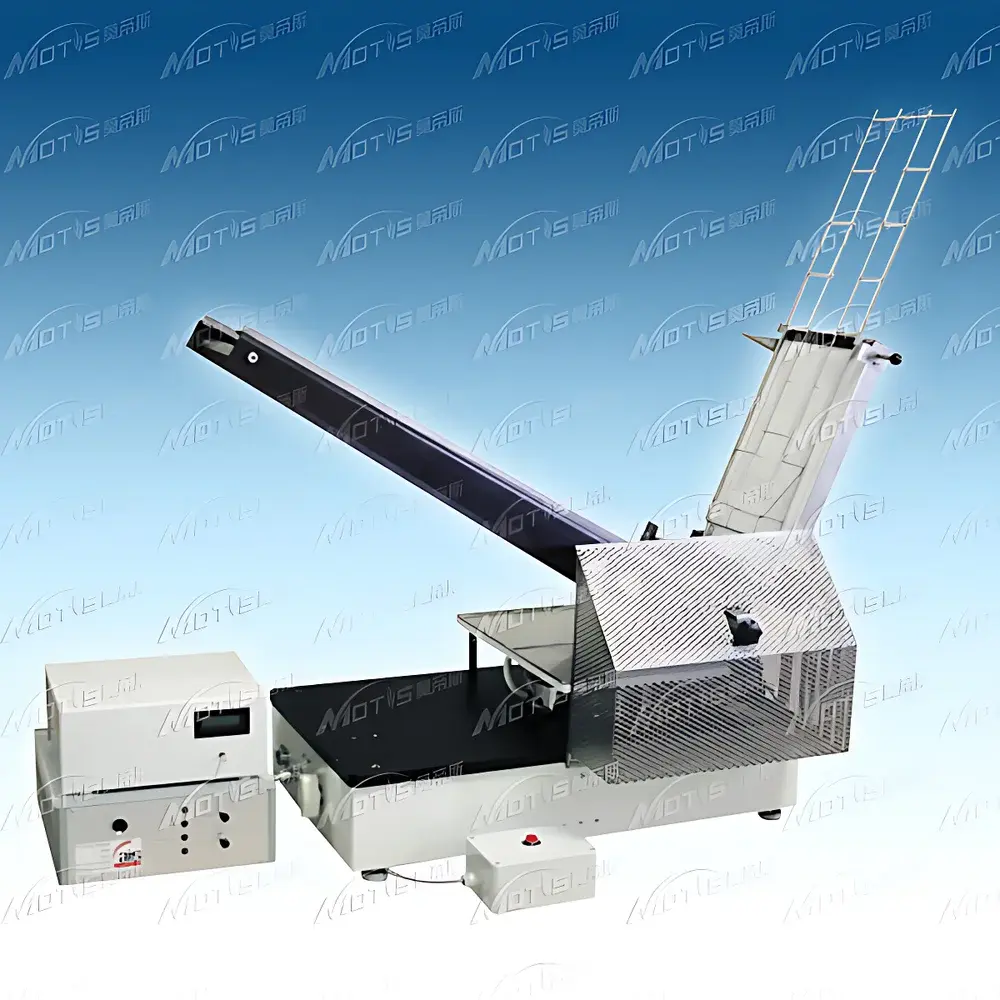
MOTIS M1 Combustion Test Chamber (NFP 92-503 Compliant)
| Brand | MOTIS |
|---|---|
| Model | 503 |
| Standard Compliance | NFP 92-503 |
| Heat Flux Source | Calibrated Electric Radiant Panel |
| Flame Application | Fan-shaped Gas Burner |
| Flame Height Control | Rotameter-adjusted to 30 mm |
| Specimen Holder | Stainless Steel Frame with Needle-type Specimen Clamp |
| Test Duration | Programmable Automatic Timer |
| Radiant Heat Monitoring | Copper Disc Calorimeter (1 unit) |
| Construction | Domestic Manufacturing (Jiangsu, China) |
| Distributor Type | Authorized General Distributor |
Overview
The MOTIS M1 Combustion Test Chamber (Model 503) is a precision-engineered apparatus designed specifically for evaluating surface flammability of building materials and interior finishes according to the French national standard NFP 92-503 — the definitive method for classification under the M1 fire rating. This classification represents the highest level of flame resistance for materials used in public buildings, healthcare facilities, and transportation interiors across France and other Francophone jurisdictions. The instrument operates on a dual-stimulus principle: controlled thermal radiation from a calibrated electric radiant panel, followed by timed impingement of a defined propane-air flame via a fan-shaped burner. Critical fire behavior parameters—including afterflame time, flaming droplet formation, char length (damaged length), and ignition delay—are quantitatively assessed under strictly reproducible boundary conditions. Unlike generic flame spread testers, the NFP 92-503 protocol mandates precise heat flux calibration (typically 35 kW/m² at specimen surface), real-time radiant energy monitoring, and geometrically constrained flame exposure—features fully implemented in this chamber’s mechanical and control architecture.
Key Features
- Electrically heated radiant panel with closed-loop temperature regulation, ensuring stable and traceable heat flux output per NFP 92-503 Annex A requirements.
- Fan-shaped gas burner assembly delivering uniform flame geometry; flame height precisely adjustable to 30 mm using a calibrated rotameter flow control system.
- Stainless steel specimen holder with integrated needle-type clamp, enabling secure, distortion-free mounting of rigid and semi-rigid substrates (e.g., PVC wall coverings, mineral fiber boards, laminated composites).
- Automated test sequence controller with programmable exposure durations for both radiant pre-heating and flame impingement phases—minimizing operator variability and supporting GLP-compliant test execution.
- Copper disc calorimeter mounted at specimen plane for real-time radiant heat flux verification (±2% accuracy), satisfying mandatory calibration validation per Clause 5.2 of NFP 92-503.
- Robust chamber enclosure with observation window, ventilation interlock, and integrated flame arrestor—designed for safe operation in ISO 17025-accredited laboratories.
Sample Compatibility & Compliance
The MOTIS Model 503 accommodates standard test specimens measuring 250 mm × 90 mm × thickness ≤ 13 mm, cut perpendicular to the intended installation orientation. It supports homogeneous, layered, and coated materials including thermoplastics, wood-based panels, textile composites, and acoustic ceiling tiles. All mechanical dimensions, burner positioning, and sensor placement conform strictly to NFP 92-503 dimensional tolerances (±1 mm). While the device itself is manufactured in Jiangsu, China, its performance validation documentation—including radiant panel calibration certificates, burner flame profile reports, and calorimeter response curves—is provided in accordance with ISO/IEC 17025 traceability requirements. It does not claim compliance with ASTM E84, EN 13823, or BS 476 Part 6/7; its design scope is exclusively aligned with French regulatory fire testing protocols.
Software & Data Management
The system includes embedded microcontroller-based timing and sequencing logic, with no proprietary PC software required for basic operation. However, optional RS-485 or analog 4–20 mA outputs enable integration into laboratory information management systems (LIMS) for automated data logging. Raw signals from the copper calorimeter and flame-on/off triggers are timestamped with ±0.1 s resolution. For audit readiness, all test records—including start time, radiant exposure duration, flame application time, observed afterflame duration, and measured char length—can be exported as CSV files. The instrument supports 21 CFR Part 11-compliant electronic record archiving when paired with validated third-party LIMS platforms meeting ALCOA+ principles (Attributable, Legible, Contemporaneous, Original, Accurate, Complete, Consistent, Enduring, Available).
Applications
This chamber is routinely deployed by fire testing laboratories, material certification bodies (e.g., CSTB-accredited labs), and R&D departments developing M1-certified construction products. Typical use cases include pre-certification screening of ceiling tile formulations, qualification of fire-retardant treated fabrics for hospital curtains, validation of intumescent coatings on steel substrates, and technical due diligence for importers supplying French public infrastructure projects. Its deterministic test output directly feeds into the M0–M4 classification matrix defined in the French Fire Safety Code (Règlement de sécurité contre les risques d’incendie dans les établissements recevant du public), making it indispensable for regulatory submission dossiers submitted to DREAL or COFRAC.
FAQ
Does this chamber comply with the latest revision of NFP 92-503 (2022 edition)?
Yes — all mechanical specifications, calibration procedures, and test sequence logic align with NFP 92-503:2022, including updated requirements for calorimeter verification frequency and specimen conditioning protocols.
Can it be used for testing upholstered furniture or flexible foams?
No — NFP 92-503 applies only to rigid or semi-rigid planar surfaces. Flexible, low-density, or vertically oriented materials require alternate standards such as NF P 92-507 or EN 1021.
Is third-party calibration support available?
Yes — MOTIS provides annual calibration kits and certified calibration services traceable to LNE (Laboratoire National de Métrologie et d’Essais) upon request.
What electrical supply is required?
230 V AC ±10%, 50 Hz, 32 A dedicated circuit for radiant panel operation; 24 V DC auxiliary for control logic.
Is CE marking applicable?
The unit carries CE marking under the Machinery Directive 2006/42/EC and EMC Directive 2014/30/EU; however, CE does not imply conformity with fire classification standards — only with fundamental safety and electromagnetic compatibility requirements.
Related Products



