
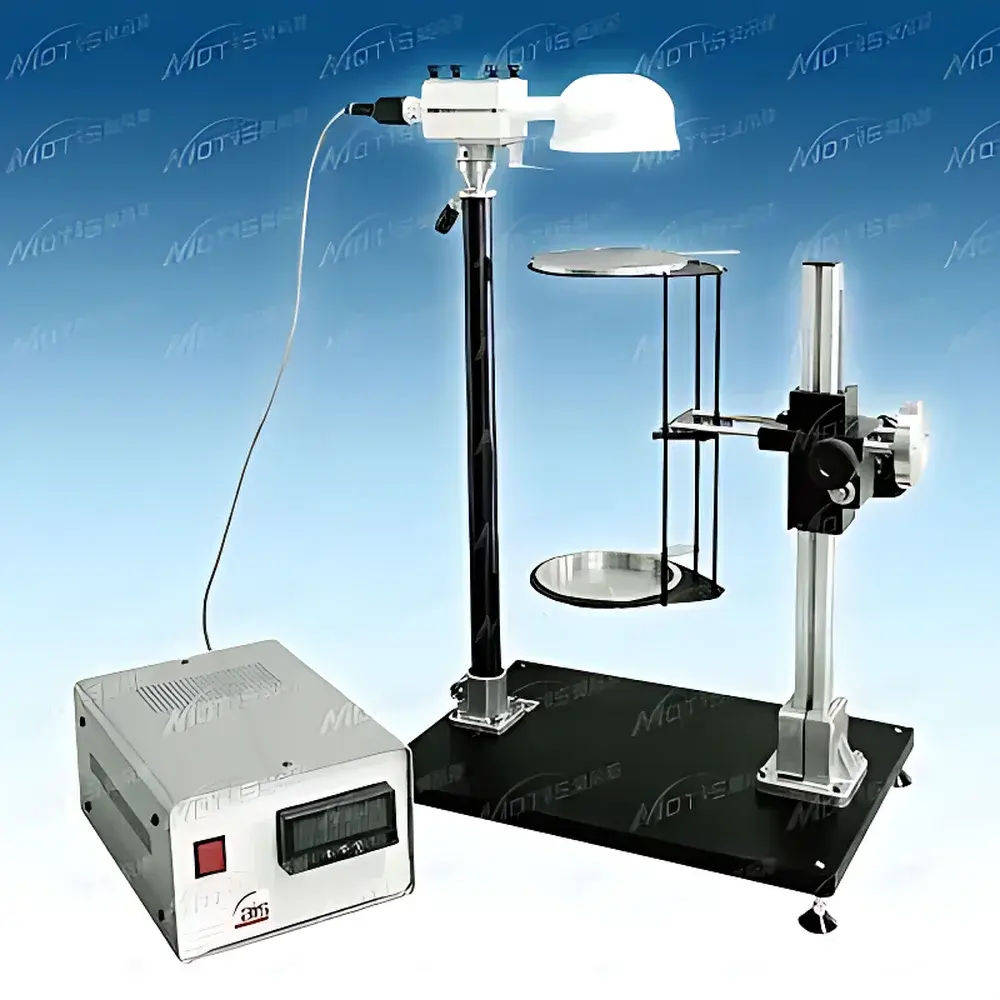
MOTIS Polynorme 505 Radiant Heat-Induced Dripping Tester
| Brand | MOTIS |
|---|---|
| Origin | Shanghai, China |
| Model | Polynorme 505 |
| Compliance | NF P92-505, EU Directive 95/28/EC |
| Radiant Flux | 30 kW/m² |
| Radiation Source | Epiradiator |
| Sample Holder | Adjustable-height stainless steel tray with cotton substrate support |
| Radiation Source Mount | Rotatable 90° stainless steel bracket |
| Power Display | Digital front-panel readout |
| Power Control | Precision radiant flux regulator |
| Height Gauge | Integrated calibratable positioning tool |
Overview
The MOTIS Polynorme 505 Radiant Heat-Induced Dripping Tester is a purpose-engineered apparatus designed to evaluate the thermal response of polymeric and fibrous materials under controlled radiant heat exposure—specifically targeting melt dripping behavior, ignitability of falling droplets, and secondary ignition of underlying cotton substrate. It operates on the principle of vertical radiant heating: a calibrated Epiradiator delivers a uniform 30 kW/m² heat flux to the underside of a horizontally mounted specimen, simulating real-world fire exposure conditions encountered in railcar interiors, automotive seating, and building insulation applications. Unlike convective flame-based tests, this method isolates radiant energy transfer as the primary ignition driver—enabling precise assessment of material decomposition kinetics, melt viscosity evolution, and droplet formation dynamics. The system is fully aligned with the mechanistic requirements of NF P92-505 (French standard for construction materials) and EU Directive 95/28/EC (motor vehicle interior flammability), both of which mandate evaluation of both flaming drip propagation and non-flaming melt accumulation.
Key Features
- Stainless steel radiation source mount engineered for repeatable 90° rotational alignment—ensuring rapid, operator-independent positioning between test cycles and minimizing mechanical drift.
- Integrated height gauge with metric刻度 (±0.5 mm resolution) enables precise vertical adjustment of specimen-to-radiant-source distance per standard-specified geometry (typically 20 mm).
- Epiradiator assembly delivering stable, spatially uniform 30 kW/m² radiant flux across a 100 mm diameter test area—verified via traceable thermopile calibration protocol.
- Digital front-panel power display provides real-time monitoring of applied electrical input to the radiator; eliminates need for routine external radiometer recalibration when operated within manufacturer-specified voltage and ambient temperature ranges.
- Motorized or manual height-adjustable specimen holder and cotton substrate tray—both constructed from high-purity alumina-coated stainless steel to resist thermal warping and oxidation at sustained 750 °C surface temperatures.
- Modular radiation output controller permitting fine-tuned adjustment of radiant flux (±5% full-scale) for method development, comparative studies, or intermediate-level screening protocols.
Sample Compatibility & Compliance
The Polynorme 505 accommodates rigid, semi-rigid, and flexible specimens measuring 150 mm × 50 mm × thickness ≤ 13 mm, including thermoplastics (e.g., PP, PET, PC), thermoset composites, coated textiles, and foam laminates. Specimens are clamped horizontally using low-conductivity ceramic fixtures to minimize conductive heat loss. The underlying cotton substrate (ISO 6941-grade, 30 g/m², conditioned to 23 ± 2 °C / 50 ± 5% RH) is positioned 300 mm below the specimen plane—per NF P92-505 Annex A—to capture and assess ignition potential of falling molten material. Full compliance documentation—including test report templates, uncertainty budgets per ISO/IEC 17025, and audit-ready calibration records—is supplied with each unit. The instrument architecture supports GLP-compliant operation through hardware-locked parameter logging and user-accessible firmware revision tracking.
Software & Data Management
While the Polynorme 505 operates as a stand-alone benchtop system without embedded software, it features RS-232 and optional Ethernet interfaces for integration into laboratory information management systems (LIMS). All critical operational parameters—including radiant power setpoint, elapsed exposure time, and observed event timestamps (drip onset, first cotton ignition, flame extinction)—are logged to non-volatile memory and exportable as CSV or XML. Optional MOTIS TestSuite™ v3.2 software provides automated pass/fail classification per NF P92-505 Table 1 criteria (Class M0–M4), generates ASTM E1354–compatible heat release rate proxies, and maintains FDA 21 CFR Part 11–compliant electronic signatures and audit trails for regulated environments.
Applications
- Qualification testing of railway carriage interior linings per EN 45545-2 R22/R23 requirements.
- Development and validation of flame-retardant masterbatches for injection-molded automotive trim components.
- Comparative analysis of melt viscosity thresholds influencing drip-induced flame spread in halogen-free cable jacketing polymers.
- Regulatory submission support for CE marking of construction products under CPR Annex ZA.
- Root-cause investigation of field-reported fire incidents involving upholstered furniture or acoustic ceiling panels.
FAQ
Does the Polynorme 505 require annual third-party calibration?
Yes—radiant flux uniformity and power meter accuracy must be verified annually by an ISO/IEC 17025-accredited laboratory using NIST-traceable thermopile sensors.
Can the instrument be used for standards beyond NF P92-505 and EU 95/28/EC?
It may serve as a platform for method adaptation per ASTM E2058 Annex A (radiant panel ignition) or GB/T 8627 (Chinese duct liner test), though formal validation per those standards requires documented equivalence studies.
Is operator training included with purchase?
MOTIS provides a two-day on-site installation and procedural training session covering sample preparation, safety interlock verification, data recording, and maintenance of the Epiradiator quartz envelope.
What is the expected service life of the Epiradiator heating element?
Under nominal 30 kW/m² operation and proper cooling cycle adherence, the tungsten-halogen emitter demonstrates ≥ 5,000 hours of stable output before luminous decay exceeds 10%.
How is cotton substrate ignition objectively determined?
Ignition is defined as sustained flaming combustion (>5 s duration) of the cotton pad, visually confirmed by two independent observers per ISO/IEC 17025 observation protocols—and recorded with synchronized high-speed video (≥ 250 fps) for dispute resolution.



