
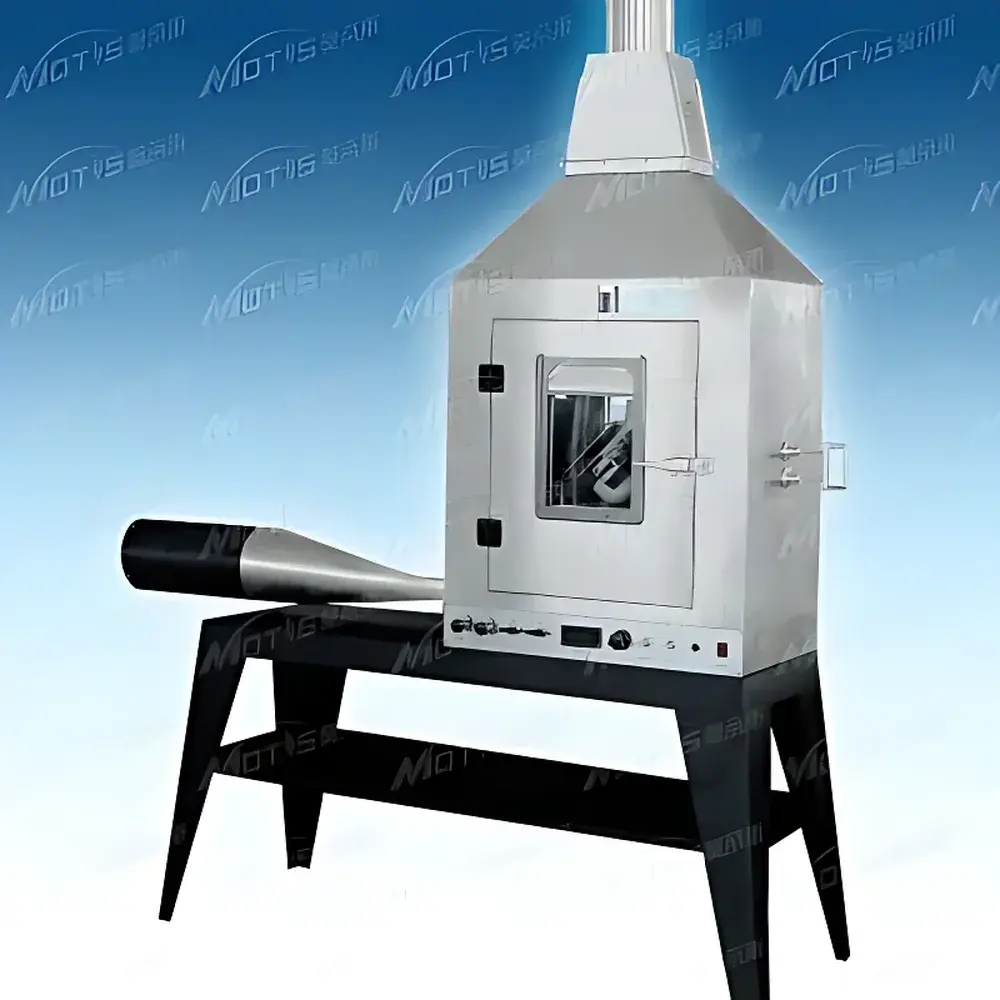
MOTIS RPT Radiant Panel Flame Spread Tester
| Brand | MOTIS |
|---|---|
| Origin | Shanghai, China |
| Model | RPT |
| Compliance | NF P92-501, TB/T 2639.1 |
| Heat Flux | 30 kW/m² |
| Key Outputs | Ignitability Index (i), Average Flame Height Index (S), Maximum Flame Height Index (h), Combustion Heat Release Index (C) |
| Construction | Stainless Steel Enclosure with Fire-Resistant Lining |
| Viewing Window | Tempered Quartz |
| Test Angle | 45° Inclined Specimen Mount |
| Radiant Source | Epiradiator with Power-Controlled Output |
| Burners | Dual Stainless Steel Burners (Upper & Lower), Pilot Ignition System |
| Flame Control | Adjustable Needle Valves with Height Gauge |
| Gas Shutoff | Quarter-Turn Isolation Valves |
| Temperature Monitoring | Top & Inlet Thermocouples |
| Software | Dedicated Test Suite with Automated Index Calculation, Report Generation & Data Export (CSV/PDF) |
Overview
The MOTIS RPT Radiant Panel Flame Spread Tester is a precision-engineered bench-scale combustion test apparatus designed to evaluate the surface flame spread behavior of solid materials under controlled radiant heat exposure. It operates on the principle of radiant ignition and flame propagation—specifically calibrated to deliver a uniform incident heat flux of 30 kW/m² across the specimen surface using a high-stability epiradiator. This thermal stimulus induces pyrolysis, volatilization of combustible species, and subsequent gas-phase ignition; the resulting flame front progression is optically monitored and quantified in real time. The instrument implements the fundamental methodology defined in the French national standard NF P92-501 for building materials and railway vehicle interior components, and is also validated for compliance with TB/T 2639.1 (Chinese railway industry standard for fire performance of interior materials). Unlike open-flame ignition methods, this radiant panel approach isolates thermal feedback effects and enables reproducible assessment of material ignitability, flame growth rate, and heat release propensity under standardized boundary conditions.
Key Features
- Robust stainless steel test chamber with fire-resistant internal lining and a high-transmittance quartz observation window for unobstructed optical monitoring of flame dynamics.
- 45° inclined specimen support frame fabricated from corrosion-resistant stainless steel, integrated with precision-machined scale markings for direct measurement of flame spread distance.
- Epiradiator-based radiant source delivering stable, spatially uniform 30 kW/m² heat flux; output power is continuously adjustable via integrated digital controller with front-panel real-time display—eliminating routine recalibration requirements.
- Dual independent stainless steel burners (upper and lower) equipped with fine-adjustment needle valves and calibrated flame-height gauges to ensure precise pilot flame positioning and repeatability.
- Dedicated pilot ignition system with continuously burning micro-flames for reliable, hands-free burner lighting prior to test initiation.
- Quarter-turn isolation valves for rapid, leak-tight shutoff of fuel supply to both burners—enhancing operational safety and procedural control.
- Redundant thermocouple array: one mounted at the chamber ceiling and another at the air inlet, enabling continuous differential temperature logging to verify thermal stability during test execution.
- Integrated ventilation management system featuring stainless steel tubular inlet ducts with particulate filtration to prevent contamination-induced measurement drift.
Sample Compatibility & Compliance
The RPT accommodates flat, rigid or semi-rigid specimens up to 450 mm × 450 mm × 50 mm (L × W × H), including polymeric composites, laminates, foams, textiles, and coated substrates used in architectural cladding, railcar interiors, and marine cabinetry. Specimen mounting follows strict dimensional and conditioning protocols per NF P92-501 (conditioning at 23 °C ± 2 °C and 50 % ± 5 % RH for ≥48 h). The system supports full traceability in regulated environments: test logs include operator ID, ambient conditions, calibration verification timestamps, and raw thermal/time-series data—enabling audit readiness for GLP-compliant laboratories and ISO/IEC 17025-accredited testing facilities. Compliance documentation includes formal validation against NF P92-501 Annex A (radiant flux mapping), TB/T 2639.1 Clause 5.2 (flame height measurement protocol), and alignment with ASTM E1321 principles for intermediate-scale radiant panel testing.
Software & Data Management
The proprietary RPT Control & Analysis Suite runs on Windows-based industrial PCs and provides fully automated acquisition, calculation, and reporting. During each test, synchronized video capture (via optional HD camera integration) is time-stamped and correlated with thermocouple readings, burner status, and radiant power output. The software computes all four standardized indices—Ignitability Index (i), Average Flame Height Index (S), Maximum Flame Height Index (h), and Combustion Heat Release Index (C)—using algorithms embedded directly from NF P92-501 Annex B. All raw datasets are stored in encrypted SQLite format with SHA-256 hash integrity checks. Reports conform to ISO/IEC 17025 clause 7.8.2: they include uncertainty statements for each index, instrument identification, environmental metadata, and digital signatures. Export options include PDF (print-ready), CSV (for statistical analysis in MATLAB or Minitab), and XML (for LIMS integration). Audit trail functionality complies with FDA 21 CFR Part 11 requirements when configured with electronic signature modules.
Applications
- Fire safety qualification of interior finishing materials for high-speed rail rolling stock (per TB/T 2639.1 and EN 45545-2).
- Development and screening of low-flame-spread coatings, intumescent systems, and halogen-free flame-retardant polymers.
- Regulatory submission support for CE marking (Construction Products Regulation CPR/EN 13501-1) and China CCC certification.
- Comparative benchmarking of material formulations across R&D iterations under identical radiant exposure profiles.
- Root-cause analysis of flame acceleration phenomena in composite laminates subjected to convective-radiative coupling.
- Training and proficiency testing for fire testing technicians in accredited laboratories (e.g., CNAS, UKAS, A2LA).
FAQ
What standards does the RPT explicitly validate against?
The RPT is factory-validated to meet the physical configuration, radiant flux uniformity, and measurement algorithm requirements of NF P92-501 (Class M0–M4 classification) and TB/T 2639.1. Optional firmware updates can extend traceability to ASTM E1321 (Radiant Panel Test) upon user request.
Is third-party calibration certification included with delivery?
Yes—each unit ships with an ISO/IEC 17025-accredited calibration certificate covering radiant flux mapping (±2.5 % deviation across 300 mm × 300 mm zone), thermocouple linearity (NIST-traceable), and burner flow rate accuracy (±1.2 % FS).
Can the RPT be integrated into an existing laboratory information management system (LIMS)?
The software supports ODBC-compliant database connectivity and provides RESTful API endpoints for bidirectional data exchange with major LIMS platforms (e.g., LabWare, STARLIMS, Thermo Fisher SampleManager).
What maintenance intervals are recommended for long-term measurement stability?
Epiradiator reflector cleaning every 50 tests; quartz window inspection and polishing quarterly; thermocouple verification annually using fixed-point dry-block calibrators; full system performance verification biannually per NF P92-501 Annex C.
Does the system support unattended operation for sequential testing?
Yes—the RPT supports batch-mode execution with automatic specimen indexing, pre-test purge cycles, and pass/fail logic triggering based on user-defined thresholds for i and S indices.



