
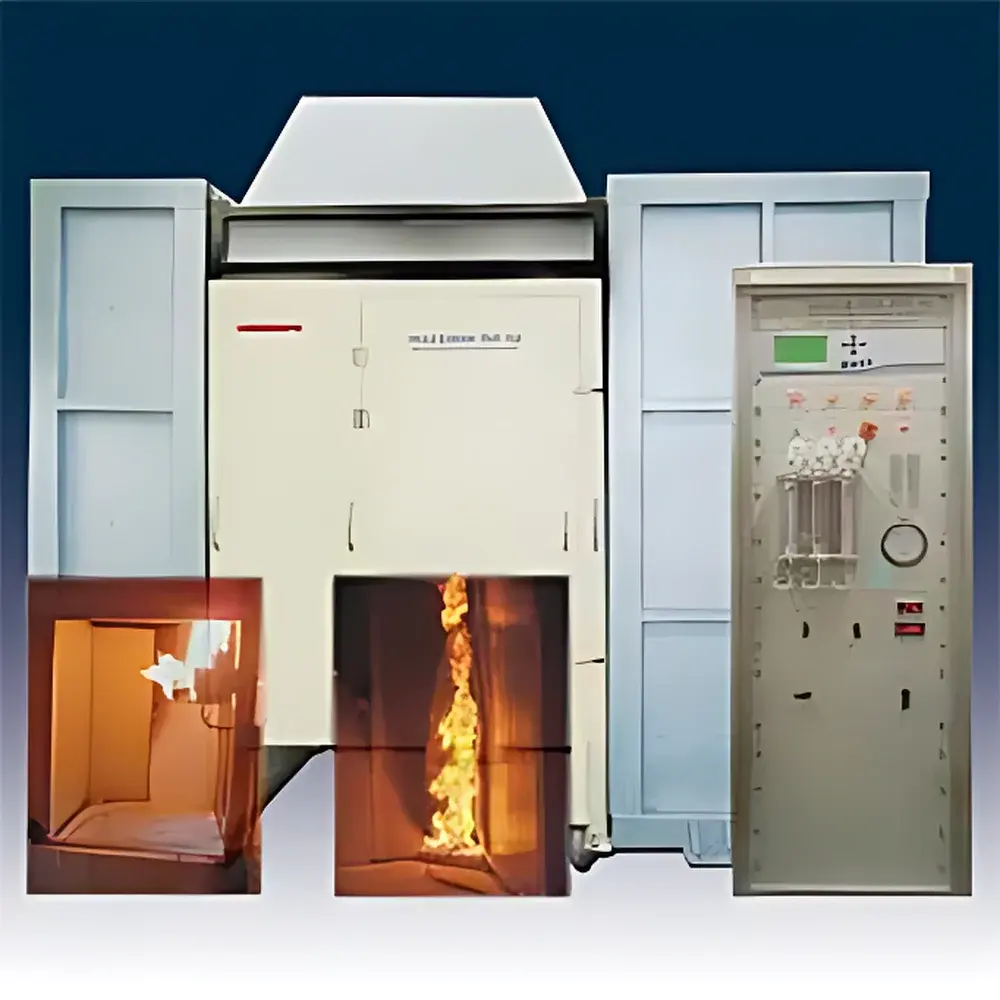
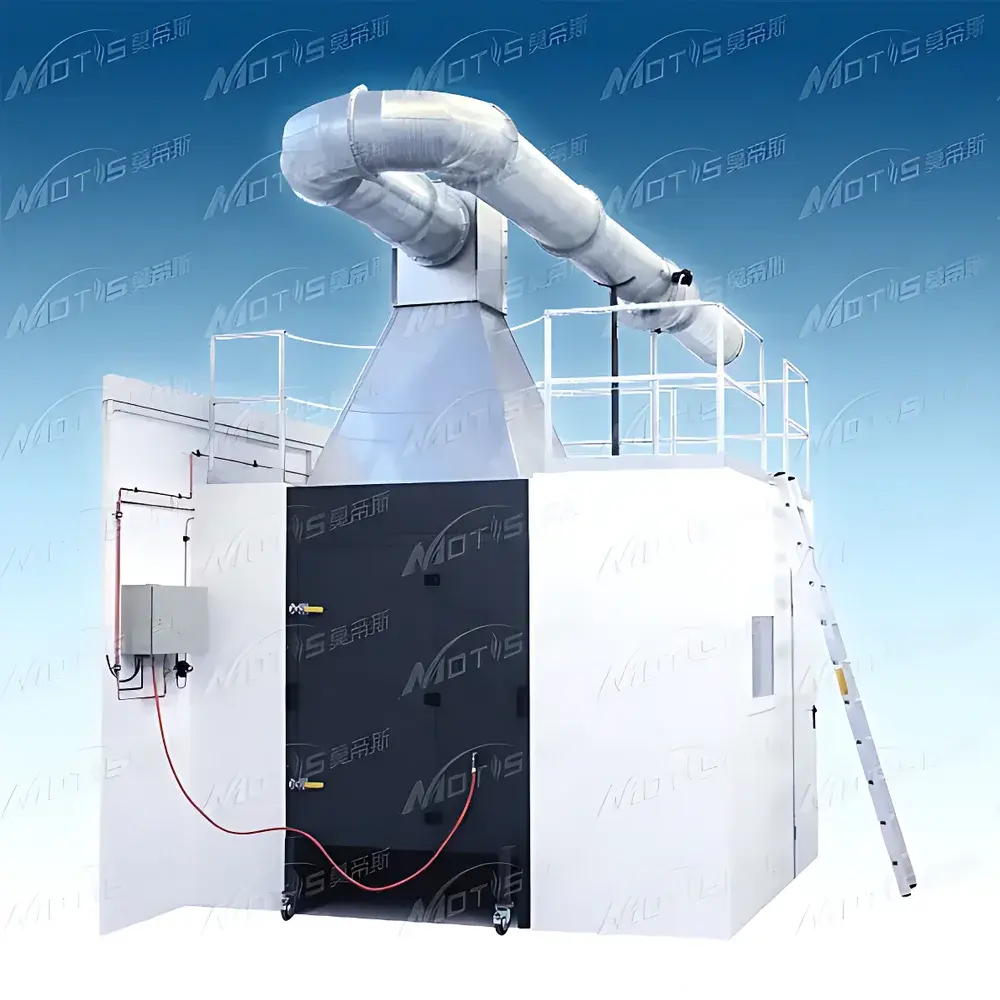
MOTIS SBI Single Burning Item Test Apparatus
| Brand | MOTIS |
|---|---|
| Model | SBI |
| Standard Compliance | EN 13823, GB/T 20284 |
| Measurement Principle | Oxygen Consumption Calorimetry & Optical Smoke Density Analysis |
| Heat Release Rate (HRR) Derivation | Via O₂ depletion in exhaust duct |
| Smoke Production Quantification | Via light extinction coefficient (k) in sampling duct |
| Flame Spread Assessment | Lateral Flame Spread (LFS) on vertical specimen wing |
| Dripping Evaluation | Visual observation and collection of molten droplets |
| Chamber Dimensions | 3 m × 3 m × 2.4 m (W × L × H) |
| Ignition Source | 31 kW propane corner burner (250 mm × 250 mm × 80 mm) |
| Sampling Zone | Integrated in exhaust duct with multi-sensor array (O₂, CO, CO₂, temperature, differential pressure, optical density) |
| Data Acquisition | Simultaneous real-time logging of thermal, gas, and flow parameters |
| Software | Dedicated SBI calibration & analysis suite compliant with EN 13823 Annex A requirements |
| Power Supply | 220 VAC ±10%, 50–60 Hz |
Overview
The MOTIS SBI Single Burning Item Test Apparatus is a fully integrated, standards-compliant fire testing system engineered for the quantitative assessment of non-loadbearing building products under intermediate-scale fire exposure. It operates on the principle of oxygen consumption calorimetry—where heat release rate (HRR) is calculated from measured oxygen depletion in the exhaust stream—and optical smoke densitometry, where smoke production is derived from light attenuation across a defined path length in the extraction duct. Designed in strict accordance with EN 13823 and GB/T 20284, the apparatus evaluates critical fire performance parameters including Fire Growth Rate (FIGRA), Total Heat Released (THR), Smoke Growth Rate (SMOGRA), Total Smoke Produced (TSP), Lateral Flame Spread (LFS), and flaming droplet formation. The test configuration simulates realistic fire development scenarios for wall and ceiling linings, insulation boards, and decorative panels, delivering data essential for Euroclass classification (B–D) and national regulatory submissions.
Key Features
- Modular combustion chamber (3 m × 3 m × 2.4 m) with refractory-lined walls and integrated ceiling hood for stable plume entrainment
- Calibrated 31 kW propane corner burner (250 mm × 250 mm × 80 mm) mounted on a precision-engineered stainless-steel trolley, enabling repeatable specimen positioning and flame impingement geometry
- Dual-sensor gas analysis subsystem: Siemens OXYMAT 61 paramagnetic oxygen analyzer (0–25% O₂, ±1% FS/week drift, <3 s response) and U23 NDIR analyzers for CO (0–1%) and CO₂ (0–10%), all with 4–20 mA analog outputs and GLP-traceable calibration protocols
- Comprehensive sampling train including PTFE-lined gas probes, chilled dew-point trap, mass flow-controlled dilution, and corrosion-resistant extraction pump
- Real-time thermocouple array (K-type) for flue gas temperature profiling, coupled with bidirectional stainless-steel Pitot-static probe and micro-differential pressure transducers for volumetric flow quantification
- Dedicated SBI control and analysis software featuring automated parameter derivation (FIGRA, THR, SMOGRA, TSP), EN 13823 Annex A validation routines, and audit-ready data export (CSV, PDF, XML)
- Full compliance with instrument uncertainty requirements per ISO/IEC 17025:2017 for accredited fire testing laboratories
Sample Compatibility & Compliance
The SBI apparatus accommodates specimens up to 1.5 m in height and 1.0 m in width, mounted vertically on the standardized trolley between two non-combustible mineral fiber boards. It supports rigid, semi-rigid, and flexible materials—including gypsum boards, mineral wool, phenolic foams, PVC wall coverings, and wood-based composites—provided they meet dimensional and mounting specifications in EN 13823 Clause 6. All measurement subsystems are validated against reference gases and NIST-traceable standards. The system satisfies metrological traceability requirements for ISO/IEC 17025 accreditation and supports full audit trails required under GLP and EU Construction Products Regulation (CPR) conformity assessment modules.
Software & Data Management
The embedded SBI software provides synchronized acquisition of >20 analog and digital channels at 10 Hz sampling resolution. It implements EN 13823-mandated algorithms for FIGRA (kW/s) and SMOGRA (m²/s) calculation, applies time-zero correction based on ignition event detection, and enforces mandatory smoothing filters per Annex A. Data files include raw sensor outputs, processed fire parameters, calibration logs, and operator annotations—all timestamped and digitally signed. Export formats comply with laboratory information management system (LIMS) ingestion requirements. The software architecture supports 21 CFR Part 11-compliant user access controls, electronic signatures, and immutable audit logs for regulated environments.
Applications
This apparatus serves as a core tool for fire safety R&D, product certification, and regulatory compliance verification in construction material manufacturing, third-party testing laboratories, and national metrology institutes. Typical use cases include pre-certification screening of façade systems prior to full-scale room corner tests, formulation optimization of flame-retardant additives in polymer composites, comparative evaluation of intumescent coatings, and technical dossier preparation for CE marking under CPR Article 9. Its output directly feeds into Euroclass declarations (e.g., B-s1,d0; C-s2,d1) and supports hazard assessment modeling in fire dynamics simulators (e.g., FDS, PyroSim).
FAQ
What fire performance parameters does the SBI test directly generate?
It derives FIGRA, THR, SMOGRA, TSP, LFS time-to-edge, and qualitative droplet behavior—all required for EN 13823 classification.
Is the system suitable for ISO 5660-1 cone calorimeter correlation studies?
While not a direct replacement, its oxygen consumption methodology aligns with ISO 5660-1 principles; cross-validation studies are supported via shared gas analysis infrastructure.
Does the system support remote diagnostics and preventive maintenance alerts?
Yes—the control software includes hardware health monitoring, sensor drift trend analysis, and automated calibration status reporting.
Can the apparatus be upgraded for particulate matter (PM) or VOC emission analysis?
The PTFE sampling train and modular gas interface allow integration of optional FTIR or GC-MS modules upon request.
What documentation is provided for ISO/IEC 17025 accreditation?
Full metrological validation reports, uncertainty budgets per parameter, traceable calibration certificates, and SOP templates aligned with ILAC-P15 requirements are included.



