
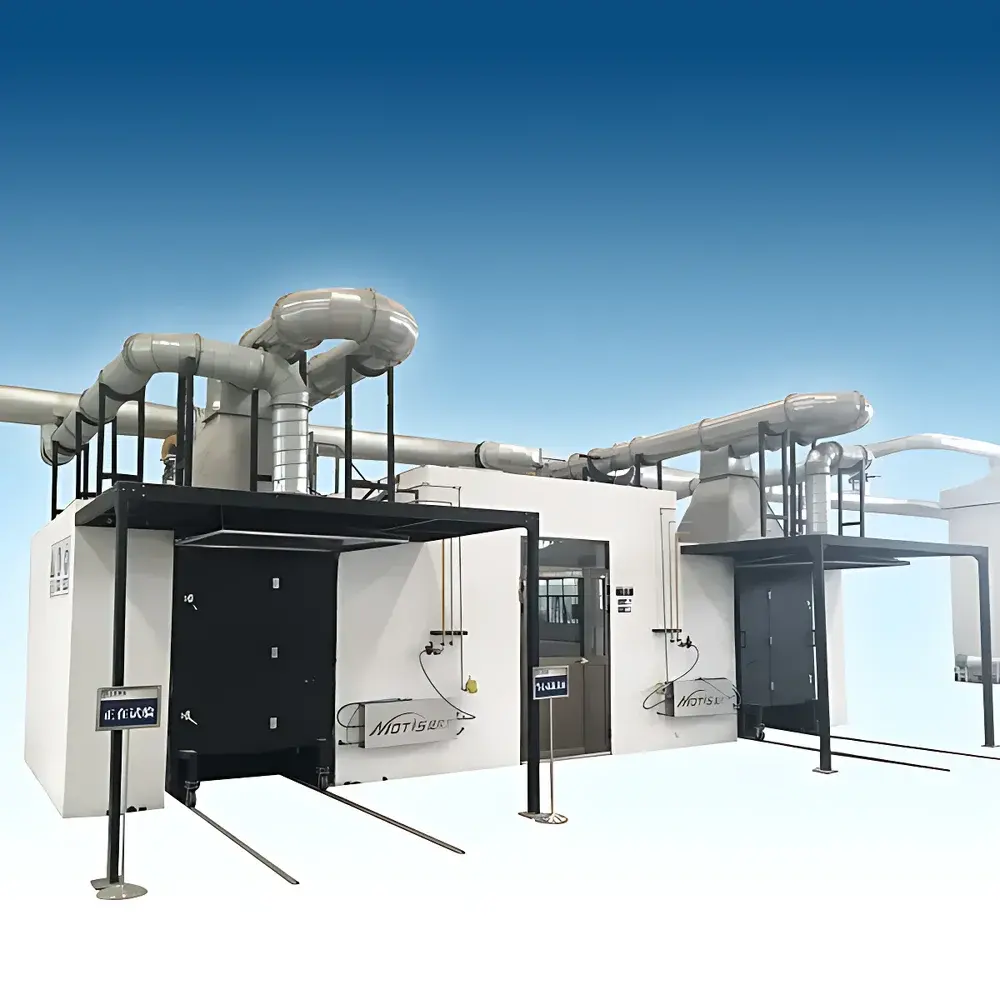
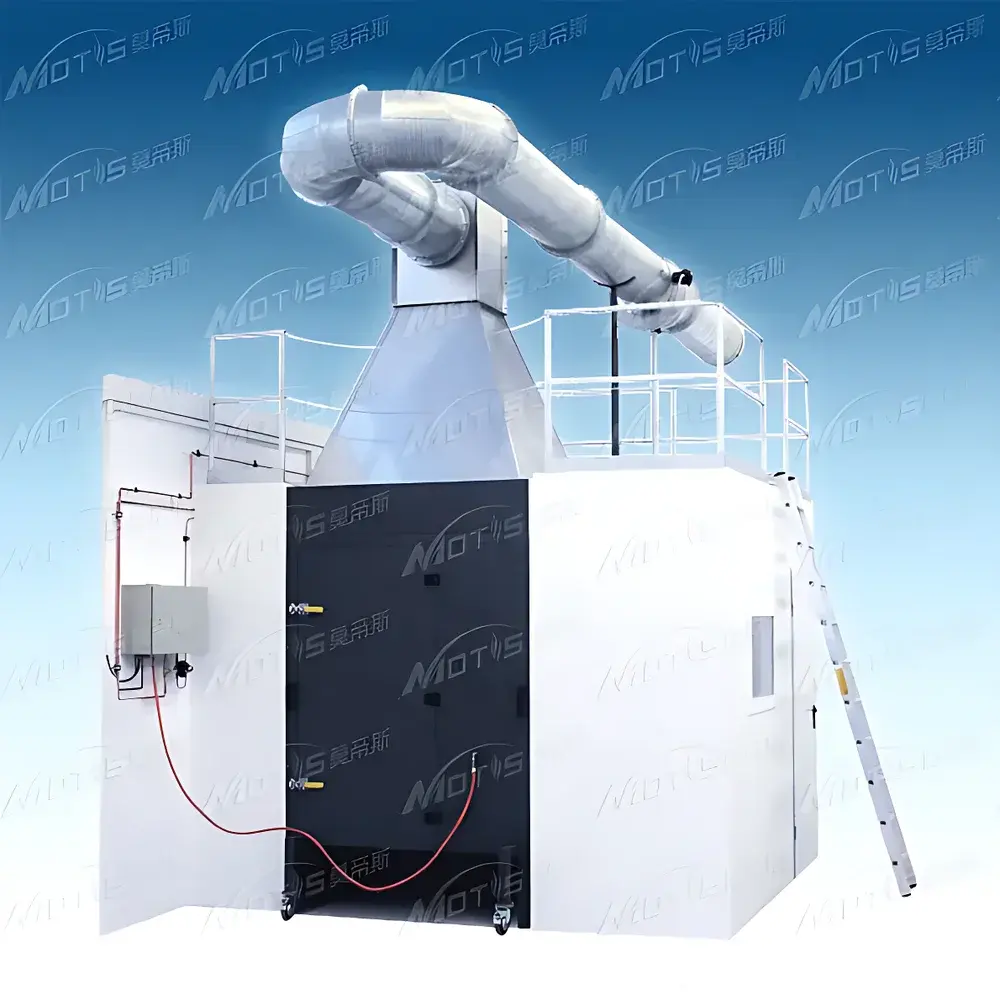
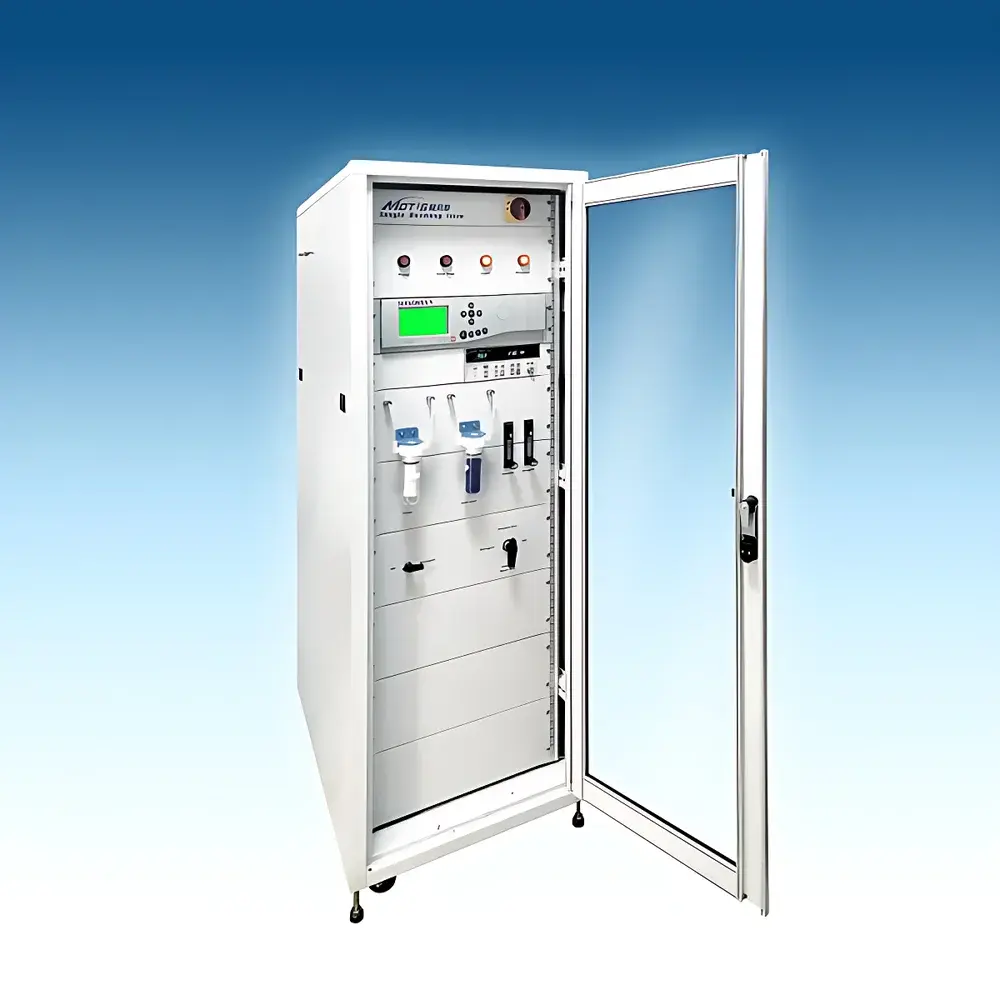
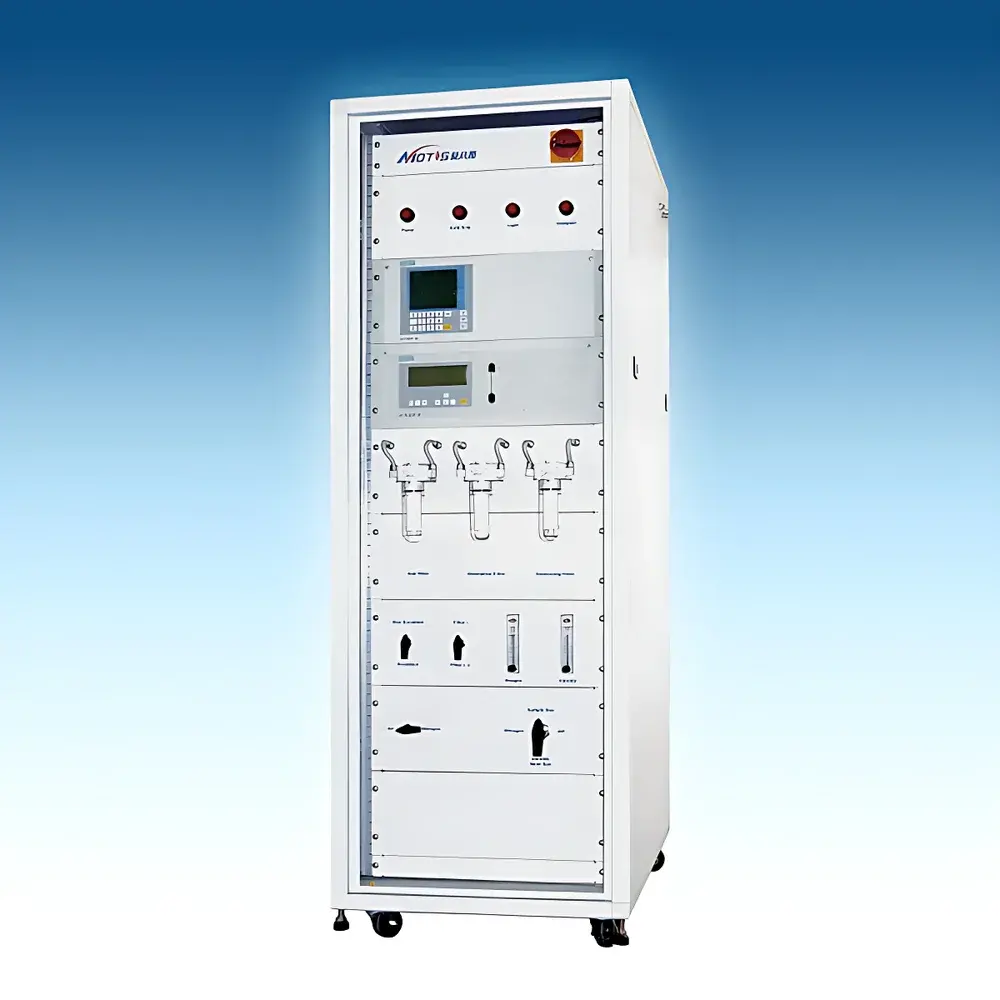
MOTIS SBI Single Burning Item Test Apparatus
| Brand | MOTIS |
|---|---|
| Origin | Jiangsu, China |
| Model | SBI |
| Compliance | EN 13823, GB/T 20284 |
| Exhaust Flow Rate | 0.50–0.65 m³/s at 298 K |
| Propane Burner Output | 30.7 ± 2 kW |
| Optical Path Diameter | ≥20 mm |
| Smoke Measurement Resolution | ≤0.1% linear stability |
| O₂ Analyzer | Paramagnetic, 16–21% (v/v), response time ≤12 s, drift ≤100 × 10⁻⁶ (30 min) |
| CO₂ Analyzer | NDIR, 0–10% (v/v), linearity ≥1% FS, response time ≤12 s |
| Thermocouples | Three 0.5 mm sheathed K-type (GB/T 16839.1), spaced at 120° on arc radius (87 ± 5) mm |
| Pressure Sensor | 0–100 Pa, accuracy ±2 Pa, 90% response time ≤1 s |
| Light Attenuation System | Incandescent source at (2900 ± 100) K, DC power stability ±0.5%, 90% response time ≤3 s |
| Data Acquisition Interval | 3 s |
Overview
The MOTIS SBI Single Burning Item Test Apparatus is a rigorously engineered fire testing system designed to quantify the reaction-to-fire performance of building products under controlled, reproducible conditions. It operates in accordance with the internationally recognized standard EN 13823 and its national adoption GB/T 20284. The apparatus employs the cone calorimetry principle adapted for large-scale specimen evaluation: combustion gases generated from a defined propane-fired flame impinging on a vertically mounted test specimen are fully captured, conditioned, and analyzed in real time. Heat release rate (HRR), total heat release (THR), smoke production rate (SPR), total smoke production (TSP), lateral flame spread (LFS), and flaming droplet formation are derived from continuous, synchronized measurements of oxygen depletion, carbon dioxide generation, optical density (via white-light attenuation), gas temperature, and volumetric exhaust flow. Unlike simplified or non-calibrated systems, the MOTIS SBI implements mandatory staircase calibration per EN 13823 Annex B and heptane calibration per Annex C to ensure traceable thermal output fidelity—critical for regulatory acceptance and inter-laboratory comparability.
Key Features
- Full-enclosure combustion chamber (3 m × 3 m × 2.4 m) with SUS304 stainless steel construction and integrated fire-rated insulation.
- Dual-propane burner configuration: primary corner-mounted 31 kW sand-box burner (250 mm × 250 mm × 80 mm) and auxiliary frame-mounted burner, both equipped with UV flame detection for fail-safe ignition monitoring and automatic shutdown.
- J-shaped exhaust ducting (Ø315 ± 5 mm) with 50 mm mineral wool insulation, incorporating precision-engineered flow conditioning elements—including a 630 mm aerodynamic vane guide and a calibrated orifice plate (ID 265 mm, OD 314 mm, thickness 2.0 ± 0.5 mm) to stabilize velocity profile and ensure laminar sampling conditions.
- Integrated multi-parameter measurement section (2155 mm length) housing three OMEGA K-type thermocouples (0.5 mm sheath, GB/T 16839.1 compliant), a bidirectional pressure probe, gas sampling ports, and a white-light attenuation system meeting CIE V(λ) spectral responsivity (±5% tolerance).
- High-fidelity gas analysis suite: UK Servomex 4100 paramagnetic O₂ analyzer (16–21% v/v, resolution 100 × 10⁻⁶) and IR-based CO₂ analyzer (0–10% v/v, linearity ≥1% FS), both with ≤12 s response time and validated drift/noise performance per EN 13823 requirements.
- Automated propane mass flow control (647–2000 mg/s) via imported mass flow controllers (accuracy ±1.5% FS), ensuring stable thermal output (30.7 ± 2 kW) with ≤5 mg/s fluctuation during test execution.
- Robust data acquisition system logging all critical parameters at 3-second intervals, supporting full audit trails, timestamped metadata, and export in CSV/Excel-compatible formats for GLP-compliant reporting.
Sample Compatibility & Compliance
The SBI apparatus accommodates specimens up to 1.5 m in height and 1.0 m in width, mounted orthogonally on a motorized trolley within a fixed steel frame. Specimen mounting geometry, boundary conditions (e.g., non-combustible backing board, shielding plate dimensions 370 ± 5 mm × 550 ± 5 mm), and environmental constraints (ambient temperature 20–25 °C, relative humidity ≤70%) strictly adhere to EN 13823 Clause 6. All mechanical, thermal, and optical subsystems undergo periodic verification against reference materials (e.g., heptane calibration yielding THR/m = 4456 ± 222.8 MJ/kg and TSP/m = 125 ± 25 m²/kg) to maintain metrological traceability. The system supports full compliance documentation packages required for CE marking, CPR classification (A1–F), and third-party certification audits (e.g., notified body assessments under EU Construction Products Regulation).
Software & Data Management
The embedded control and analysis software provides role-based access, electronic signature support, and 21 CFR Part 11–compliant audit trail functionality—including user action logging, parameter change history, and immutable test record archiving. Calibration workflows are structured into discrete modules: O₂/CO₂ analyzer zero/span and drift validation; optical system noise/drift and filter characterization; volumetric flow verification via orifice plate calibration; staircase thermal output validation (including qgas/HRR ratio stability checks over 40–160 s windows); and heptane reference burn execution. All calibrations generate PDF-formatted reports with pass/fail status, uncertainty estimates, and technician signatures. Raw data files retain native timestamping, sensor ID tagging, and engineering unit metadata—enabling seamless import into LIMS or statistical process control platforms.
Applications
The MOTIS SBI is deployed by fire testing laboratories, material R&D centers, and regulatory bodies to evaluate surface products (e.g., wall claddings, ceiling tiles, insulation boards) for classification under the European Classification System (CPR). It delivers the foundational metrics required for determining Euroclass ratings: FIGRA (Fire Growth Rate Index), THR600s, SMOGRA (Smoke Growth Rate Index), TSP600s, LFS (Lateral Flame Spread), and flaming droplet behavior. Its design enables direct correlation with small-scale tests (e.g., ISO 5660-1 cone calorimeter) and supports development of fire modeling inputs (e.g., HRR curves for CFD simulations in FDS or PyroSim). The apparatus is routinely used in pre-certification screening, quality assurance of production batches, and forensic fire investigation support.
FAQ
Does the SBI system perform mandatory staircase calibration per EN 13823?
Yes—staircase calibration is fully automated and integrated into the software workflow, verifying thermal output fidelity across five discrete power steps with strict criteria on O₂/CO₂ analyzer lag, burner switching latency (<12 s), and HRR stability (±5% over 30 s intervals).
What gas analysis technology is used for O₂ and CO₂ measurement?
O₂ is measured using a paramagnetic sensor (Servomex 4100); CO₂ is measured via non-dispersive infrared (NDIR) detection—both certified to EN 13823 Annex D specifications for sensitivity, linearity, and dynamic response.
Is the optical smoke measurement system compliant with CIE photopic luminosity function V(λ)?
Yes—the silicon photodiode detector and optical train are calibrated to match the CIE V(λ) curve within ±5%, ensuring metrologically valid optical density (OD) values directly traceable to international lighting standards.
Can the system generate CPR-compliant test reports automatically?
Yes—final reports include all required EN 13823 Annex E tables, graphical HRR/SPR curves, annotated LFS progression images, and digital signatures, exportable as PDF/A-1b for archival compliance.
What maintenance intervals are recommended for critical components?
Gas analyzers require biannual zero/span calibration; the optical system demands quarterly cleaning and annual photometric recalibration; thermocouples and pressure sensors are verified annually per ISO/IEC 17025 internal calibration procedures.



