
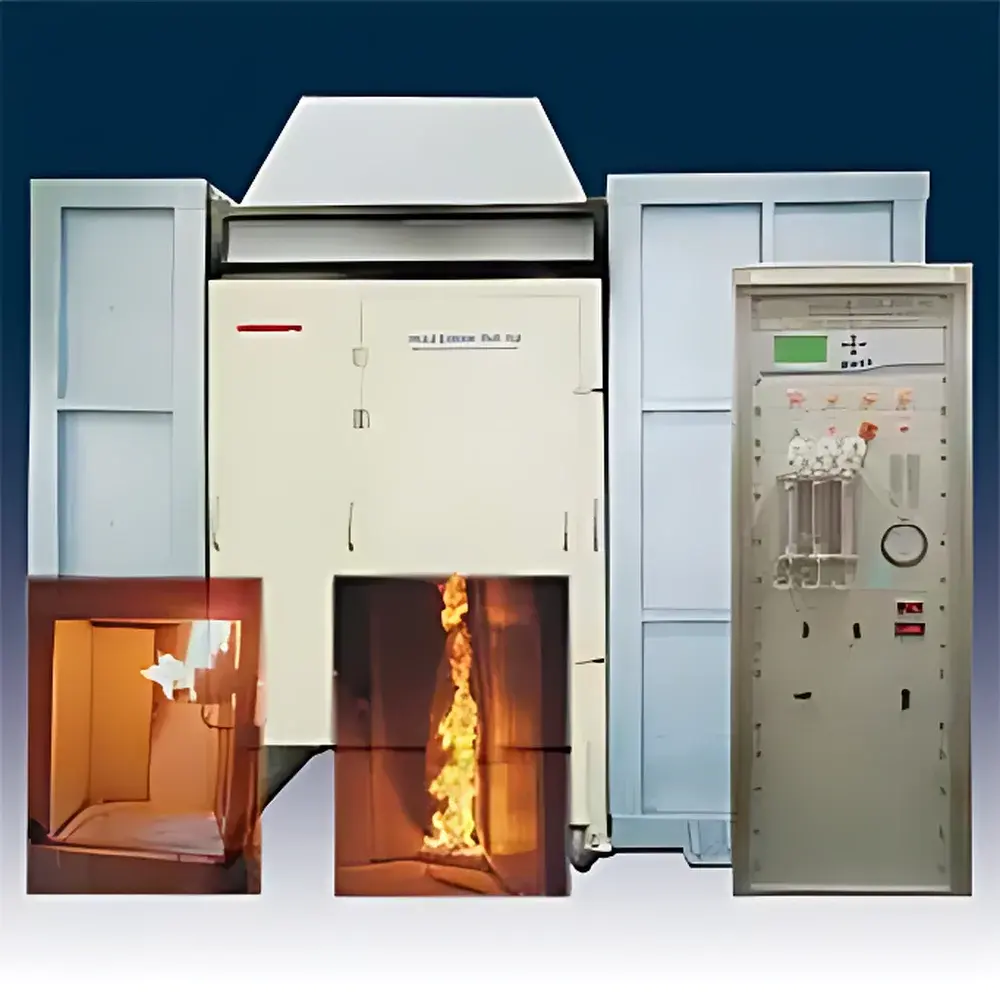
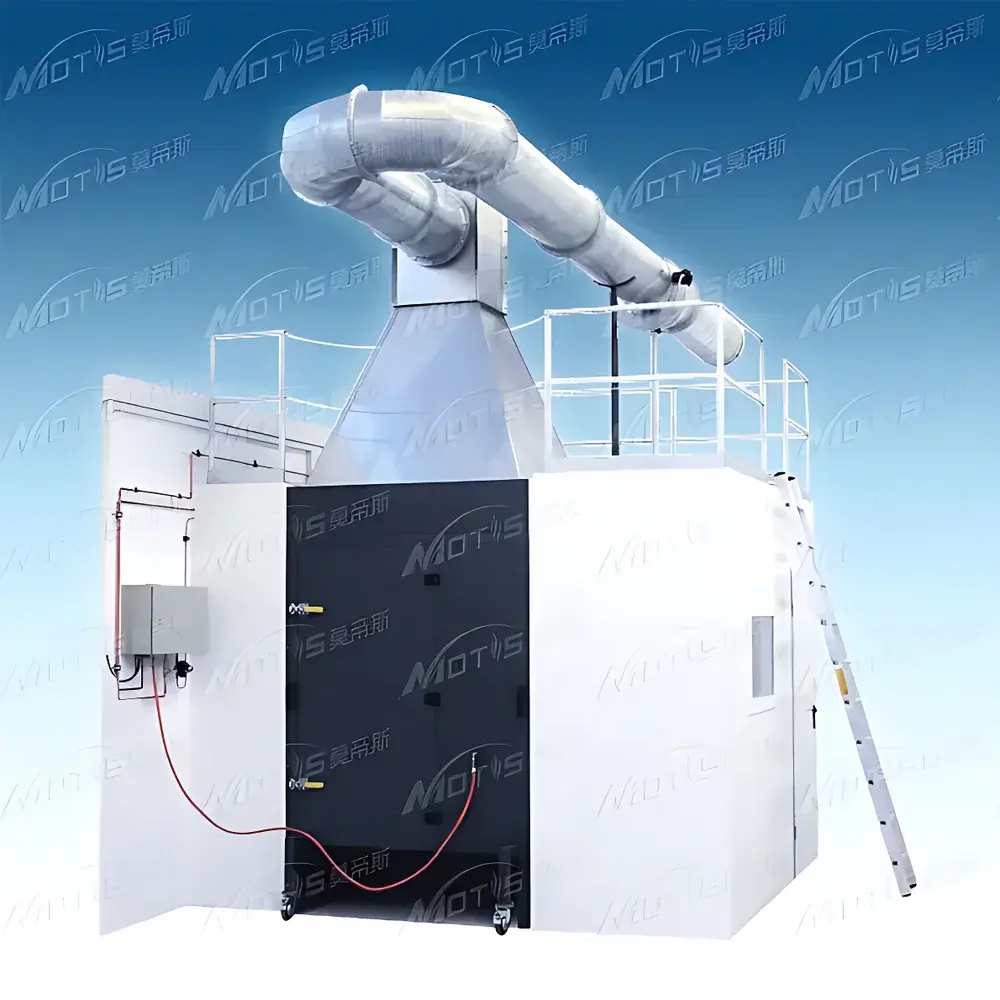
MOTIS SBI Single Burning Item Test Apparatus
| Brand | MOTIS |
|---|---|
| Origin | Jiangsu, China |
| Model | SBI |
| Compliance | EN 13823, GB/T 20284 |
| Measurement Principle | Oxygen depletion calorimetry + optical smoke density analysis + flame spread observation |
| Key Outputs | FIGRA, THR, SMOGRA, TSP, LFS, droplet formation assessment |
| Core Subsystems | Siemens-based gas analysis cabinet (O₂, CO, CO₂), data acquisition system, calibrated propane corner burner (31 kW), 3 m × 3 m × 2.4 m fire test chamber with conical hood and sampling duct |
Overview
The MOTIS SBI Single Burning Item Test Apparatus is a fully integrated, standards-compliant fire testing system engineered for the quantitative assessment of non-load-bearing building products under realistic intermediate-scale fire exposure conditions. It operates on the principle of oxygen depletion calorimetry—measuring the fractional reduction in oxygen concentration within the exhaust stream to calculate heat release rate (HRR) with high reproducibility—and combined optical attenuation measurement for smoke production quantification. Designed in strict accordance with EN 13823 and its national adoption GB/T 20284, the apparatus subjects vertically mounted specimens (up to 1.5 m height × 1.0 m width) to a controlled 31 kW propane corner burner positioned at the base of the sample assembly. The test chamber—a thermally stable, insulated enclosure measuring 3.0 m (L) × 3.0 m (W) × 2.4 m (H)—features a conical exhaust hood connected to a dedicated sampling duct where real-time gas composition, temperature, mass flow, and optical density are continuously monitored. This configuration enables derivation of critical fire performance indices including Fire Growth Rate (FIGRA), Total Heat Release (THR), Smoke Growth Rate (SMOGRA), Total Smoke Production (TSP), Lateral Flame Spread (LFS), and qualitative evaluation of flaming droplets and particle shedding.
Key Features
- Calibrated 31 kW propane corner burner with precisely dimensioned sand-filled rectangular combustion head (250 mm × 250 mm × 80 mm), mounted at the lower vertical corner of the specimen support trolley
- Modular Siemens analytical instrumentation cabinet housing OXYMAT 61 paramagnetic oxygen analyzer (0–25% O₂, ±1% FS weekly drift, <3 s response time) and U23 NDIR analyzers for CO (0–1%) and CO₂ (0–10%)
- Dual-channel data acquisition system with synchronized sampling of thermocouple signals (K-type, up to 1200 °C), differential pressure transducers, gas concentration outputs, and optical density (via laser photometer)
- Stainless steel bi-directional Pitot-static probe paired with micro-differential pressure sensor for accurate volumetric flow determination in the exhaust duct
- Corrosion-resistant PTFE-lined gas sampling train including cold trap dehumidifier, flow stabilization module, peristaltic sampling pump, and back-pressure regulation
- Mass flow controller (MFC)-based fuel supply system with integrated pressure-reducing valve, flashback arrestor, and redundant safety interlocks
- Standardized stainless-steel test trolley with dual non-combustible backing plates (perpendicular orientation) and adjustable specimen mounting fixtures
Sample Compatibility & Compliance
The SBI apparatus accommodates rigid and semi-rigid flat-panel building materials—including insulation boards, decorative wall claddings, ceiling tiles, and floor coverings—mounted as single-layer or multi-layer assemblies per EN 13823 Annex A. Specimens are conditioned at 23 ± 2 °C and 50 ± 5% RH for ≥48 h prior to testing. All measurement subsystems comply with metrological traceability requirements outlined in ISO/IEC 17025:2017. The system supports full audit trail generation and electronic signature capability in alignment with GLP and GMP documentation practices. Data output formats are compatible with third-party fire modeling tools (e.g., FDS, CFAST) and satisfy reporting requirements for CE marking documentation under EU Construction Products Regulation (CPR) Annex ZA.
Software & Data Management
The embedded Windows-based control and analysis software provides real-time visualization of all measured parameters—including HRR, smoke obscuration (m⁻¹), O₂ depletion (%), CO/CO₂ concentrations, gas temperature, and mass flow—with configurable alarm thresholds and automatic event tagging. Calibration routines follow EN 13823 Section 7.3 protocols, including zero/span verification for gas analyzers and thermocouple validation using reference junctions. Raw data is stored in binary format with timestamped metadata (ISO 8601), exportable to CSV or XML for external statistical analysis. Audit logs record operator actions, calibration events, system errors, and parameter modifications—fully compliant with FDA 21 CFR Part 11 requirements when configured with user authentication and electronic signature modules.
Applications
- Classification of construction products into Euroclass categories (A1, A2, B, C, D, E) per EN 13501-1
- Development and validation of fire-retardant formulations for polymer composites and fiber-reinforced panels
- Comparative assessment of surface flame spread behavior across material thicknesses, densities, and substrate configurations
- Generation of input data for fire safety engineering simulations and compartment fire modeling
- Supporting technical documentation for regulatory submissions to notified bodies (e.g., UKCA, CE, CCC)
- Research into pyrolysis kinetics and smoke toxicity precursor evolution under controlled ventilation conditions
FAQ
What standards does the MOTIS SBI system fully comply with?
EN 13823:2010+A1:2014 and GB/T 20284–2006, including all mandatory annexes related to burner calibration, gas analysis accuracy, and data reporting structure.
Is the system suitable for testing composite or multi-layer specimens?
Yes—specimens may consist of bonded layers (e.g., core + facing), provided total thickness does not exceed 200 mm and installation follows Annex A of EN 13823.
Can the apparatus be integrated into an existing fire test laboratory infrastructure?
The system is delivered as a modular unit; exhaust ducting, electrical supply (220 VAC ±10%, 50–60 Hz), compressed air (for burner ignition), and structural anchoring must be provided by the end user per IEC 60079-10-1 zoning guidelines.
What maintenance intervals are recommended for gas analyzers?
Oxygen and infrared analyzers require quarterly zero/span verification using certified calibration gases; annual full metrological recalibration is advised per ISO/IEC 17025.
Does the software support automated report generation in English and other languages?
The base software generates reports in English conforming to EN 13823 Annex B; localized templates (e.g., German, French, Spanish) are available as optional licensed modules.



