
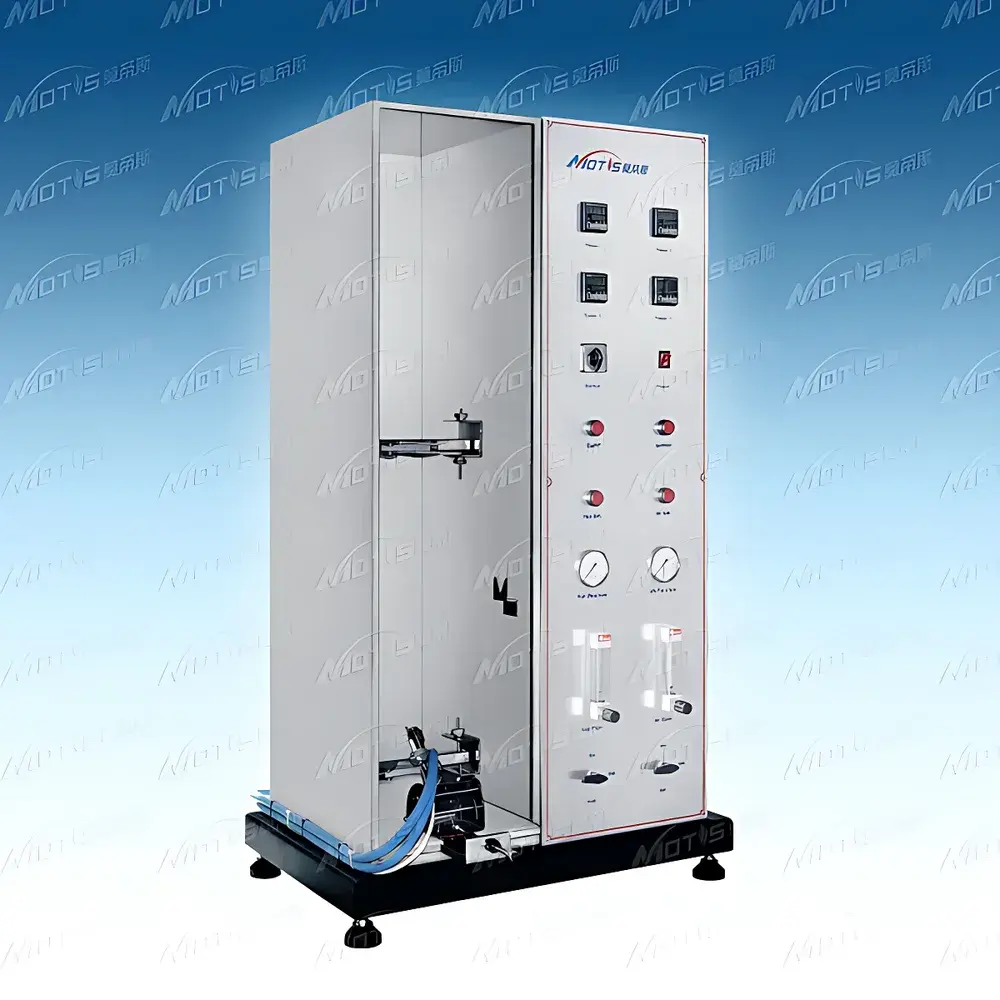
MOTIS SCV Single-Vertical-Wire Combustion Test Chamber
| Brand | MOTIS |
|---|---|
| Origin | Shanghai, China |
| Model | SCV |
| Chamber Dimensions (H×W×D) | 1300 mm × 300 mm × 450 mm |
| Sample Mounting | Dual stainless-steel support rods |
| Burner | 1 kW premixed gas burner (propane/air) |
| Gas Control System | Pressure gauge, pressure-reducing valve, rotameter, shut-off ball valve, and check valve |
| Compliance | IEC 60332-1-1, IEC 60332-1-2, IEC 60332-1-3, EN 50086-1:1994, GB/T 18380.11–2022, GB/T 18380.12–2022 |
Overview
The MOTIS SCV Single-Vertical-Wire Combustion Test Chamber is a precision-engineered apparatus designed to evaluate the vertical flame propagation behavior of single insulated wires, cables, and optical fiber cables under controlled laboratory conditions. It operates in strict accordance with the fundamental principles of vertical flame testing—where a defined flame source is applied to the lower end of a vertically oriented specimen for a specified duration, and the extent of flame spread, char length, and presence of flaming droplets are quantitatively assessed. This test method is rooted in the physics of flame front propagation along polymer insulation materials and reflects real-world fire initiation risks in low-energy, confined cable routing environments such as building risers, control panels, and data centers. The SCV chamber’s robust stainless-steel construction ensures dimensional stability, thermal integrity, and long-term repeatability across thousands of test cycles.
Key Features
- Monolithic 304 stainless-steel test chamber with internal dimensions of 1300 mm (height) × 300 mm (width) × 450 mm (depth), engineered for uniform thermal distribution and zero deformation during repeated exposure to 1 kW flame loads.
- Dual adjustable stainless-steel mounting rods enable secure vertical alignment of single-core specimens up to 600 mm in exposed length, accommodating round cables, flat cables, and jacketed optical fibers per IEC 60332-1 series requirements.
- Premixed 1 kW gas burner utilizing propane/air mixture at stoichiometric ratio, delivering consistent heat flux profile and flame geometry compliant with Annex A of IEC 60332-1-2.
- Integrated gas control panel featuring calibrated pressure gauge (0–1 MPa range), precision pressure-reducing valve, glass-tube rotameter (0–10 L/min air flow, ±2% full-scale accuracy), and fail-safe shut-off ball valve—all mounted on a dedicated stainless-steel subframe.
- Redundant safety architecture including an inline gas check valve to prevent backflow ignition, flame arrestor integration in gas supply lines, and non-ignitable chamber interior surfaces meeting UL 94 V-0 equivalency.
Sample Compatibility & Compliance
The SCV chamber supports standardized test specimens conforming to IEC 60332-1-1 (procedure for single-wire evaluation), IEC 60332-1-2 (flame spread measurement protocol), and IEC 60332-1-3 (dripping combustion assessment). It accommodates insulated conductors with outer diameters from 0.5 mm to 25 mm, including PVC, PE, LSZH, FEP, and cross-linked polyolefin sheaths. All mechanical fixtures—including clamps, holders, and positioning guides—are fabricated from non-combustible, thermally stable alloys to eliminate interference with flame dynamics. The system fully satisfies national and international regulatory frameworks: EN 50086-1:1994 (conduit systems), GB/T 18380.11–2022 and GB/T 18380.12–2022 (Chinese national standards aligned with IEC 60332-1), and is routinely validated during third-party GLP audits for cable type approval laboratories.
Software & Data Management
While the SCV is a manually operated, hardware-dominant test platform, it includes structured documentation workflows compatible with ISO/IEC 17025-accredited quality management systems. Test logs—comprising specimen ID, ambient temperature/humidity, gas pressure/flow readings, flame application time, post-test char length measurement, and dripping observation notes—are recorded on preformatted paper templates or imported into LIMS via CSV export from optional digital timer modules (e.g., MOTIS-TM100 with RS-232 interface). All calibration records for pressure gauges, rotameters, and thermocouples are traceable to CNAS-certified metrology labs. For laboratories operating under FDA 21 CFR Part 11 or EU Annex 11 requirements, the SCV may be integrated into electronic batch record systems via external PLC-controlled ignition sequencing modules (sold separately).
Applications
The SCV chamber serves as a core verification tool in wire and cable manufacturing QA/QC labs, third-party certification bodies (e.g., SGS, TÜV Rheinland, CQC), and R&D facilities developing flame-retardant polymer compounds. Typical use cases include: qualification of new insulation formulations against flame-spread thresholds; comparative evaluation of halogen-free versus halogenated compounds under identical thermal load; root-cause analysis of dripping failures in LSZH cables; validation of cable marking durability after flame exposure; and supporting technical documentation for CE marking, CCC certification, and UL file submissions. Its design enables direct correlation with fire modeling inputs used in compartment fire simulations (e.g., CFAST, FDS).
FAQ
What standards does the SCV chamber directly support?
IEC 60332-1-1, IEC 60332-1-2, IEC 60332-1-3, EN 50086-1:1994, GB/T 18380.11–2022, and GB/T 18380.12–2022.
Is the burner certified to deliver a reproducible 1 kW heat output?
Yes—the burner assembly is factory-calibrated using NIST-traceable thermal flux mapping and verified annually per ISO/IEC 17025 clause 6.5.2.
Can the SCV be upgraded for automated data capture?
Yes—optional accessories include digital timing modules, thermocouple arrays (Type K, 0–1000 °C), and flame detection sensors compatible with LabVIEW or custom SCADA integration.
Does the chamber require external ventilation or fume extraction?
Yes—operation mandates connection to a dedicated exhaust duct system with ≥0.5 m/s face velocity at the chamber aperture, per NFPA 90A and local industrial hygiene regulations.
What maintenance intervals are recommended for gas system components?
Rotameter calibration every 6 months; pressure gauge verification annually; burner nozzle inspection and cleaning after every 50 test cycles.



