
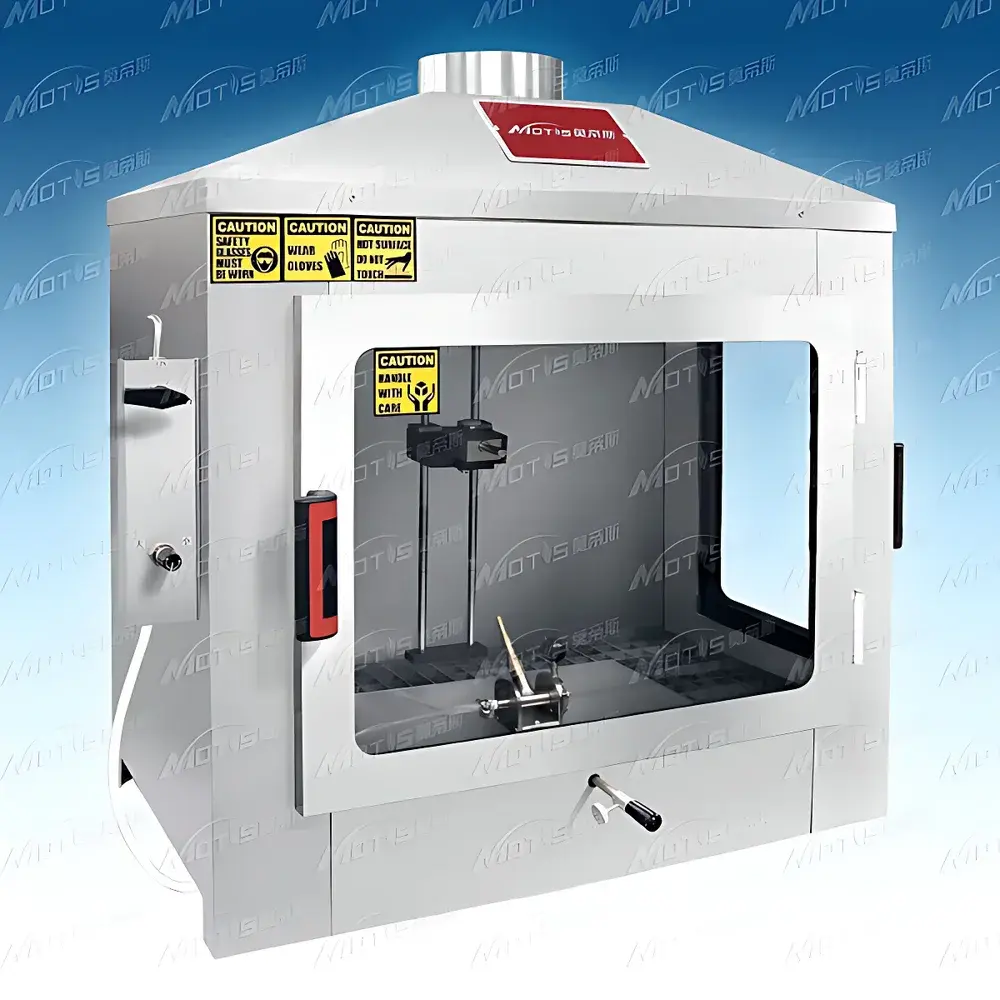
MOTIS SIT Building Material Ignitability Test Furnace
| Brand | MOTIS |
|---|---|
| Origin | Jiangsu, China |
| Manufacturer Type | Authorized Distributor |
| Country of Origin | China |
| Model | SIT |
| Pricing | Available Upon Request |
| Compliance | EN ISO 11925-2, DIN 53438, GB/T 8626 |
| Chamber Material | SUS304 Stainless Steel |
| Viewing Windows | Dual Tempered Glass Doors |
| Flame Orientation | Adjustable (Vertical or 45°) |
| Flame Height Control | Rotameter with Calibration Gauge |
| Sample Holder | Dual-Mode (Vertical/Horizontal Translation + 90° Rotation) |
| Sample Fixtures | Standard & Wide Stainless Steel Clamps |
| Ignition Position Options | Center-Line (40 mm above bottom edge) / Edge-Ignition (depth-dependent per thickness) |
| Optional Accessories | 0–10 m/s Anemometer, 0.2 s Resolution Timer |
Overview
The MOTIS SIT Building Material Ignitability Test Furnace is a precision-engineered combustion test apparatus designed to evaluate the surface flammability behavior of construction products under controlled small-flame ignition conditions. It operates in accordance with the fundamental principle of direct flame impingement—where a defined propane or butane flame is applied to a conditioned specimen for a standardized duration (typically 15 or 30 seconds), and the resulting ignition response (flame spread, afterflame time, afterglow time, and char depth) is observed and recorded. This method is rooted in the cone calorimeter–informed fire physics framework but implemented in a simplified, deterministic configuration suitable for classification testing rather than heat release quantification. The furnace supports both center-line and edge-ignition protocols as mandated by EN ISO 11925-2, enabling evaluation across multiple Euroclass categories (B–E, Bf1–Ef1, BL–EL) and national classifications (e.g., GB/T 8626 for Chinese building materials). Its robust thermal enclosure, calibrated flame delivery system, and mechanically repeatable sample positioning ensure high inter-laboratory reproducibility—critical for regulatory submissions and third-party certification.
Key Features
- Chamber constructed entirely from SUS304 stainless steel for long-term corrosion resistance, thermal stability, and compliance with clean-room-compatible laboratory environments.
- Dual tempered glass observation doors provide unobstructed, distortion-free visual monitoring of flame propagation without compromising thermal containment integrity.
- Multi-axis sample holder mechanism: vertically adjustable via handwheel-driven lead screw; horizontally translatable via mechanical linkage; and rotatable ±90° to accommodate both horizontal and vertical specimen orientations required by EN ISO 11925-2 Annex A and B.
- Flame source assembly supports two fixed angular configurations—0° (vertical) and 45°—manually selected prior to test initiation to match standard-specified ignition geometry.
- Precise flame height regulation via calibrated rotameter, supplemented by a dedicated flame height measurement gauge traceable to NIST-traceable dimensional standards.
- Included dual clamp set: standard-width clamp for specimens ≤250 mm wide, and wide-format clamp for oversized panels up to 300 mm—both fabricated from non-combustible, low-thermal-conductivity stainless steel.
- Integrated mounting interface for optional accessories, including Class II anemometers (0–10 m/s range) to verify ambient air velocity compliance (<0.2 m/s at specimen surface per EN ISO 11925-2 Clause 6.2) and high-resolution digital timers (0.2 s resolution) for accurate afterflame/afterglow timing.
Sample Compatibility & Compliance
The SIT furnace accommodates flat, rigid, or semi-rigid construction materials—including gypsum board, fiber-cement panels, wood-based composites, polymer-coated metals, insulation foams, and decorative laminates—within dimensional limits of 250 × 90 mm (standard) or 300 × 90 mm (wide clamp mode). Specimen thickness ranges from 1 mm to ≥10 mm, with protocol-specific ignition point placement: (i) center-line ignition at 40 mm above the lower edge for general surface evaluation; (ii) edge ignition at the bottom-center (≤3 mm thick), 1.5 mm below surface (3–10 mm), or layered-edge assessment (≥10 mm multilayer assemblies). All operational parameters align with EN ISO 11925-2:2010+A1:2015 (Fire tests — Ignitability of building products using a small flame), DIN 53438-2 (Flammability testing of plastics), and GB/T 8626–2007 (Test method for ignitability of building materials). The system design inherently supports GLP-compliant documentation workflows when paired with validated data acquisition modules.
Software & Data Management
While the SIT furnace operates as a manually controlled, hardware-centric test platform, its architecture includes standardized I/O ports (RS-232, analog voltage output) for integration with external PC-based data logging systems. When deployed in regulated environments, users may configure compliant software solutions—such as LabVIEW-based custom applications or validated LIMS interfaces—to capture timestamped event markers (ignition start/end, flame extinction, glow cessation), ambient temperature/humidity readings, and anemometer outputs. Full audit trail capability, electronic signature support, and 21 CFR Part 11–compliant user access control can be achieved through third-party middleware aligned with ISO/IEC 17025 and EN 14350–1 requirements. No proprietary firmware or closed-source software is embedded—ensuring full transparency and long-term maintainability.
Applications
- Classification testing of wall linings, ceiling tiles, and façade cladding per Euroclass B–D ratings.
- Verification of flame-retardant treatment efficacy on wood derivatives and textile composites.
- Pre-certification screening for CE marking under Construction Products Regulation (CPR) Annex ZA.
- Quality assurance testing in manufacturing QA/QC labs for insulation boards and sandwich panels.
- Research into ignition thresholds of novel bio-based construction materials under standardized thermal insult.
- Technical support for fire safety engineering reports submitted to local building authorities or notified bodies (e.g., UL, BRE, VdS).
FAQ
What flame fuel gas is recommended for EN ISO 11925-2 testing?
Propane is the default fuel specified in EN ISO 11925-2; butane may be used if explicitly permitted by the referencing product standard and documented in the lab’s scope of accreditation.
Is calibration of the rotameter traceable to national standards?
Yes—the supplied rotameter is factory-calibrated against certified gas flow standards; users must perform annual verification using a NIST-traceable thermal mass flow meter per ISO/IEC 17025 Clause 6.5.
Can the SIT furnace be used for testing textiles or floor coverings?
No—this instrument is specifically designed for rigid or semi-rigid building products. Textiles and flooring require distinct test configurations (e.g., ISO 6925, EN ISO 6926) and are outside the validated operating envelope.
Does the system include flame failure detection or automatic shutdown?
Not as standard; however, optional flame supervision modules (UV/IR sensors with relay outputs) can be retrofitted to meet local electrical safety codes (e.g., IEC 61000-6-4, EN 61000-6-2).
Are test report templates provided with the instrument?
A generic test record template compliant with EN ISO 11925-2 Annex C is included in the user manual; laboratories must adapt it to their internal document control procedures and accreditation requirements.



