
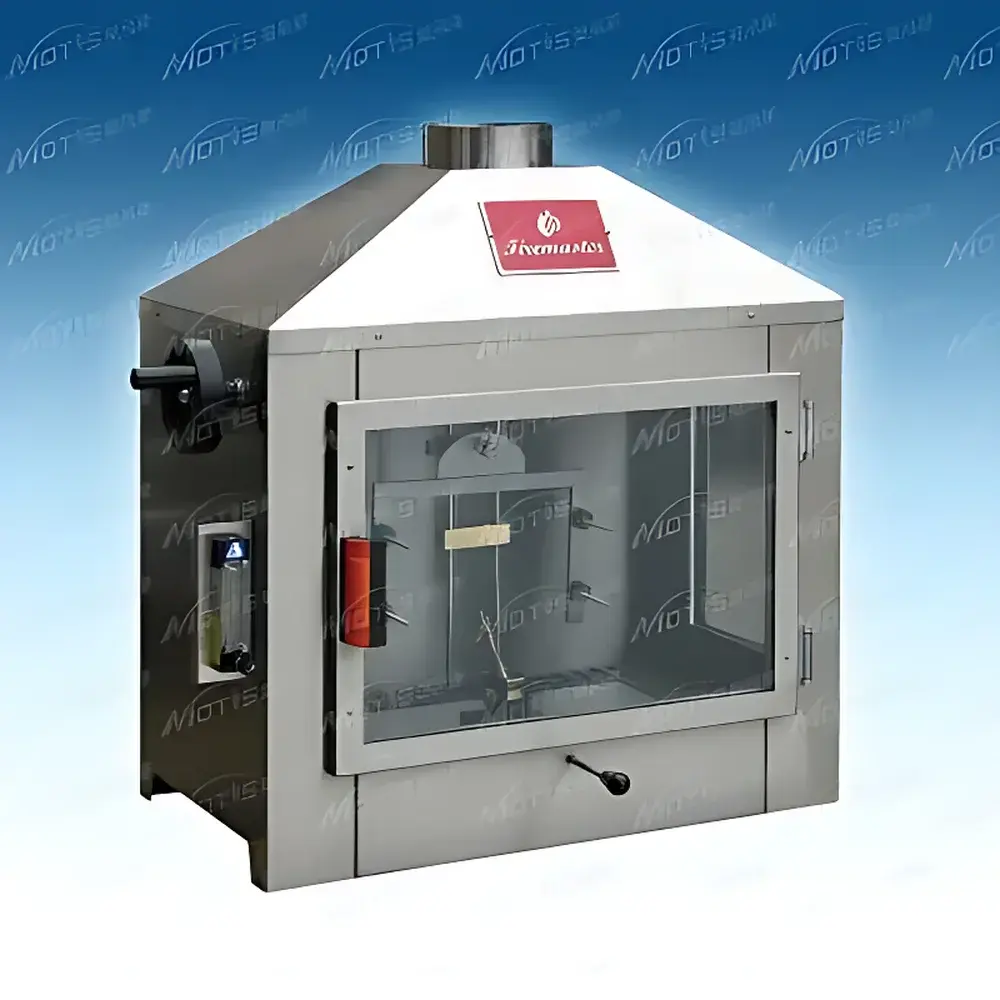
MOTIS SIT Vertical Ignitability Tester
| Brand | MOTIS |
|---|---|
| Model | SIT |
| Principle | Kleinbrenner small-flame impingement (vertical orientation) |
| Standards Compliance | EN ISO 11925-2, DIN 53438, GB/T 8626, DIN 4102-1 (Class B2) |
| Chamber Construction | Full stainless steel |
| Viewing Windows | Dual tempered glass doors |
| Sample Holder | Adjustable vertical/horizontal positioning |
| Ignition Source | Selectable 0° (vertical) or 45° angle |
| Flame Height Control | Rotameter-regulated propane/air flame |
| Flame Measurement | Integrated calibrated flame gauge |
| Airflow Monitoring | 0–10 m/s anemometer |
| Timing Resolution | 0.2 s |
| Accessories | Annex A sample clamp & template set |
| Sample Fixtures | Two interchangeable stainless steel clamps |
| Origin | Shanghai, China |
| Distribution Type | Authorized distributor |
Overview
The MOTIS SIT Vertical Ignitability Tester is a precision-engineered combustion test apparatus designed to evaluate the surface flammability behavior of building materials under controlled small-flame impingement. Based on the internationally recognized Kleinbrenner principle—originally developed by German fire safety researchers—the instrument delivers a defined propane/air flame at either 0° (vertical) or 45° orientation onto the vertical surface of a conditioned specimen. This method simulates real-world ignition scenarios where external flame sources contact wall, ceiling, or facade components. The tester operates in strict accordance with EN ISO 11925-2:2010 (“Reaction to fire tests — Ignitability of building products subjected to direct impingement of flame”), DIN 53438 (Parts 1–3), and GB/T 8626–2007, making it suitable for classification testing of materials into Euroclasses Bfl, Cfl, Dfl, and Efl, as well as legacy DIN 4102 Class B2 ratings. Its robust stainless-steel chamber architecture ensures long-term dimensional stability, thermal integrity, and resistance to corrosive combustion byproducts.
Key Features
- Full 304 stainless-steel test chamber with dual large-area tempered glass viewing doors for unobstructed observation and operator safety
- Adjustable sample holder enabling precise vertical and horizontal positioning to meet exact specimen alignment requirements per EN ISO 11925-2 Clause 6.2
- Dual stainless-steel sample clamps—including one conforming to Annex A geometry—supporting standardized specimen mounting for both rigid and semi-rigid substrates
- Rotameter-controlled flame height adjustment (typically 20 mm ± 1 mm for standard propane/air mixtures) ensuring repeatable ignition energy delivery
- Integrated flame measurement gauge calibrated to traceable reference standards for routine verification prior to each test sequence
- High-resolution digital timer with 0.2-second resolution, synchronized with flame application initiation and sustained burning observation phases
- Onboard anemometer (0–10 m/s range) for ambient airflow verification inside the test chamber, satisfying ventilation control requirements outlined in EN ISO 11925-2 Annex B
Sample Compatibility & Compliance
The SIT accommodates specimens up to 230 mm × 230 mm × thickness ≤ 50 mm (standard dimensions per EN ISO 11925-2). It supports rigid boards, sandwich panels, coated metals, mineral fiber composites, polymer-based laminates, and treated wood derivatives. All mechanical adjustments—including flame angle selection, sample tilt, and holder translation—are manually actuated with locking mechanisms to prevent drift during exposure. The system is validated for use in laboratories operating under GLP conditions and supports audit-ready documentation when paired with compliant data recording practices. While the instrument itself does not include automated pass/fail logic, its output parameters (ignition time, flame spread distance, sustained flaming duration) are directly transcribed into classification reports aligned with EN 13501-1 and national fire regulations.
Software & Data Management
The MOTIS SIT is a benchtop hardware platform designed for manual operation and operator-recorded data entry. It does not incorporate embedded firmware or proprietary software. However, its analog/digital interfaces—including timer output signals and optional anemometer voltage outputs—can be integrated with third-party data acquisition systems (e.g., LabVIEW, MATLAB, or custom SCADA platforms) for time-stamped logging. Laboratories implementing electronic records must ensure compliance with 21 CFR Part 11 requirements through external validation of their DAQ configuration, including audit trail generation, user access controls, and electronic signature capability. Calibration certificates for the rotameter, timer, and anemometer are supplied with initial commissioning and recommended annually per ISO/IEC 17025:2017 Clause 6.5.
Applications
This tester is routinely deployed in construction material R&D labs, third-party certification bodies (e.g., TÜV, UL, CNAS-accredited facilities), and quality assurance departments of insulation, cladding, and interior finish manufacturers. Typical use cases include pre-compliance screening of façade systems prior to full-scale room corner tests (ISO 9705), formulation optimization of flame-retardant additives in polymer matrices, verification of intumescent coating performance after aging cycles, and root-cause analysis of field-reported ignition incidents. Its adherence to harmonized European and Chinese national standards enables cross-border regulatory submissions without retesting.
FAQ
What flame fuel gas is required for operation?
Propane (≥95% purity) mixed with compressed air via the integrated rotameter system. Natural gas or butane are not supported due to differing stoichiometric ratios and flame characteristics.
Is the SIT compatible with ASTM E1321 or UL 94 testing protocols?
No. The SIT implements only the Kleinbrenner small-flame impingement methodology specified in EN ISO 11925-2 and related standards. ASTM E1321 uses a different radiant heat source; UL 94 employs horizontal/vertical burning configurations with distinct specimen conditioning and pass criteria.
Does the unit include calibration tools or certified reference materials?
The system ships with a NIST-traceable flame gauge and a documented calibration certificate for the digital timer. Users are responsible for periodic verification of the rotameter and anemometer using accredited external services.
Can test data be exported in CSV or PDF format?
Data export functionality is not native to the SIT. Export capability depends entirely on the external DAQ or laboratory information management system (LIMS) interfaced with the instrument’s analog outputs.
What maintenance intervals are recommended?
Weekly visual inspection of burner nozzles and glass doors; monthly cleaning of stainless-steel surfaces with non-chlorinated solvents; annual full calibration and mechanical verification performed by MOTIS-authorized service technicians.



