
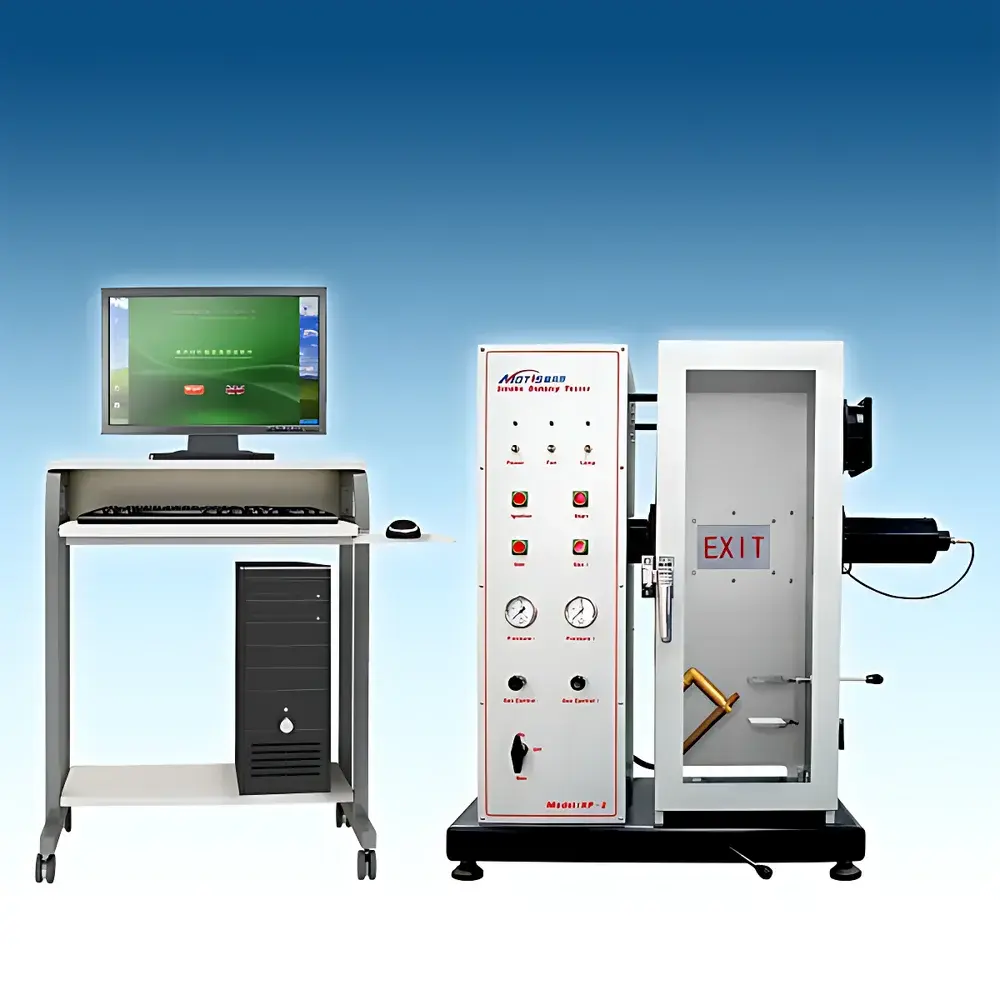
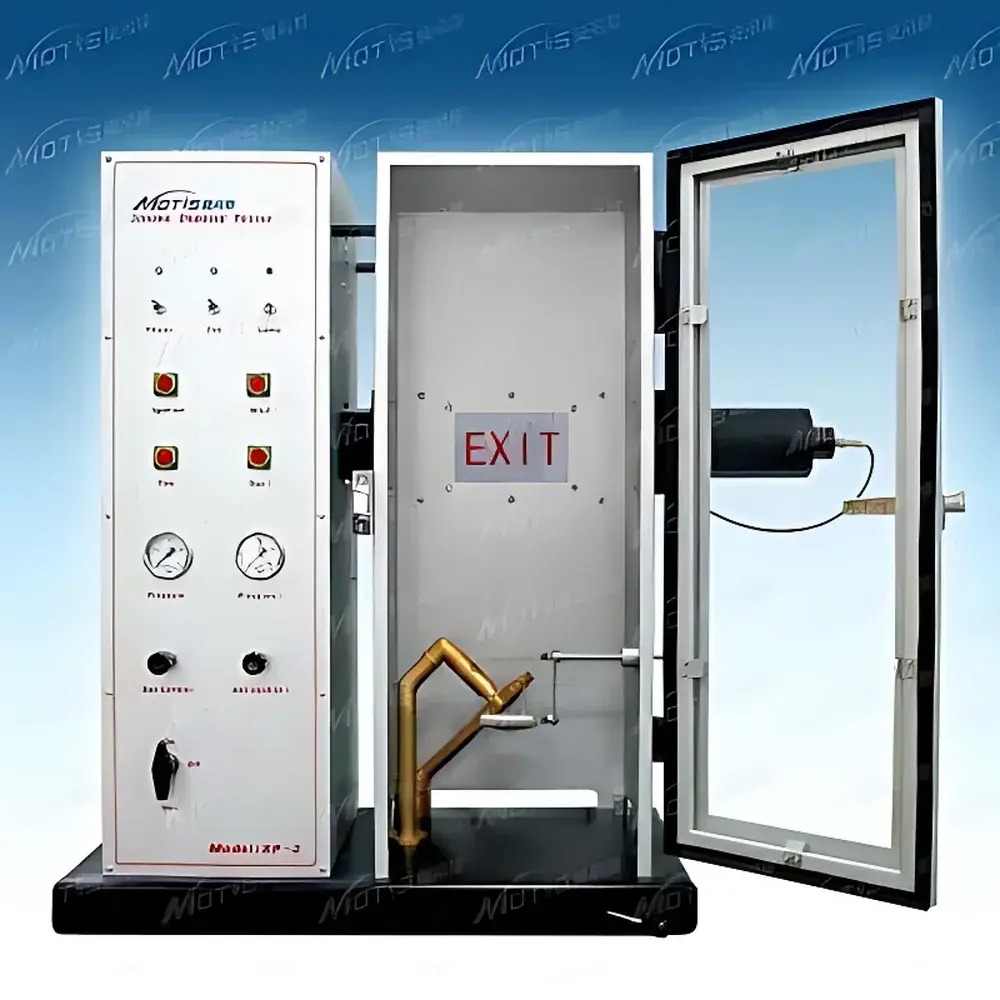
MOTIS XP-2 Smoke Density Chamber for Building Materials
| Brand | MOTIS |
|---|---|
| Model | XP-2 |
| Standard Compliance | ASTM D2843 |
| Chamber Coating | PTFE (Teflon®) Interior |
| Light Source | Calibrated Incandescent Lamp |
| Photodetector | Cosine-Corrected Silicon Photodiode with Visible-Spectrum Bandpass Filter (380–780 nm) |
| Main Burner Pressure | 256 kPa |
| Auxiliary Burner | Integrated for Dripping Combustion Control |
| Data Acquisition Interval | 15 s |
| Output | SDR (Smoke Density Rating) Integral & Time-Resolved Curve |
| Software Features | Multi-sample SDR Overlay, Comparative Analysis, CFR 21 Part 11–Ready Report Export |
| Chamber Marking | High-Contrast “EXIT” Label on White Background |
| Viewing Window | Optical-Grade Quartz, UV/IR-Blocked |
Overview
The MOTIS XP-2 Smoke Density Chamber is a precision-engineered instrument designed for quantitative assessment of smoke obscuration generated during the combustion of building materials under controlled radiant and flame exposure conditions. It operates in strict accordance with ASTM D2843 – “Standard Test Method for Determining Smoke Density of Materials by Radiant Heating,” which defines smoke density rating (SDR) as the time-integrated optical attenuation caused by smoke particles suspended in a defined test chamber volume. The measurement principle is rooted in the Beer–Lambert law: incident light intensity (I₀) from a stabilized incandescent source is attenuated to intensity (I) after traversing the smoke-laden chamber; transmittance (T = I/I₀) is continuously recorded, and SDR is calculated as the negative natural logarithm of mean transmittance over the 4-minute test duration (SDR = −ln(Tₘₑₐₙ)). Unlike legacy systems relying on analog signal conditioning, the XP-2 integrates digital photometry with cosine-corrected detection and spectral filtering—ensuring metrological traceability to CIE photopic luminosity function and eliminating non-physiological contributions from UV and IR radiation.
Key Features
- PTFE-coated dual-chamber architecture provides exceptional resistance to acidic condensates and halogenated corrosion products formed during polymer combustion—extending service life beyond 10 years under routine QC use.
- Optically calibrated incandescent light source paired with a silicon photodiode featuring NIST-traceable cosine correction and a visible-bandpass filter (380–780 nm) ensures high photometric fidelity and human-eye spectral weighting compliance.
- Dual-burner configuration: primary burner delivers precisely regulated 256 kPa flame impingement for surface ignition; auxiliary burner engages automatically upon melt-drip detection to maintain continuous combustion of falling residues per ASTM D2843 Annex A2.
- High-contrast “EXIT” label printed on white chamber base enables real-time visual assessment of smoke layer stratification and settling behavior through the front quartz viewport—supporting qualitative correlation with quantitative SDR output.
- Firmware-embedded 15-second data acquisition synchronizes with ASTM-mandated reporting intervals; raw transmittance values are timestamped and stored with microsecond resolution for audit-ready traceability.
Sample Compatibility & Compliance
The XP-2 accommodates standard ASTM D2843 specimens (25.4 mm × 25.4 mm × thickness ≤ 25.4 mm), including rigid boards, foams, coated substrates, and laminates commonly used in wall assemblies, ceiling systems, and insulation applications. All hardware and software components meet ISO/IEC 17025 requirements for testing laboratory competence. The system supports GLP-compliant operation via configurable user access levels, electronic signature capture, and immutable audit trails—including full metadata logging (operator ID, calibration status, ambient temperature/humidity, chamber purge cycles). Optional 21 CFR Part 11 add-on enables FDA-regulated environments to achieve electronic record integrity, change control, and retention compliance.
Software & Data Management
The XP-2 Control Suite is a Windows-based application built on .NET Framework with SQLite backend storage. It provides real-time transmittance curve visualization, automatic SDR calculation per ASTM D2843 Section 9, and post-test overlay of up to three independent runs for comparative kinetics analysis. Statistical functions include coefficient of variation (CV%) computation across replicates and pass/fail flagging against user-defined SDR thresholds (e.g., ≤ 75 for Class B fire-rated materials per EN 13501-1). Reports export natively to PDF with embedded digital signatures and optional CSV/Excel exports for LIMS integration. All data files carry SHA-256 checksums and are write-protected post-acquisition.
Applications
This instrument serves critical roles in fire safety R&D, regulatory certification (UL 723, GB/T 8626, EN ISO 5659-2), and quality assurance for manufacturers of architectural panels, PVC wall coverings, polyurethane insulation, cable jacketing, and transportation interior composites. Its reproducible SDR outputs inform material selection for smoke toxicity modeling (e.g., correlation with CO yield in cone calorimetry), support NFPA 275 compliance documentation, and feed into fire dynamics simulation inputs (FDS, PyroSim). Independent testing laboratories utilize the XP-2 for third-party verification required by ICC-ES, CE marking, and China CCC certification pathways.
FAQ
Does the XP-2 comply with international fire test standards beyond ASTM D2843?
Yes—the optical design and procedural logic align with ISO 5659-2 (smoke production rate), GB/T 8627 (Chinese national standard), and JIS A 1321, enabling cross-standard equivalency assessments when operated under corresponding specimen and environmental protocols.
Can the XP-2 be integrated into an existing LIMS or MES environment?
Yes—via standardized ODBC drivers and RESTful API endpoints (available under extended license), allowing bidirectional data exchange with LabVantage, Thermo Fisher SampleManager, and Siemens Opcenter.
What maintenance intervals are recommended for photometric calibration?
Annual NIST-traceable recalibration of the photodetector assembly and lamp spectral output is advised; internal self-diagnostic routines verify lamp stability and detector linearity before each test sequence.
Is remote monitoring supported?
The XP-2 Control Suite supports secure TLS 1.2–encrypted remote desktop access and live dashboard streaming via optional MOTIS Cloud Connect module—enabling multi-site lab oversight without compromising data sovereignty.



