
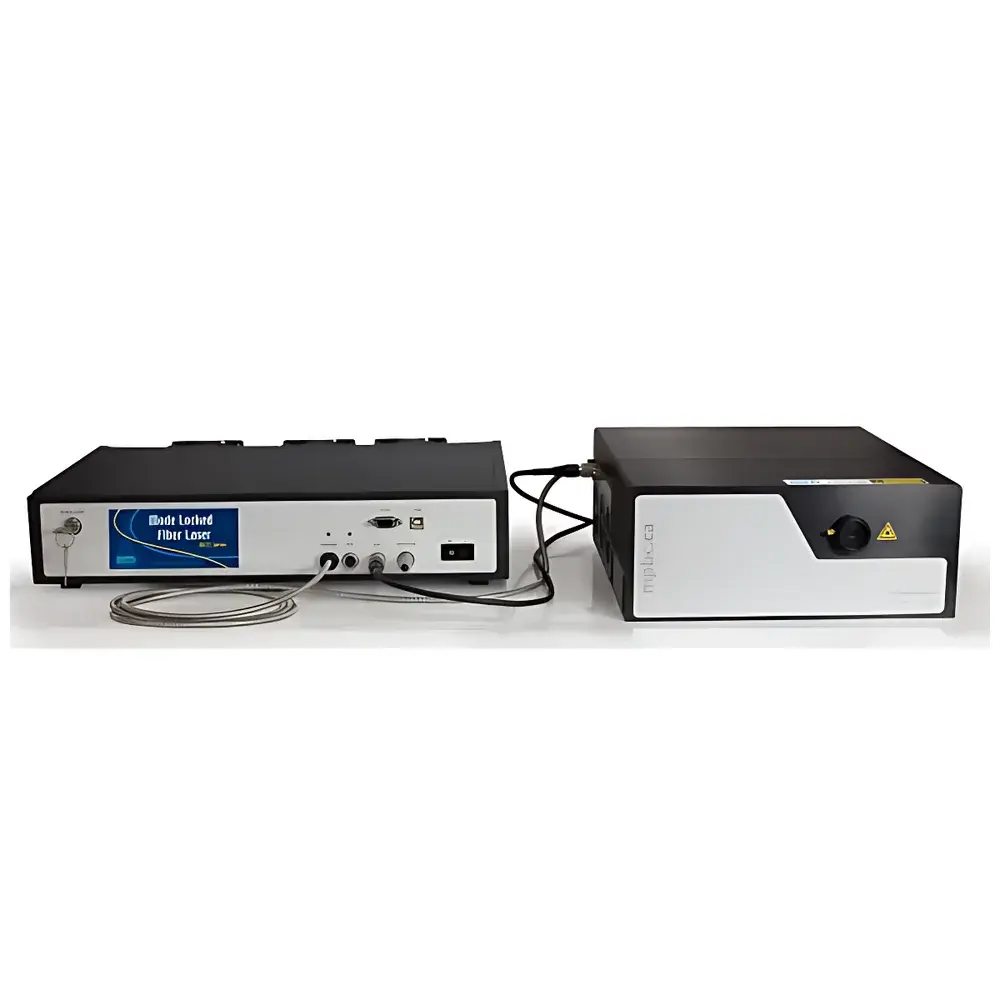
MPB AFML-Series and MLFL-Series Mode-Locked Femtosecond Fiber Lasers
| Brand | MPB |
|---|---|
| Origin | Canada |
| Type | Imported Instrument |
| Model | AFML-1030 & MLFL-920/1190 |
| Central Wavelengths | 920 nm, 1030 nm, 1190 nm |
| Pulse Duration | 100–800 fs |
| Repetition Rate | 25 MHz / 80 MHz |
| Average Output Power | ≥1 W (MLFL) / 3–10 mW (AFML) |
| Beam Diameter | 1 mm |
| Polarization | Linear (>99%) |
| Spectral Bandwidth | ~10 nm |
| Architecture | All-Fiber, Alignment-Free, Maintenance-Free |
Overview
The MPB AFML-Series and MLFL-Series mode-locked femtosecond fiber lasers are engineered for precision ultrafast photonics applications requiring high stability, exceptional beam quality, and long-term operational reliability. These all-fiber, alignment-free laser systems operate on the principle of passive mode-locking via nonlinear polarization evolution or semiconductor saturable absorber mirrors (SESAMs), generating transform-limited or near-transform-limited pulses with minimal chirp. Unlike bulk-optic Ti:sapphire lasers, MPB’s fiber-based architecture eliminates sensitive free-space optics, reducing susceptibility to environmental perturbations and enabling robust deployment in shared-core microscopy labs, industrial metrology environments, and multi-user academic facilities. The MLFL-Series delivers 1 W average power at 920 nm and 1190 nm—wavelengths strategically selected to match the two-photon excitation cross-sections of key fluorescent probes (e.g., GFP, tdTomato) and deep-tissue penetration windows in biological tissue. The AFML-Series operates at 1030 nm with 25 MHz repetition rate, optimized as a low-noise seed source for high-energy amplifier systems, including Yb-doped fiber amplifiers and optical parametric chirped-pulse amplification (OPCPA) architectures.
Key Features
- All-fiber monolithic design: No free-space optics; no periodic realignment required
- Hermetically sealed, convection-cooled modules: 2RU pump unit (440 × 343 × 92 mm) and compact laser head (284 × 324 × 116 mm for MLFL; sub-1U footprint for AFML)
- Linear polarization >99% with Gaussian spatial profile (M² < 1.1) and 1 mm beam diameter (1/e²)
- Factory-optimized pulse duration: 100–200 fs (MLFL) and 600–800 fs (AFML), verified by intensity autocorrelation and spectral phase reconstruction
- Low amplitude noise (<0.3% RMS, 10 Hz–10 MHz) and timing jitter <30 fs (integrated 10 kHz–10 MHz) — critical for pump-probe and asynchronous optical sampling
- Integrated GUI-controlled driver with analog modulation input, TTL sync output, and USB 2.0 interface for remote monitoring and parameter logging
Sample Compatibility & Compliance
These lasers are designed for integration into regulated research and preclinical imaging platforms. The all-fiber construction ensures compliance with IEC 60825-1:2014 (Laser Product Safety) Class 4 requirements when properly enclosed. Beam delivery is compatible with standard SMF-28 or polarization-maintaining (PM) fiber pigtails (FC/APC or FC/PC connectors), supporting seamless coupling into commercial multiphoton microscopes (e.g., Zeiss LSM 980 NLO, Bruker Ultima). Pulse characteristics meet ASTM E2973-22 criteria for ultrafast laser sources used in biomedical optical sectioning. For GLP/GMP-aligned laboratories, optional firmware enables audit-trail-enabled parameter logging aligned with FDA 21 CFR Part 11 principles (user authentication, electronic signatures, immutable records).
Software & Data Management
MPB provides the LaserControl Suite — a cross-platform (Windows/macOS/Linux) application built on Qt and Python-based backend — enabling real-time monitoring of output power, repetition rate stability, and internal temperature gradients. All operational parameters are timestamped and exportable in HDF5 format for traceable data provenance. The SDK supports LabVIEW, MATLAB, and Python APIs (via PySerial and NumPy), allowing synchronization with external hardware triggers (e.g., galvo scanners, Pockels cells, time-correlated single-photon counting modules). Firmware updates are performed over secure HTTPS with SHA-256 signature verification, ensuring integrity during field deployment.
Applications
- Multiphoton Microscopy: Dual-wavelength MLFL systems enable simultaneous excitation of spectrally distinct fluorophores without mechanical filter switching
- Ultrafast Spectroscopy: As pump sources for transient absorption and coherent anti-Stokes Raman scattering (CARS) setups requiring sub-200 fs temporal resolution
- Terahertz Generation & Detection: Optical rectification in ZnTe or DAST crystals using 1190 nm pulses for enhanced bandwidth and signal-to-noise ratio
- Optical Frequency Comb Referencing: AFML-Series serves as low-phase-noise seed for f–2f interferometers and octave-spanning supercontinuum generation
- Micro/Nano Fabrication: Precision ablation of biodegradable polymers and thin-film photovoltaics with minimized thermal diffusion zones
- Time-of-Flight Metrology: High-repetition-rate seeding for optical clock distribution and distributed fiber sensing networks
FAQ
What is the typical warm-up time to achieve spectral and temporal stability?
Less than 15 minutes from cold start, with pulse duration drift <±2% and central wavelength shift <±0.1 nm over 8-hour continuous operation.
Can the repetition rate be externally modulated or synchronized?
Yes — both series support RF synchronization (SMA input, 50 Ω, ±5 Vpp) and offer programmable repetition rate tuning within ±100 kHz (MLFL) or ±5 kHz (AFML) via software-defined PLL control.
Is there an option for dispersion compensation or pulse compression?
MPB offers OEM-integrated grating-based or chirped-fiber-Bragg-grating compressors, delivering sub-50 fs pulses at the sample plane when coupled with appropriate adaptive optics.
Are these lasers qualified for use in ISO 13485-certified medical device manufacturing environments?
While not standalone medical devices, the lasers comply with essential requirements of IEC 61326-1 for EMC and IEC 62304 for embedded software lifecycle management — documentation packages available upon request for OEM integration.
What maintenance is required over a 10-year service life?
None beyond periodic inspection of fiber connectors and cooling vents; mean time between failures (MTBF) exceeds 50,000 hours per IEC 62380 reliability prediction models.



