
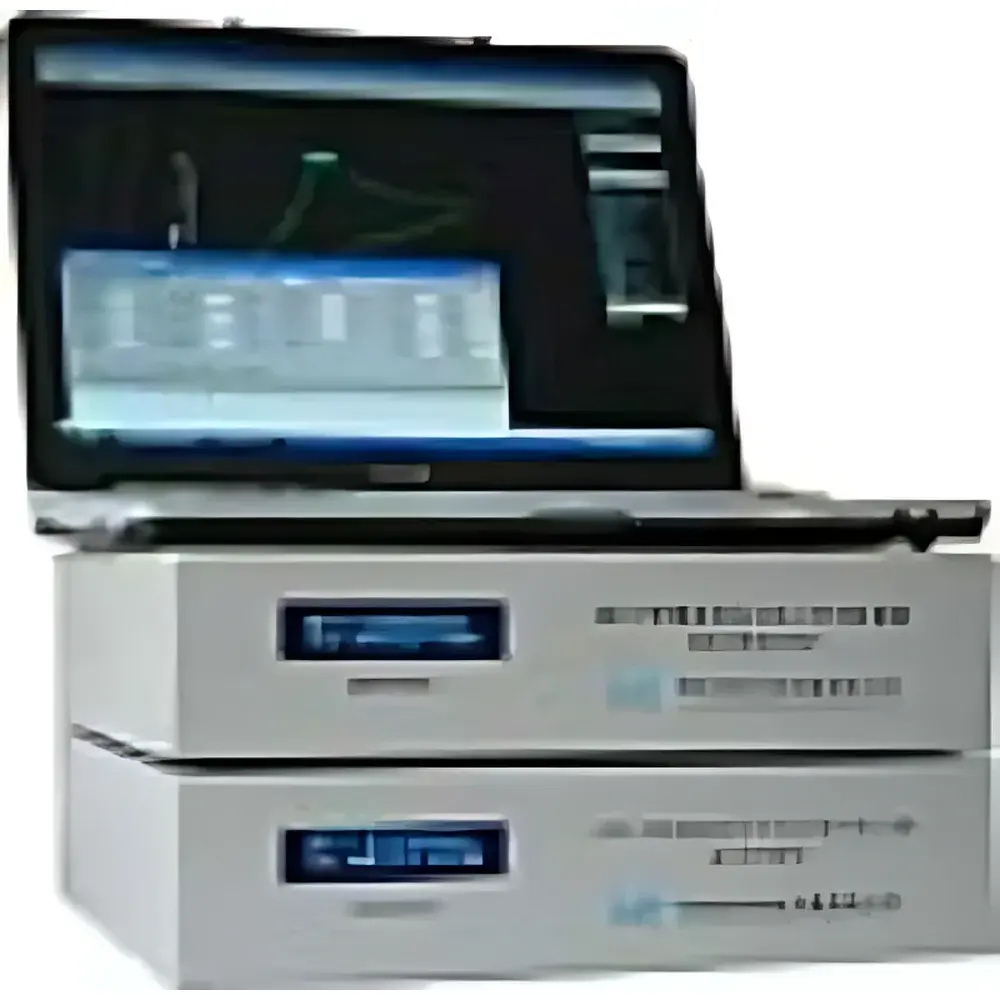
MPI-P Microfluidic Chip Electrochemical Detection System
| Origin | Imported |
|---|---|
| Manufacturer Type | Authorized Distributor |
| Model | MPI-P |
| Instrument Category | Microfluidic Chip System |
| Electrochemical Analyzer Specifications | Potential Range: ±10 V |
| Current Range | ±250 mA |
| Reference Electrode Input Impedance | 10¹² Ω |
| Sensitivity | 1×10⁻¹² A to 0.1 A (16 decades) |
| Input Bias Current | <50 pA |
| Potential Increment | 1 mV |
| Scan Rate | 1×10⁻⁴ to 200 V/s |
| Supported Techniques | Cyclic Voltammetry (CV), Linear Sweep Voltammetry (LSV), Chronoamperometry (CA), Chronocoulometry (CC), Bulk Electrolysis (BE), Open Circuit Potential vs. Time (OCPT) |
| High-Voltage Power Supply | 4 Channels, 0–2000 V per channel, 0–2 mA per channel, Programmable Output Mode (Output/Disconnect/Ground), Current-Limit Protection (0–2 mA), 10-Step Program Sequence |
Overview
The MPI-P Microfluidic Chip Electrochemical Detection System is a purpose-engineered platform for integrated electrochemical analysis within microfluidic chip environments. Designed for rigorous laboratory use in academic research, pharmaceutical development, and point-of-care diagnostics R&D, the system combines a high-fidelity bipotentiostat/galvanostat with synchronized multi-channel high-voltage power supply control—enabling simultaneous electrochemical interrogation and electrophoretic actuation on chip-based devices. Its architecture follows core principles of interfacial electrochemistry under laminar flow conditions, supporting quantitative detection of redox-active species (e.g., dopamine, H₂O₂, NADH, metal ions) with sub-picoampere current resolution and nanovolt-level potential stability. The system operates on the fundamental premise that microscale confinement enhances mass transport efficiency and signal-to-noise ratio, making it especially suited for low-volume, high-sensitivity assays where conventional macroelectrodes exhibit diffusion-limited response or fouling artifacts.
Key Features
- Integrated dual-function architecture: Co-located electrochemical workstation and programmable 4-channel HV supply enable real-time coupling of detection (e.g., amperometric sensing) and sample manipulation (e.g., electrophoretic injection, zone focusing) on monolithic or hybrid microfluidic chips.
- Ultra-low noise potentiostat design with input bias current <50 pA and reference electrode impedance ≥10¹² Ω—critical for stable measurements in low-conductivity buffers commonly used in chip-based separations.
- 16-decade current sensitivity range (1 pA to 100 mA), programmable in 1-mV potential increments, supporting both transient and steady-state techniques including CV, LSV, CA, CC, BE, and OCPT.
- Independent HV channel control (0–2000 V, 0–2 mA per channel) with selectable output states (active output, open-circuit, ground) and stepwise voltage/current ramping (up to 10 programmable steps), facilitating precise spatiotemporal control of electroosmotic flow and analyte mobilization.
- Rugged, shielded chassis with grounded Faraday enclosure compatibility—minimizes electromagnetic interference during low-current measurements typical of chip-integrated electrodes (e.g., Au, Pt, carbon ink, or screen-printed working electrodes).
Sample Compatibility & Compliance
The MPI-P system supports standard glass, PDMS, PMMA, and COC-based microfluidic chips with embedded or external electrode configurations (3-electrode or 2-electrode setups). It accommodates chips with channel dimensions from 10 µm to 500 µm and reservoir volumes from 1 µL to 50 µL. Electrode integration includes drop-cast, sputtered, or lithographically patterned transducers; compatibility extends to commercially available electrochemical biochips (e.g., those functionalized with enzymes, aptamers, or antibodies). From a regulatory standpoint, the instrument’s hardware architecture and firmware support audit-trail-enabled operation when paired with compliant data acquisition software—aligning with GLP documentation requirements and enabling traceability per FDA 21 CFR Part 11 when configured with electronic signature and user access controls. While not certified as an IVD device, its performance characteristics meet relevant ASTM E2913 (standard guide for electrochemical sensor validation) and ISO 15197 (for glucose monitoring system verification) benchmarking practices in research settings.
Software & Data Management
The MPI-P operates via PC-hosted control software featuring modular experiment wizards, real-time waveform visualization, and batch protocol scripting. All raw current/potential/time datasets are saved in vendor-neutral .csv and HDF5 formats, preserving metadata such as timestamp, technique parameters, electrode configuration, and HV channel status. Software includes built-in baseline correction, peak integration (tangent skim and Gaussian deconvolution), and export-ready plotting with customizable axis scaling and error bar annotation. For laboratory information management system (LIMS) integration, the application provides a documented COM/ActiveX interface and RESTful API endpoints for remote triggering, parameter upload, and result retrieval—supporting automated workflows in high-throughput screening environments. Data integrity safeguards include automatic checksum generation, version-stamped file naming, and optional encrypted local storage.
Applications
- Development and optimization of lab-on-a-chip platforms for neurotransmitter detection in neurochemical monitoring studies.
- Electrochemical immunoassays and DNA hybridization assays using redox-labeled probes on functionalized chip surfaces.
- Real-time monitoring of enzymatic reaction kinetics (e.g., glucose oxidase, horseradish peroxidase) under continuous-flow conditions.
- Method validation for microchip electrophoresis–electrochemical detection (ME-EC) hyphenated systems targeting pharmaceutical impurities or metabolites.
- Fundamental investigation of electrode kinetics and double-layer capacitance at microstructured interfaces under controlled convection.
FAQ
What microfluidic chip formats are compatible with the MPI-P system?
Standard planar chips with integrated three-electrode configurations (working, counter, reference) or external electrode interfaces (e.g., via gold-plated contact pads or fluidic connectors) are supported. Chip materials must be electrically insulating and chemically inert under applied potentials.
Can the MPI-P perform simultaneous electrochemical detection and electrophoretic injection?
Yes—the independent control of the electrochemical cell and four HV channels allows concurrent application of detection bias and separation voltage, enabling true on-chip coupling without external switching hardware.
Is the system suitable for GMP-regulated environments?
While the MPI-P itself is not a Class II medical device, its data handling architecture—when deployed with validated software and procedural controls—meets foundational requirements for GMP-aligned analytical method development and transfer in early-phase bioprocess analytics.
Does the system support custom waveform generation beyond standard techniques?
Yes—via script-based programming mode, users can define arbitrary potential vs. time profiles, including multi-segment ramps, pulses, and conditional triggers linked to current thresholds or time events.
What maintenance is required for long-term operational stability?
Routine calibration using certified redox standards (e.g., ferrocene/ferricinium) is recommended every 3 months; HV output linearity verification with high-voltage probes should be performed annually. No consumable parts are embedded in the core electronics module.




