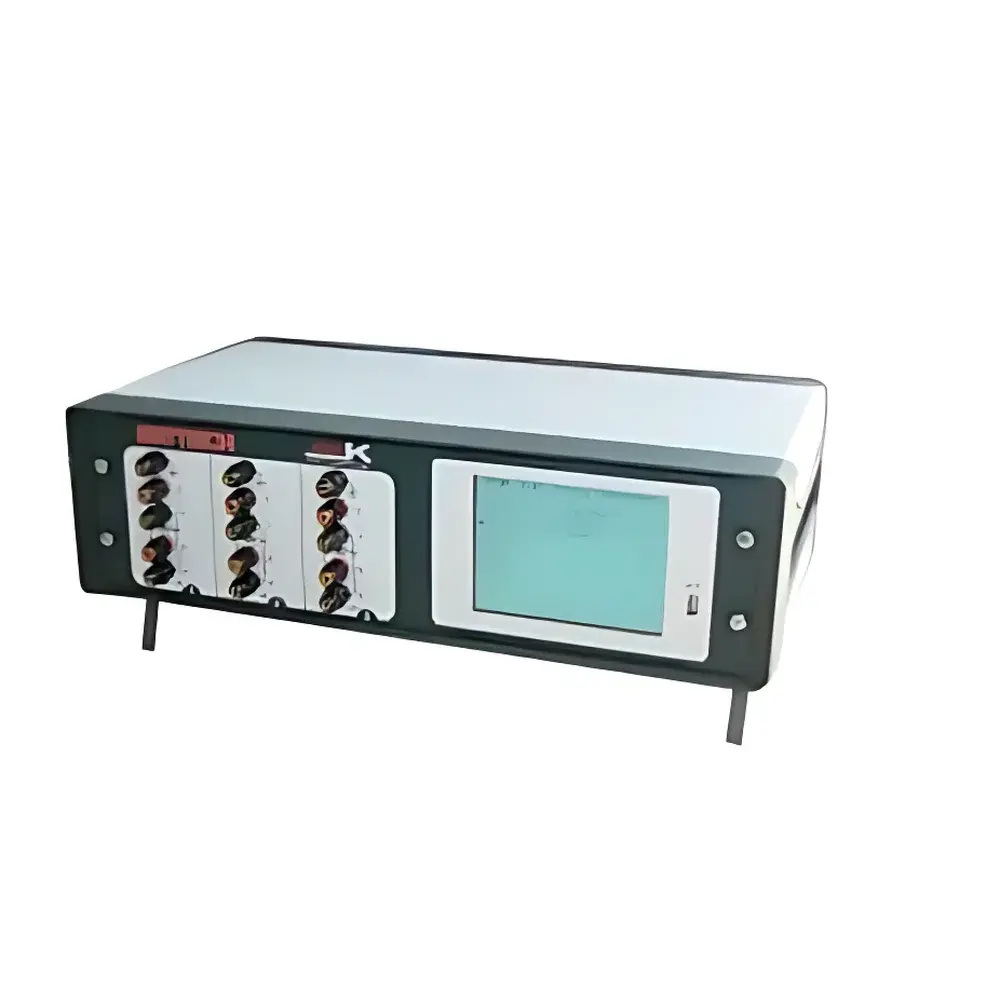
ISOTECH Bridge Switching Unit
| Brand | ISOTECH |
|---|---|
| Origin | USA |
| Model | Bridge Switching Unit |
| Channel Capacity | 3 standard (expandable to 90 channels) |
| Accuracy | <0.07 ppm full-scale, <0.017 ppm ratio accuracy (ratio range: 0–0.25 & 0.95–1.05) |
| Resolution | 0.001 ppm / 0.001 mK |
| Internal Standards | 25 Ω, 100 Ω, 400 Ω |
| Standard Stability | TCR < 0.05 ppm/°C |
| Excitation Current | 0.1–1 mA (±0.4% of reading ±0.7 µA |
| Resistance Range | 0–100 kΩ |
| Measurement Speed | <1 s (resistance), <2 s (temperature) |
| Input Compatibility | PRTs, thermistors, thermocouples |
| Display | 6.4″ VGA (640×480) color TFT LCD with capacitive touch |
| Interface | GPIB, RS-232, USB, Ethernet |
| Operating System | Embedded Windows CE |
| Switching Technology | Solid-state semiconductor switching |
| Connector Type | “Cable Pod” modular interface (accepts 4 mm banana plugs, flat-blade terminals, and bare wire) |
| Contact Material | Gold-plated tellurium-copper |
| ADC Architecture | Low-noise sigma-delta converter with low-noise preamplifier |
| Environmental Spec | 15–30 °C / 50–85 %RH (specification conditions) |
| Power | 88–264 VAC, 47–63 Hz, ≤20 W, ≤1.5 A RMS |
Overview
The ISOTECH Bridge Switching Unit is a high-precision, multi-channel resistance and temperature measurement system engineered for metrology-grade calibration laboratories, national standards institutes, and advanced R&D facilities requiring traceable, stable, and repeatable bridge-based measurements. It operates on the principle of precision DC resistance comparison using a four-terminal (Kelvin) configuration, integrating programmable excitation current sources, low-noise sigma-delta analog-to-digital conversion, and solid-state semiconductor switching to eliminate mechanical contact drift and thermal EMF errors. Unlike conventional manual or relay-based bridge switches, this unit delivers sub-part-per-million stability and repeatability by leveraging ultra-low-TCR internal reference resistors (25 Ω, 100 Ω, 400 Ω), tightly controlled excitation current accuracy, and thermally optimized signal conditioning architecture. Its design supports direct integration into automated calibration workflows compliant with ISO/IEC 17025, ASTM E1137, and IEC 60751, enabling primary-level verification of platinum resistance thermometers (PRTs), thermistors, and thermocouple reference junctions.
Key Features
- Three fully configurable measurement channels—each independently assignable to resistance, ratio, temperature (°C/°F/K), voltage, or derived units—with seamless expansion capability to up to 90 channels via daisy-chained units.
- Sub-ppm metrological performance: full-scale accuracy better than 0.07 ppm and ratio accuracy better than 0.017 ppm over defined ratio ranges (0–0.25 and 0.95–1.05), validated per NIST-traceable protocols.
- Ultra-stable internal reference resistors with temperature coefficient of resistance (TCR) < 0.05 ppm/°C and annual stability < 2 ppm/year—certified for use in accredited calibration labs under ISO/IEC 17025 audit requirements.
- Programmable excitation current source (0.1–1 mA) with absolute accuracy of ±0.4% of reading ±0.7 µA and 280 nA resolution, supporting both constant-current and constant-voltage measurement modes.
- Integrated “Cable Pod” connector system featuring gold-plated tellurium-copper contacts—optimized for low thermal EMF (< 0.1 µV/°C), high repeatability, and compatibility with 4 mm banana plugs, flat-blade terminals, and stripped wire connections.
- Embedded Windows CE operating system enables standalone operation without external PC dependency; all measurement control, data logging, and analysis are executed internally.
- Low-noise signal chain incorporating a dedicated sigma-delta ADC and custom low-noise preamplifier—designed to minimize quantization noise, 1/f noise, and external interference in sensitive resistance ratio applications.
Sample Compatibility & Compliance
The Bridge Switching Unit is designed for direct interfacing with primary and secondary temperature sensors used in metrology and industrial calibration. It natively supports platinum resistance thermometers (PRTs) per IEC 60751 Class A and AA, NIST SRM-certified thermistors, and thermocouple types B, E, J, K, N, R, S, and T—when used with appropriate reference-junction compensation. All sensor-specific algorithms (e.g., ITS-90 polynomial interpolation for PRTs, Steinhart-Hart for thermistors) are embedded and configurable. The instrument complies with electromagnetic compatibility (EMC) requirements per EN 61326-1:2013 and safety standards per UL 61010-1 and IEC 61010-1. Its measurement uncertainty budget is documented and compatible with uncertainty evaluation frameworks required under ISO/IEC 17025 Clause 6.4.2 and FDA 21 CFR Part 11 for electronic records when paired with validated software modules.
Software & Data Management
Data acquisition, visualization, and export are handled through the unit’s native GUI running on the embedded Windows CE platform. Real-time plots, statistical summaries (mean, std dev, min/max), and time-stamped logs are generated during measurement sessions. All raw and processed data—including resistance values, ratio outputs, calculated temperatures, and environmental metadata—are exportable in CSV and Excel-compatible formats (.xlsx). Graphical overlays support comparative analysis across multiple sensors or calibration cycles. Communication interfaces include IEEE-488 (GPIB), RS-232, USB virtual COM port, and 10/100 Mbps Ethernet—enabling integration into LabVIEW, Python (via PyVISA), or custom SCADA environments. Audit trail functionality records operator actions, configuration changes, and calibration events with timestamps and user IDs—meeting GLP/GMP documentation expectations for regulated industries.
Applications
- Primary calibration of standard platinum resistance thermometers (SPRTs) and industrial PRTs in national metrology institutes and accredited calibration labs.
- Multi-sensor thermal mapping and uniformity testing in environmental chambers, ovens, and incubators—leveraging simultaneous 3+ channel monitoring with synchronized sampling.
- Thermistor characterization and stability testing under controlled thermal soak conditions, including long-term drift assessment per MIL-STD-202.
- Reference-junction compensation and cold-junction emulation for thermocouple calibration systems operating under ISO 17025 or ANSI/NCSL Z540.
- Resistance bridge automation in cryogenic and high-precision instrumentation setups where thermal EMF and contact resistance must be minimized.
- Education and research applications in metrology courses, sensor physics labs, and materials science departments requiring hands-on exposure to traceable resistance measurement principles.
FAQ
What sensor types does the ISOTECH Bridge Switching Unit support?
It directly supports platinum resistance thermometers (PRTs), thermistors, and thermocouples—using built-in ITS-90, Callendar-Van Dusen, and Steinhart-Hart algorithms for temperature calculation.
Can the unit operate without a connected computer?
Yes—it features an embedded Windows CE OS and full touchscreen GUI, enabling complete standalone operation for measurement, logging, and data export.
Is the instrument suitable for ISO/IEC 17025-accredited laboratories?
Yes—its metrological specifications, documented uncertainty budget, audit trail capability, and traceable reference standards meet key requirements for accreditation under Clause 6.4 (Equipment) and Clause 7.7 (Uncertainty of Measurement).
How is thermal EMF minimized in the connection system?
Through gold-plated tellurium-copper terminals, symmetrical Kelvin wiring, and low-thermal-EMF semiconductor switching—resulting in typical thermal EMF < 0.1 µV/°C at junctions.
What is the maximum number of channels supported in a single system?
The base unit provides three channels; up to 90 channels can be achieved via cascaded configurations using standard Ethernet or GPIB synchronization protocols.
Does the unit support automated calibration report generation?
While the device itself does not generate formatted PDF reports, it exports structured data (CSV/XLSX) and metadata compatible with third-party calibration management software (e.g., MET/CAL, Quantum, or custom Python-based reporting tools) that comply with ISO 17025 report requirements.