
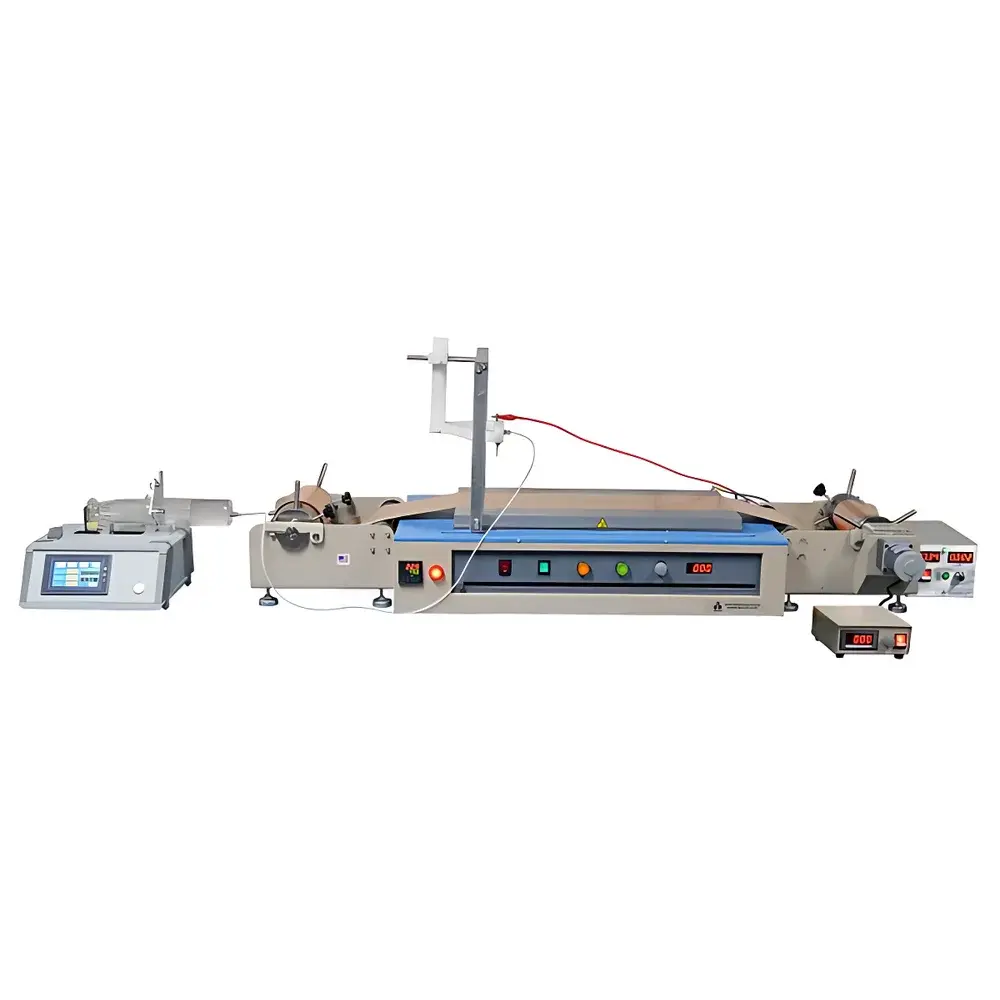
MSK-ESC-R2R Roll-to-Roll Electrospinning System
| Brand | KJ GROUP (Shenyang Kejing) |
|---|---|
| Origin | Liaoning, China |
| Manufacturer Type | Authorized Distributor |
| Country of Origin | China |
| Model | MSK-ESC-R2R |
| Pricing | Upon Request |
| Electrode Configuration | Linear 5-needle spinneret |
| Coating Width | 160 mm |
| Substrate Travel Speed | 2.2–117.2 mm/s |
| Heating Platform Max Temp | 100 °C |
| Temperature Control Accuracy | ±1 °C (PID) |
| High-Voltage Output | 0–50 kV, max 1 mA |
| Needle OD | 0.9 mm |
| Needle ID | 0.6 mm |
| Needle Length | 12 mm |
| Needle Spacing | 25 mm |
| Needle-to-Heater Distance Range | 70–235 mm |
| Syringe Pump Flow Rate | 0.1–45 mm/min (linear displacement) |
| Syringe Volume | 250 mL |
| System Footprint | 805 × 435 × 565 mm (L×W×H) |
Overview
The MSK-ESC-R2R Roll-to-Roll Electrospinning System is a benchtop-scale, integrated nanofiber manufacturing platform engineered for continuous, scalable production of electrospun polymer membranes. It operates on the principle of high-voltage electrohydrodynamic jetting: a polymer solution or melt is extruded through conductive capillary needles under controlled flow, subjected to an electric field (0–50 kV), inducing jet instability and rapid solvent evaporation to yield submicron to nanoscale fibers deposited onto a moving substrate. Unlike batch-mode electrospinning systems, the MSK-ESC-R2R implements true roll-to-roll (R2R) processing—enabling reproducible, meter-length fabrication of uniform nanofibrous mats with defined basis weight, porosity, and fiber alignment. Its modular architecture integrates precision syringe pumping, multi-needle electrostatic deposition, real-time thermal drying, and synchronized web handling—all within a compact, laboratory-compatible footprint. Designed for materials R&D and pilot-scale process validation, it supports development of functional nanofibers for filtration, battery separators, wound dressings, and smart textiles.
Key Features
- Linear 5-needle spinneret with fixed 25 mm inter-needle spacing and adjustable vertical positioning (70–235 mm from heating stage), ensuring consistent electric field distribution and minimizing inter-needle charge repulsion via single-cable high-voltage feed.
- Motor-driven R2R web transport system with gear-reduced DC motor (1–41 rpm), enabling precise substrate velocity control from 2.2 to 117.2 mm/s—critical for tuning fiber morphology, mat thickness, and areal density.
- PID-controlled heated platen (max 100 °C, ±1 °C stability) positioned immediately downstream of the deposition zone to accelerate solvent removal prior to winding, reducing post-processing drying time and preventing fiber fusion or tackiness.
- LCD touchscreen syringe pump delivering programmable linear displacement (0.001–120 mm stroke, 0.01–8 mm/min fine adjustment), compatible with standard 250 mL Luer-lock syringes for stable, pulseless polymer solution delivery.
- Modular mechanical design: height-adjustable support frame, horizontally movable spinneret assembly (accommodating substrates up to 200 mm wide), and standardized mounting interfaces for future integration of environmental chambers or inline metrology tools.
Sample Compatibility & Compliance
The MSK-ESC-R2R accommodates a broad range of electrospinnable formulations—including aqueous and organic solutions of PVA, PAN, PLA, PVDF, TPU, and gelatin—as well as low-viscosity thermoplastic melts when paired with optional heated nozzle modules. Substrates include PET, PI, nonwovens, aluminum foil, and conductive fabrics (width ≤200 mm, thickness ≤0.5 mm). All electrical subsystems comply with IEC 61010-1 safety standards for laboratory equipment. The high-voltage generator incorporates current limiting and arc detection; the heating stage meets UL/CSA thermal insulation requirements. While not certified for GMP manufacturing, the system’s repeatable parameter logging (voltage, current, speed, temperature, pump rate) supports GLP-aligned documentation for academic publications, patent filings, and preclinical material qualification.
Software & Data Management
Operation is fully manual via dedicated front-panel controls—no PC dependency or proprietary software required. Voltage, current, heater setpoint, and pump displacement are digitally displayed and independently adjustable. All operational parameters are logged in non-volatile memory with timestamping (via internal RTC) for traceability across experimental runs. Export-ready data (CSV format) can be retrieved via USB port for post-hoc correlation of processing conditions with SEM imaging, BET surface area, or filtration efficiency metrics. Optional RS-485 interface enables integration into centralized lab automation networks supporting SCADA or MES platforms compliant with ISA-88/ISA-95 frameworks.
Applications
- Development of high-efficiency PM2.5 air filter media via electrospun polyacrylonitrile or cellulose acetate nanofiber layers exhibiting >99.97% particle capture at 0.3 µm with low pressure drop.
- Fabrication of thermally responsive core–shell separator membranes for lithium-ion batteries, where electrospun PVDF-HFP/PMMA architectures provide shutdown functionality at 130 °C while maintaining ionic conductivity.
- Scalable production of transparent nanofiber scaffolds for optical-grade flexible electronics substrates and anti-fogging coatings.
- Rapid prototyping of wound-healing matrices using coaxial electrospinning of collagen–chitosan blends with controlled release profiles validated by HPLC and Franz diffusion cell assays.
- Process mapping studies correlating needle voltage, collector speed, and humidity to fiber diameter distribution (measured by ImageJ + ASTM E122-22 sampling protocols).
FAQ
What polymer concentrations are compatible with the 0.6 mm ID needles?
Typical working ranges are 8–20 wt% for common solvents (e.g., DMF/acetone for PAN), verified via shear-thinning rheology assessment prior to loading. Viscosities exceeding 500 mPa·s require preheating or dilution.
Can the system operate under controlled humidity or inert atmosphere?
Yes—the enclosed deposition chamber features dual 60 mm glove ports and optional N₂ purge fittings (kit available separately), enabling operation at RH <30% or under argon for oxygen-sensitive melts.
Is the heating stage compatible with metallic foils or conductive substrates?
Yes. The PID-controlled resistive heating element is electrically isolated; substrates up to 200 mm width and 0.5 mm thickness—including Al, Cu, and stainless steel foils—are routinely processed without arcing or thermal distortion.
What maintenance intervals are recommended for long-term reliability?
Needle cleaning after each run (ultrasonic bath in ethanol), HV cable insulation inspection every 6 months, and syringe pump calibration annually per ISO/IEC 17025 guidelines. Full service manual and spare parts list provided with shipment.
Does the system support coaxial or triaxial electrospinning configurations?
The base model uses single-capillary needles. Coaxial capability requires retrofitting with KJ GROUP’s MSK-ESC-CX adapter kit (sold separately), which maintains concentric alignment and independent fluidic control for core–shell fiber synthesis.






