
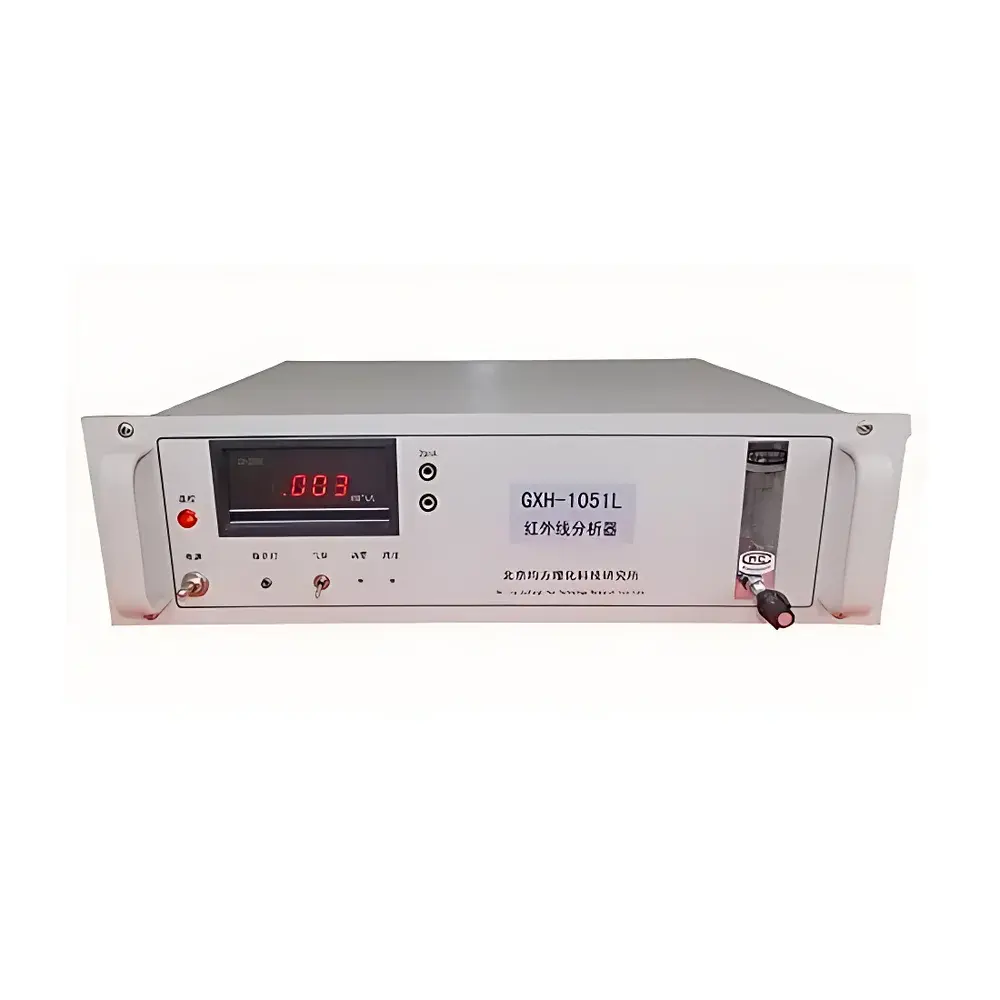
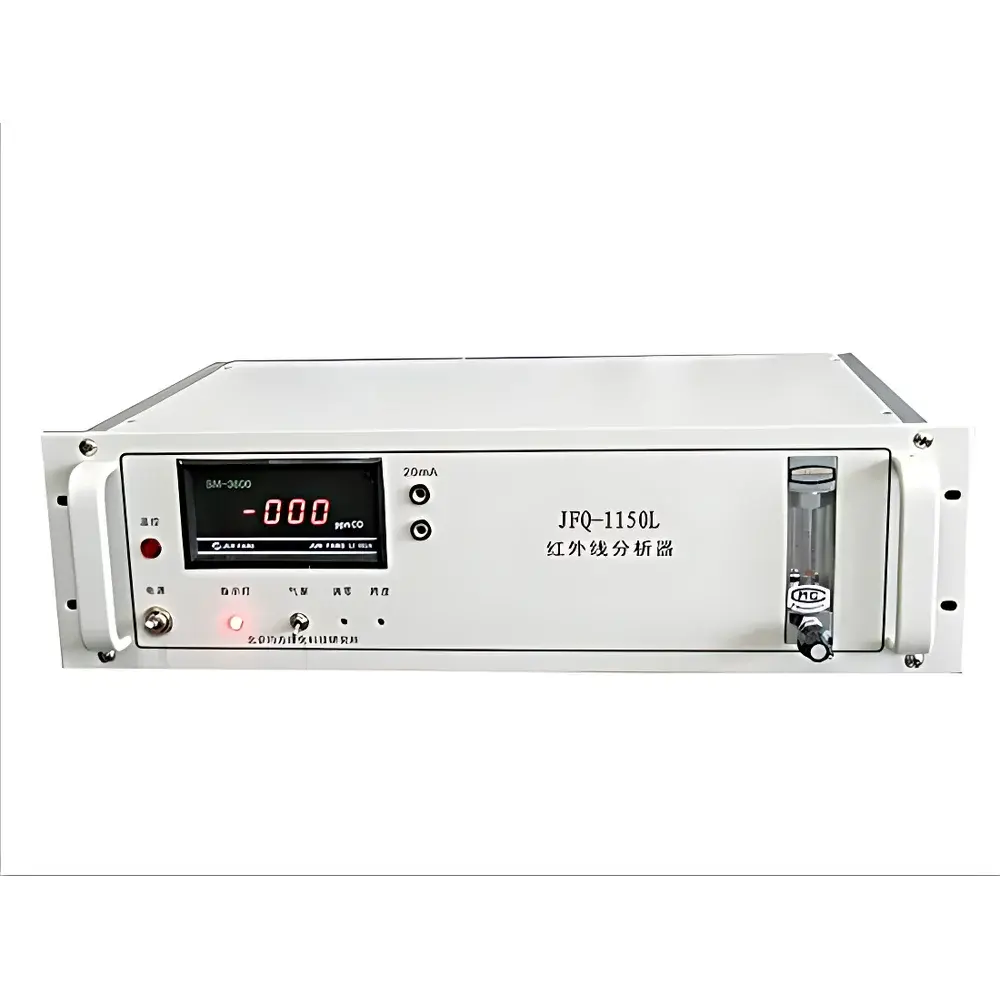
MSR GXH-1051L Online Carbon Monoxide Analyzer
| Brand | MSR (Msfang Li Hua) |
|---|---|
| Origin | Beijing, China |
| Model | GXH-1051L |
| Instrument Type | Online Gas Analyzer |
| Measured Gas | CO (Carbon Monoxide) |
| Measurement Principle | Non-Dispersive Infrared (NDIR) Absorption |
| Range | 0–50 ppm (standard), customizable up to 0–100% vol |
| Repeatability | ≤ ±1% FS |
| Linearity Error | ≤ ±2% FS |
| Zero Drift | ≤ ±1% FS / 48 h |
| Span Drift | ≤ ±1% FS / 48 h |
| Response Time (T90) | ≤ 30 s |
| Resolution | 0.1 ppm (minimum) |
| Warm-up Time | ≤ 60 min |
| Operating Humidity | ≤ 90% RH (non-condensing) |
| Power Supply | AC 220 V ±10%, 50 Hz ±5% |
| Output Signal | 4–20 mA analog |
| Sample Pump | Integrated diaphragm pump |
| Enclosure | Rack-mountable embedded chassis |
| Temperature Control | Internal thermostatic stabilization |
Overview
The MSR GXH-1051L Online Carbon Monoxide Analyzer is an industrial-grade, continuous-emission monitoring (CEM) instrument engineered for real-time, in-situ quantification of carbon monoxide (CO) concentration in process gas streams. It operates on the physical principle of non-dispersive infrared (NDIR) absorption spectroscopy—leveraging the characteristic fundamental vibrational absorption band of CO near 4.6 µm. This optical method delivers high selectivity against common interferents (e.g., CO2, CH4, H2O vapor) when combined with narrow-band interference filters and temperature-stabilized detector architecture. Designed for unattended operation in demanding environments—including stack gas monitoring, combustion control loops, chemical reactor off-gas analysis, and indoor air quality (IAQ) surveillance—the GXH-1051L integrates a built-in sampling pump, flow regulation, particulate filtration, and internal thermostatic control to ensure measurement stability across ambient fluctuations. Its rack-mountable embedded chassis enables seamless integration into PLC-controlled SCADA systems or centralized environmental monitoring platforms.
Key Features
- NDIR optical detection system with dual-wavelength reference compensation for enhanced long-term drift resistance
- Integrated sample handling: stainless-steel inlet, adjustable flow control (0.5–2.0 L/min), and particulate filter (5 µm) as standard
- Internal thermostatic regulation maintaining optical path and detector at constant temperature (±0.1 °C), minimizing thermal-induced signal drift
- High-resolution analog output (4–20 mA, isolated, HART-compatible) with configurable range mapping and fault signaling (e.g., sensor failure, flow loss)
- Low maintenance design: no consumables, no moving optical parts, and IR source lifetime exceeding 5 years under continuous operation
- Compliance-ready firmware supporting audit trails, calibration logging, and user-access-level controls aligned with GLP and ISO/IEC 17025 documentation requirements
Sample Compatibility & Compliance
The GXH-1051L is validated for use with dry, non-corrosive gas matrices typical of flue gas (post-desulfurization), syngas, biogas upgrading streams, HVAC ducts, and laboratory exhaust lines. For wet or acidic samples (e.g., raw flue gas), optional heated sample line and Nafion™ dryer integration are recommended. The analyzer meets key regulatory performance criteria outlined in GB/T 16157–1996 (China), HJ 75–2017 (Chinese CEMS Technical Specification), and aligns with functional equivalency benchmarks referenced in EPA Method 10 and EN 15267-3 for CO analyzers. While not certified to UL/CSA or ATEX standards out-of-the-box, its enclosure satisfies IP54 ingress protection and can be configured with explosion-proof housings (optional) for Zone 2 hazardous locations per IEC 60079-0.
Software & Data Management
The GXH-1051L supports local configuration via front-panel keypad and LCD display, with full parameter access—including zero/span calibration, alarm thresholds (high/low/fault), damping time, and diagnostic status—via Modbus RTU over RS-485. Optional Ethernet interface (TCP/IP) enables remote configuration, real-time data streaming, and historical log export (CSV) through standardized OPC UA servers. All calibration events, sensor diagnostics, and output deviations are timestamped and stored in non-volatile memory for ≥12 months. Firmware implements secure user roles (operator, engineer, administrator) and supports electronic signatures for critical actions, satisfying traceability requirements under FDA 21 CFR Part 11 when deployed in regulated manufacturing environments.
Applications
- Continuous emissions monitoring (CEMS) of CO in coal-fired, biomass, and waste-to-energy boiler stacks
- Combustion efficiency optimization in industrial furnaces and kilns via real-time CO feedback control
- Safety interlock systems in enclosed parking garages, tunnels, and underground facilities
- Process gas purity verification in hydrogen production (water-gas shift tail gas) and ammonia synthesis loops
- Environmental compliance reporting for municipal wastewater treatment plant biogas flaring systems
- Research-grade CO kinetics studies in catalytic reaction engineering laboratories
FAQ
What gases can interfere with CO measurement on the GXH-1051L?
Water vapor and high concentrations of CO2 (>10%) may induce minor cross-sensitivity; however, the NDIR optical design with spectral filtering and dual-wavelength compensation reduces this effect to <±0.5% FS under typical operating conditions.
Is field calibration required, and how often?
Zero calibration using certified nitrogen (or clean air) is recommended every 7 days for critical applications; span calibration with certified CO standard gas (e.g., 20 ppm in N2) is advised monthly or after maintenance—both supported via front-panel guided routines.
Can the GXH-1051L operate in sub-zero ambient temperatures?
The base unit is rated for 0–45 °C ambient; for outdoor or cold-climate deployment, an optional heated enclosure (–20 to +50 °C operational range) with condensate management is available.
Does it support digital communication protocols beyond Modbus?
Yes—firmware v2.3+ adds native support for BACnet MS/TP and MQTT over TLS, enabling direct integration with building management systems (BMS) and cloud-based IoT platforms.
How is measurement traceability maintained?
Each unit ships with a factory calibration certificate referencing NIST-traceable CO standards; internal EEPROM logs all calibrations with operator ID, timestamp, and before/after deviation values—exportable for QA audits.
Related Products







