
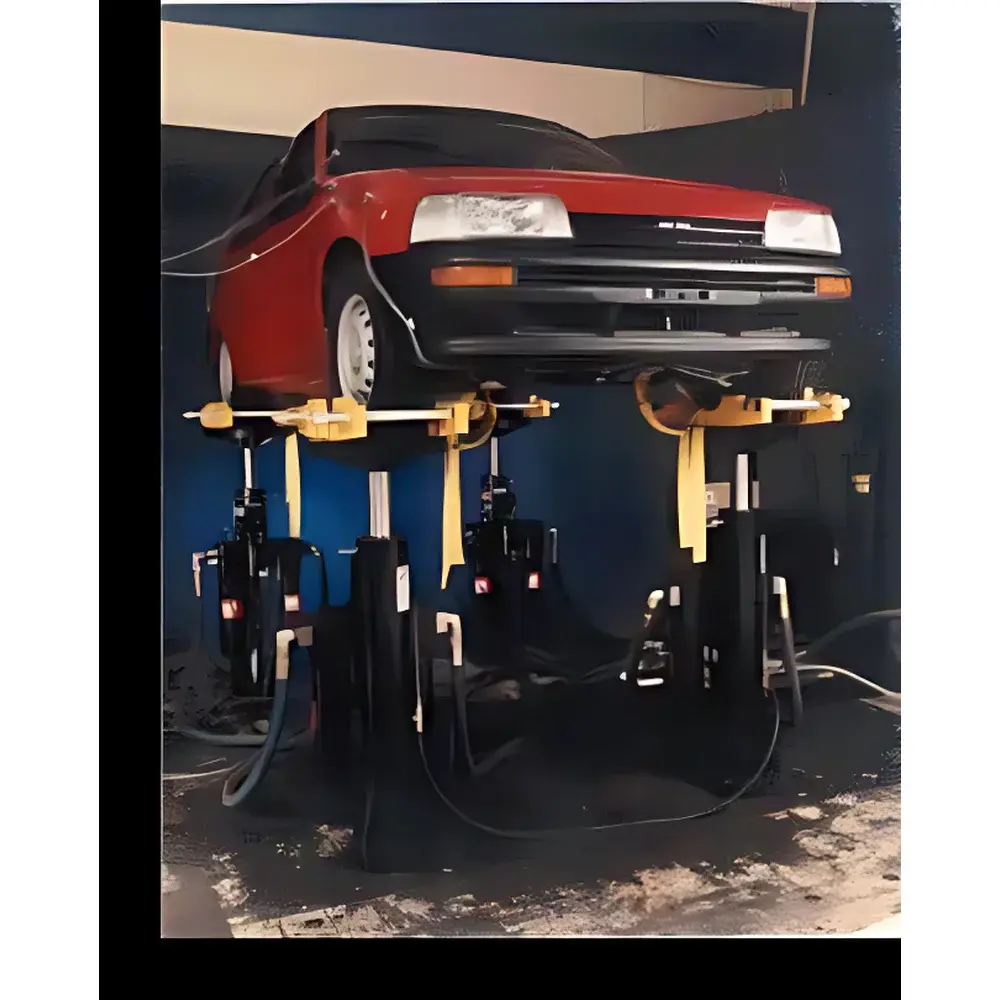
MTS 320 Four-Post Tire-Coupled Road Simulator
| Origin | USA |
|---|---|
| Manufacturer Type | Authorized Distributor |
| Origin Category | Imported |
| Model | 320 |
| Pricing | Upon Request |
Overview
The MTS 320 Four-Post Tire-Coupled Road Simulator is an electro-hydraulic, multi-axis physical testing system engineered for high-fidelity simulation of real-world road-induced dynamic loads on complete vehicles or subassemblies. Operating on the principle of tire-coupled excitation—where vertical displacement profiles derived from measured road surfaces are precisely replicated at each wheel station—the system enables controlled, repeatable, and traceable evaluation of structural integrity, suspension kinematics, ride quality, and interior noise generation. Unlike free-suspension shaker tables, the MTS 320 maintains full vehicle mass inertia and tire–road interface fidelity through direct coupling to production tires mounted on rigid wheel trays. Its four independently controlled hydraulic actuators deliver synchronized or decoupled motion in Z-axis (vertical), supporting both correlated (e.g., ISO 8608 road spectra) and uncorrelated (e.g., pothole, bump, curb impact) input profiles. Designed for integration with environmental chambers, the system supports thermal and humidity conditioning during testing—critical for evaluating material aging effects on NVH (Noise, Vibration, Harshness) behavior and fatigue life under realistic service conditions.
Key Features
- Four-channel independent hydraulic actuation with high-bandwidth servo-valve control, enabling precise replication of time-domain road profiles up to 100 Hz bandwidth (dependent on payload and amplitude)
- Modular actuator mounting: floor-recessed installation option for seamless integration with climate-controlled environmental enclosures (−40 °C to +85 °C, 10–95% RH)
- Automated wheelbase and track-width adjustment via motorized carriage system, configurable via front-panel interface or optional remote control unit (validated for QA/QC audit workflows)
- Dual-mode servo-valve architecture: high-flow valve for high-force fatigue cycling (up to ±150 kN per channel, typical); low-flow precision valve for fine-amplitude, high-sensitivity NVH excitation (sub-0.1 mm resolution)
- Integrated data acquisition synchronization: analog and digital I/O channels time-stamped to <10 µs resolution, compliant with IEEE 1588 PTP v2 for distributed test systems
- Structural frame rated for static load capacity ≥30,000 kg; optimized for passenger cars, SUVs, light/medium/heavy-duty trucks (configurable per MTS part-number variants: 320-025A, 320-035A, 320-050A, 320-100A, 320-200B)
Sample Compatibility & Compliance
The MTS 320 accommodates full-vehicle testing across OEM-defined weight classes—from compact sedans (≤1,800 kg) to Class 8 commercial trucks (≤36,000 kg GVWR)—without disassembly. Wheel trays accept standard production tires (R12–R24), with optional quick-change hub adapters for rapid vehicle swap. The system complies with mechanical safety standards including ISO 12100 and ANSI B11.0, and its control architecture supports validation under automotive functional safety guidelines (ISO 26262 ASIL-B). When operated within validated environmental chambers, test protocols align with SAE J2412 (acoustic durability), ISO 10326-1 (ride comfort), and ASTM E1847 (road surface profile characterization). Data logging and audit trails meet GLP/GMP requirements per FDA 21 CFR Part 11 when configured with MTS TestSuite™ software and electronic signature modules.
Software & Data Management
Control and analysis are performed using MTS TestSuite™, a Windows-based platform supporting real-time closed-loop control, waveform playback (from ISO, SAE, or user-recorded road files), and automated test sequencing. All raw sensor data—including actuator position, force, acceleration, temperature, and acoustic pressure—are stored in HDF5 format with embedded metadata (test ID, operator, calibration status, environmental setpoints). Built-in FFT, order tracking, and coherence analysis tools support root-cause diagnosis of squeaks, rattles, and buzzes (SRB). Export options include CSV, MATLAB .mat, and ASAM MDF 4.1 for third-party post-processing. Role-based access control, electronic signatures, and immutable audit logs ensure regulatory traceability for ISO/IEC 17025-accredited laboratories.
Applications
- Body-in-white (BIW) and chassis fatigue validation per GM W3175, Ford CETP, and VW PV1210 specifications
- Ride quality benchmarking against ISO 2631-1 and SAE J1050 metrics using repeatable spectral inputs
- NVH troubleshooting: isolation of trim panel resonances, bushing nonlinearities, and joint microslip mechanisms under thermally cycled conditions
- Suspension component durability assessment—including control arms, ball joints, and air springs—under combined vertical and phase-shifted inputs
- Early-stage vehicle development: correlation of virtual road-load data (from multibody simulation) with physical test results to refine CAE models
- Supplier component release testing: verification of Tier-1 parts against OEM-specific durability and acoustic thresholds
FAQ
What types of road profiles can the MTS 320 replicate?
It supports time-history waveforms acquired from laser profilometers (e.g., ARAN, ROMDAS), synthesized spectra (ISO 8608, SAE J1211), and user-defined transient events (e.g., speed bumps, expansion joints).
Can the system perform both fatigue and NVH testing on the same vehicle without hardware reconfiguration?
Yes—via the dual-servo-valve module, which allows automatic switching between high-force (fatigue) and low-force/high-resolution (NVH) modes under software command.
Is environmental chamber integration supported as a factory-installed option?
Yes—MTS offers turnkey integration with leading environmental chamber suppliers (Weiss, ESPEC, Angelantoni), including structural reinforcement, thermal shielding, and sealed feedthroughs for hydraulic and signal lines.
How is test repeatability ensured across multiple test runs or different operators?
Through NIST-traceable actuator calibration, automated setup validation routines, and parameter-locking features in TestSuite™ that enforce identical boundary conditions, loading sequences, and data sampling rates.
Does the system support remote monitoring and diagnostics?
Yes—via secure HTTPS-enabled web interface and OPC UA server, allowing real-time status viewing, alarm notification, and predictive maintenance alerts based on hydraulic pressure decay and valve response trends.
Related Products



