
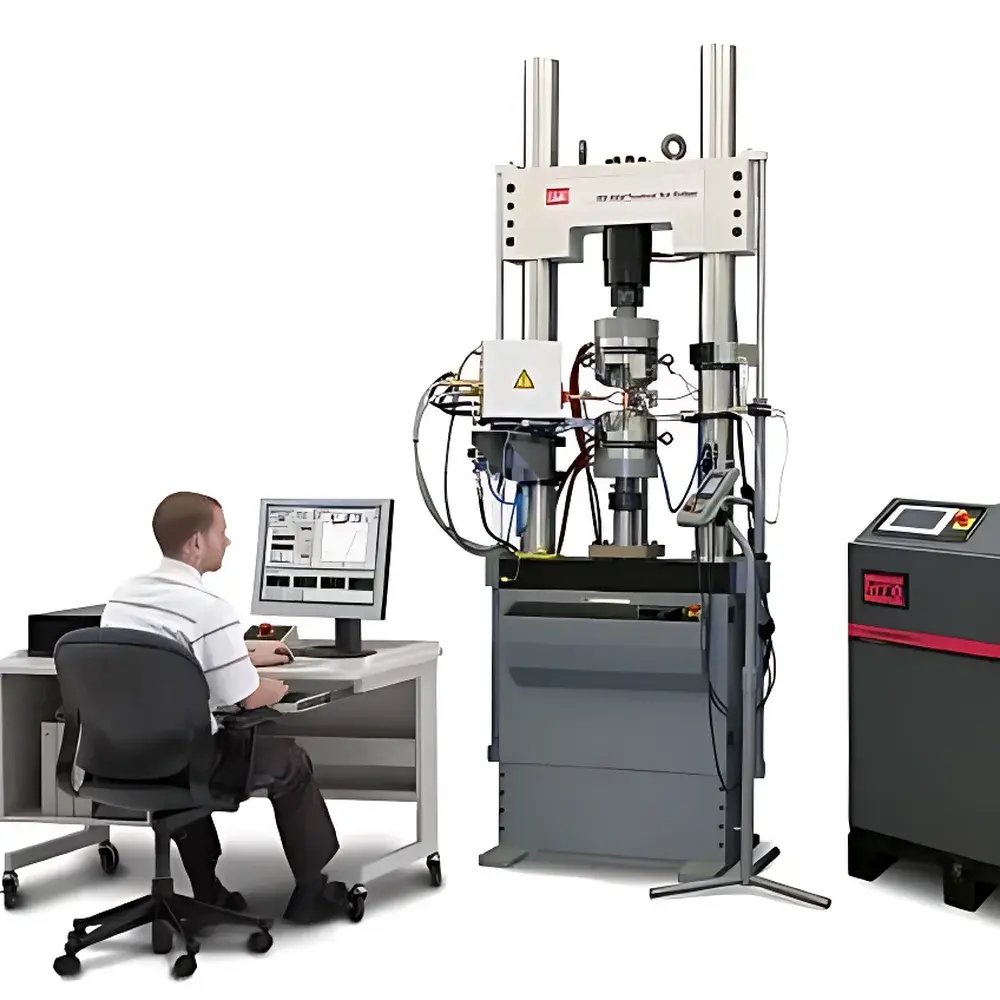
MTS 809 Electro-Hydraulic Servo Axial-Torsional Combined Fatigue Testing System
| Brand | MTS |
|---|---|
| Origin | USA |
| Model | MTS 809 |
| Maximum Test Load | 1000 kN |
| Machine Weight | 1100–3100 kg |
| Instrument Type | Electro-Hydraulic Servo Fatigue Testing System |
| Category | Axial-Torsional Combined Loading System |
Overview
The MTS 809 Electro-Hydraulic Servo Axial-Torsional Combined Fatigue Testing System is a high-performance, dual-actuation mechanical test platform engineered for rigorous evaluation of material and component behavior under complex multiaxial loading conditions. Utilizing synchronized electro-hydraulic servo control, the system applies precisely coordinated axial force and torsional moment to specimens—enabling true biaxial stress-state simulation that reflects real-world service environments such as rotating shafts, turbine blades, biomedical implants, and structural fasteners. Unlike uniaxial fatigue systems, the MTS 809 implements independent closed-loop control of both axial displacement/force and torsional angle/torque, supporting advanced waveform synthesis (e.g., in-phase, out-of-phase, elliptical, or Lissajous path loading) in accordance with ASTM E1937, ISO 1099, and ASTM E2207 standards for multiaxial fatigue testing.
Key Features
- Integrated dual-axis electro-hydraulic servo architecture with independently controlled axial and torsional actuators, each equipped with high-bandwidth servo valves and precision feedback transducers.
- Maximum axial static load capacity of 1000 kN, supported by a rigid, preloaded frame structure designed to minimize deflection and maintain alignment stability during high-cycle fatigue operation.
- Modular load train configuration accommodating interchangeable grip systems—including hydraulic wedge grips, torsional collet chucks, and custom adapter interfaces—for metallic, composite, and polymer specimens ranging from sub-mm wires to large-diameter forgings.
- Real-time synchronization of axial and torsional actuation with phase resolution better than ±0.5°, enabling accurate reproduction of non-proportional loading paths critical for critical plane analysis and multiaxial fatigue life prediction models.
- Rugged mechanical design with machine weight spanning 1100–3100 kg depending on configuration—optimized for installation on reinforced concrete foundations to ensure vibration isolation and long-term metrological stability.
Sample Compatibility & Compliance
The MTS 809 accommodates standardized and custom specimen geometries per ASTM E606 (strain-controlled fatigue), ASTM E466 (force-controlled constant amplitude), and ISO 12106 (axial-torsional fatigue). Specimen mounting options support round, tubular, cruciform, and notched configurations up to 150 mm diameter. All control algorithms and data acquisition routines comply with ISO/IEC 17025 requirements for testing laboratories, and the system supports audit-ready documentation for GLP and GMP-regulated applications—including FDA 21 CFR Part 11-compliant electronic signatures when integrated with MTS TestSuite™ software.
Software & Data Management
Control and analysis are performed using MTS TestSuite™ MX software—a Windows-based, modular platform featuring intuitive test sequence scripting, real-time waveform monitoring, and automated pass/fail evaluation against user-defined limits. The software provides native support for DIC (Digital Image Correlation) integration, strain gauge signal conditioning, and high-speed transient capture at up to 10 kHz sampling rate across all channels. All test data—including raw sensor outputs, calculated engineering parameters (e.g., shear strain amplitude, von Mises equivalent stress), and metadata—are stored in a structured, timestamped binary format (.tdms) with embedded calibration traceability and full revision history. Export options include CSV, HDF5, and MATLAB-compatible files for post-processing in third-party fatigue life modeling tools (e.g., nCode DesignLife, FEMFAT).
Applications
- Multiaxial fatigue characterization of aerospace alloys (Ti-6Al-4V, Inconel 718) under combined tension-torsion loading for engine component certification.
- Biomechanical evaluation of orthopedic implant interfaces—including screw-bone and stem-cement interactions—under physiological cyclic loading profiles.
- Development and validation of constitutive models for anisotropic composites subjected to non-proportional loading histories.
- Qualification testing of high-strength bolted joints and welded connections in offshore and wind energy structures per DNV-RP-C203 and IIW recommendations.
- Fundamental research into crack initiation and propagation mechanisms under biaxial stress states, including critical plane method validation and microstructural fatigue response mapping.
FAQ
What types of control modes does the MTS 809 support?
It supports force-controlled, displacement-controlled, and strain-controlled modes for both axial and torsional axes—individually or in coordinated multiaxial profiles.
Is the system compatible with extensometers and torque transducers from third-party manufacturers?
Yes—MTS 809 features universal analog and digital I/O interfaces compliant with IEEE 1451.4 TEDS standards, enabling plug-and-play integration with calibrated sensors from major vendors.
Can the system perform thermomechanical fatigue (TMF) testing?
While the base MTS 809 is a mechanical-only platform, it can be integrated with environmental chambers (e.g., MTS 653 series) and infrared heating systems to enable coupled thermal-mechanical axial-torsional fatigue protocols.
What foundation requirements apply for installation?
A minimum 1.2 m thick reinforced concrete slab with isolated footing is recommended; detailed dynamic load spectra and anchoring specifications are provided in the MTS Foundation Design Guide (Doc. No. 809-FDN-001).
Does the system meet ISO 17025 accreditation requirements for accredited testing labs?
Yes—the system’s traceable calibration hierarchy, uncertainty budget documentation, and software validation packages align with ILAC-G8:2022 and ISO/IEC 17025:2017 clause 6.4 and 6.5 requirements.



