
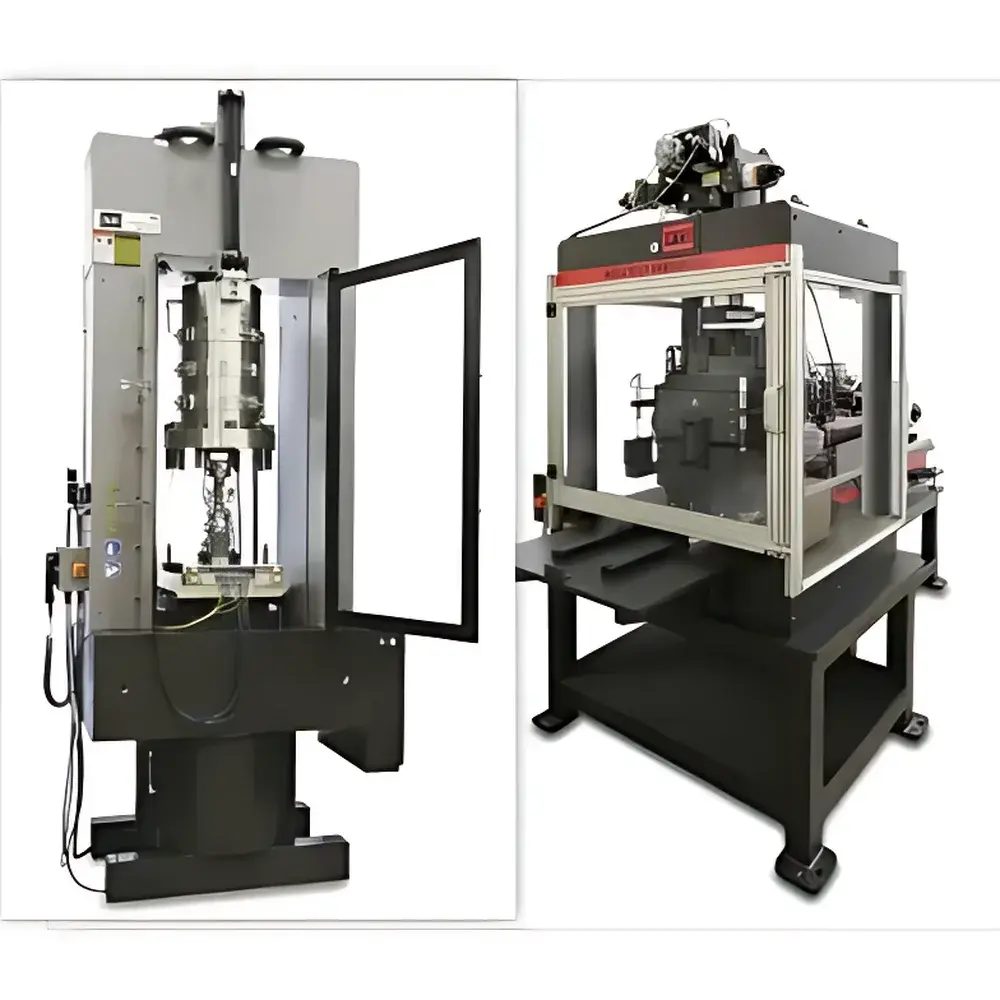
MTS 815 / 816 Rock Mechanics Testing System
| Brand | MTS |
|---|---|
| Origin | USA |
| Model | MTS 815 / MTS 816 |
| Maximum Test Load | 4600 kN |
| Application Scope | Uniaxial & Triaxial Mechanical Testing of Rocks, Concrete, and Geomaterials |
| Compliance Context | ASTM D7012, ISO 14689, USP <1042>, GLP/GMP-Aware Data Audit Trail Support |
| Environmental Capability | Up to 140 MPa Confining Pressure, Up to 120°C Temperature, Up to 20,000 psi Pore Fluid Pressure |
Overview
The MTS 815 and MTS 816 Rock Mechanics Testing Systems are high-capacity, electro-hydraulic servo-controlled testing platforms engineered for precision mechanical characterization of geological and civil engineering materials under simulated in-situ conditions. These systems operate on the principles of controlled stress–strain response measurement via closed-loop hydraulic actuation, enabling rigorous evaluation of elastic modulus, Poisson’s ratio, peak strength, post-peak softening behavior, fracture toughness, and time-dependent deformation (creep and relaxation). Designed specifically for geomechanics laboratories, oilfield research centers, and nuclear waste repository assessment programs, the MTS 815/816 platforms support standardized uniaxial compression, triaxial compression, direct shear, and coupled thermo-hydro-mechanical (THM) testing protocols—fully compliant with ASTM D7012 (Standard Test Methods for Compressive Strength and Elastic Moduli of Intact Rock Core Specimens), ISO 14689 (Geotechnical Investigation and Testing — Identification and Classification of Rock), and relevant sections of API RP 11S1 and USP (Mechanical Testing of Solid Dosage Forms, adapted for structural integrity benchmarking).
Key Features
- Robust dual-column or four-column load frame architecture rated for 4600 kN axial capacity, optimized for high-stiffness loading paths and minimal frame compliance during high-pressure triaxial tests.
- Integrated digital control system with real-time PID tuning, capable of synchronized multi-channel control of axial load, confining pressure, pore fluid pressure, temperature, and acoustic emission signals.
- Modular accessory ecosystem including MTS Triaxial Pressure Vessels (up to 140 MPa), Direct Shear Test Kits (for cylindrical, prismatic, and irregular specimens), and Ultrasonic Pulse Transmission Modules (operating at 0.5–5 MHz transducer frequencies).
- Thermal management interface supporting heating jackets and cooling circuits compatible with sustained operation at 120°C and rapid thermal ramping rates ≤2°C/min.
- Load cell calibration traceable to NIST standards; displacement measurement via high-resolution LVDTs (≤0.1 µm resolution) and optical extensometers for non-contact strain monitoring.
Sample Compatibility & Compliance
The MTS 815/816 accommodates specimen geometries ranging from standard Ø50 mm × 100 mm rock cores to large-diameter concrete cylinders (up to Ø300 mm) and irregular fracture network samples. It supports testing of low-porosity crystalline rocks (e.g., granite, basalt), high-porosity sedimentary formations (e.g., sandstone, limestone), cementitious composites, shale, and synthetic geomaterial analogs. All test sequences adhere to audit-ready data governance: electronic records comply with FDA 21 CFR Part 11 requirements through optional electronic signature modules and immutable audit trails. System validation documentation aligns with ISO/IEC 17025:2017 for testing laboratories and supports GLP and GMP-aligned quality assurance workflows.
Software & Data Management
TestMaster™ NX software provides unified control, acquisition, and analysis across all MTS rock mechanics configurations. It enables script-based test sequencing (including cyclic loading, stepwise confinement ramping, and hold-and-monitor routines), real-time visualization of stress–strain–pore pressure–temperature (σ–ε–pf–T) hypersurfaces, and automated export to HDF5, CSV, and MATLAB-compatible formats. Advanced post-processing tools include AE event clustering, ultrasonic velocity tomography reconstruction, and elastic tensor inversion from multi-directional wave propagation data. All software modules undergo annual cybersecurity hardening per IEC 62443-3-3 and maintain full backward compatibility with legacy MTS 810-series test definitions.
Applications
- Deep geothermal reservoir characterization: quantifying thermally induced microcrack evolution under coupled thermal–mechanical loading.
- CO2 sequestration caprock integrity assessment: measuring time-dependent permeability changes under sustained supercritical CO2 saturation and elevated confining stress.
- Nuclear waste disposal host rock evaluation: determining long-term creep strain accumulation in bentonite–granite interfaces at 90–120°C.
- Hydraulic fracturing design support: deriving anisotropic fracture initiation pressures and breakdown energy thresholds in laminated shale cores.
- Civil infrastructure durability modeling: correlating ultrasonic attenuation spectra with chloride ingress depth and alkali–silica reaction progression in aged concrete.
FAQ
What is the maximum confining pressure achievable with the MTS Triaxial Pressure Vessel?
The standard MTS 656 Triaxial Pressure Vessel supports up to 140 MPa (20,000 psi) confining pressure, with optional high-pressure variants rated to 200 MPa for ultra-deep crustal simulation studies.
Can the MTS 815/816 perform true triaxial (σ1 ≠ σ2 ≠ σ3) testing?
Yes—the platform supports biaxial and true triaxial configurations via add-on independent lateral actuation modules, enabling principal stress path control beyond conventional axisymmetric triaxial constraints.
Is ultrasonic velocity measurement integrated into the base system or an optional upgrade?
Ultrasonic pulse transmission and reception capability is available as a factory-integrated option; it requires no field retrofitting and shares synchronization clocks with the main controller for sub-microsecond timing accuracy.
Does the system meet regulatory requirements for pharmaceutical or medical device material testing?
While primarily designed for geomechanics, its mechanical integrity verification protocols and 21 CFR Part 11-compliant software options make it suitable for USP -aligned solid dosage form characterization when configured with appropriate fixtures and validation packages.
What level of technical support and calibration services does MTS provide globally?
MTS offers on-site installation qualification (IQ), operational qualification (OQ), and performance qualification (PQ) services through certified regional service engineers; annual metrological recalibration is traceable to national standards bodies (NIST, PTB, NPL) and includes uncertainty budgets per ISO/IEC 17025.



