
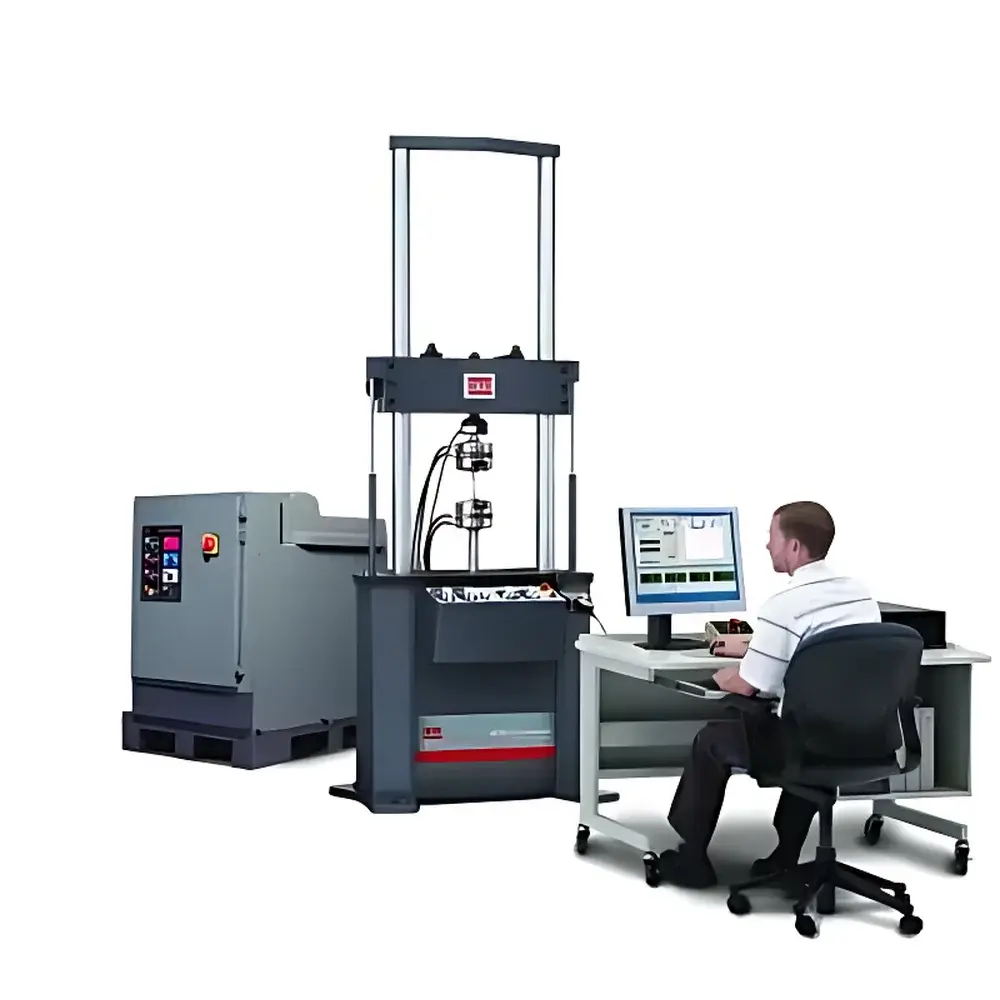
MTS Landmark Electro-Hydraulic Servo Testing System
| Brand | MTS |
|---|---|
| Origin | USA |
| Model | Landmark Series |
| Max Test Load | 500 kN |
| Frequency Range | < 200 Hz |
| Frame Weight | 635–1760 kg |
| Type | Electro-Hydraulic Servo Fatigue Testing Machine |
| Compliance | ASTM E4, E8, E606, E647, ISO 1099, ISO 6892-1, ASTM D3479, USP <1042>, FDA 21 CFR Part 11 (with optional audit trail module) |
Overview
The MTS Landmark Electro-Hydraulic Servo Testing System is a high-performance, vertically oriented materials testing platform engineered for precision static, dynamic, and fatigue characterization of structural components and advanced engineering materials. Built upon MTS’s decades-long heritage in servo-hydraulic actuation, the Landmark series employs closed-loop electro-hydraulic control architecture to deliver exceptional force fidelity, displacement resolution, and waveform tracking accuracy across a broad operational bandwidth (< 200 Hz). Its core measurement principle relies on real-time feedback from high-stability load cells, linear variable differential transformers (LVDTs), and strain gauges—integrated into a rigid, low-resonance frame designed to minimize parasitic motion and maintain test integrity under high-cycle loading conditions. As a direct successor to legacy platforms such as the MTS 810 and 858 systems, the Landmark series incorporates refined hydraulic manifold design, optimized valve response dynamics, and enhanced thermal management to ensure long-term stability during extended fatigue campaigns—critical for R&D labs, aerospace component qualification centers, and Tier-1 automotive suppliers conducting ASTM E606 (low-cycle fatigue), E647 (crack growth rate), and ISO 1099 (high-cycle fatigue) compliant testing.
Key Features
- Vertically configured, high-rigidity frame with reinforced crosshead guidance and integrated alignment verification system
- Patented self-aligning hydraulic actuator with zero-offset piston rod sealing and minimal lateral play—reducing specimen misalignment-induced scatter in fatigue life data
- High-bandwidth, multi-channel digital controller (MTS FlexTest® SE) supporting up to 16 synchronized I/O channels with sub-millisecond sampling resolution
- Quiet, air-cooled hydraulic power unit (HPU) featuring pressure-compensated variable-displacement pumps and active filtration (β≥200 at 5 µm) for extended fluid service life
- Modular test space design accommodating custom fixtures, environmental chambers (−70 °C to +350 °C), and in-situ imaging accessories (DIC, thermography)
- Factory-calibrated force measurement traceable to NIST standards with linearity ≤ ±0.5% of full scale and repeatability ≤ 0.25% RMS
Sample Compatibility & Compliance
The Landmark system supports standardized and non-standard specimens across metallic alloys (aluminum, titanium, superalloys), fiber-reinforced composites (CFRP, GFRP), welded joints, castings, and additively manufactured parts. Its modular load train enables rapid reconfiguration for tension-tension, compression-compression, push-pull, or torsional fatigue modes. All hardware and firmware configurations meet essential regulatory and industry compliance requirements—including mechanical safety per ISO 12100, electromagnetic compatibility (EMC) per EN 61326-1, and software validation support for GLP/GMP environments. Optional audit-trail-enabled software modules satisfy FDA 21 CFR Part 11 requirements for electronic records and signatures, while built-in test method libraries align with ASTM E4 (load verification), E8/E8M (tensile properties), and ISO 6892-1 (metallic materials tensile testing at ambient temperature).
Software & Data Management
Control and analysis are executed via MTS TestSuite™ software—a Windows-based application offering intuitive workflow-driven test sequencing, real-time parameter monitoring, and automated pass/fail evaluation against user-defined acceptance criteria. The platform supports scripting (Python API integration), batch processing of multi-specimen programs, and direct export to common engineering formats (CSV, HDF5, MATLAB .mat). Raw data streams—including force, displacement, strain, and auxiliary sensor inputs—are time-stamped with microsecond precision and stored in a structured database with role-based access control. For enterprise deployment, TestSuite™ integrates seamlessly with LIMS and PLM systems through OPC UA and RESTful web services, enabling traceable data lineage from test initiation through final report generation.
Applications
- Aerospace: Full-scale fatigue testing of landing gear components, turbine disk simulations, and damage tolerance assessment per FAA AC 20-107B
- Automotive: Powertrain durability validation (engine mounts, suspension links), crash pulse simulation, and NVH-related dynamic stiffness characterization
- Biomedical: Cyclic loading of orthopedic implants (ISO 14801), stent fatigue testing (ASTM F2516), and polymer scaffold degradation studies
- Energy: Wind turbine blade root joint testing, nuclear fuel cladding cyclic creep evaluation, and geothermal material performance under thermo-mechanical coupling
- Academic Research: Multiaxial fatigue under proportional/non-proportional loading paths, crack initiation mapping using acoustic emission synchronization, and machine learning–driven feature extraction from high-frequency waveform datasets
FAQ
What is the maximum achievable test frequency for a 500 kN Landmark system under sinusoidal loading?
Under full-load sinusoidal excitation, the practical upper limit is 100 Hz; however, with reduced amplitude and optimized hydraulic tuning, controlled waveforms up to 195 Hz may be sustained within specified force error bands (±2% peak-to-peak).
Does the Landmark system support closed-loop strain control during high-cycle fatigue tests?
Yes—when equipped with extensometers or non-contact strain measurement (e.g., digital image correlation), the FlexTest® SE controller executes true dual-closed-loop control (force + strain) with independent gain scheduling per channel.
Can existing MTS 810 fixtures and controllers be retrofitted to a Landmark frame?
Mechanical fixtures with compatible mounting interfaces (e.g., ISO 2620-compliant grip adapters) are generally interoperable; however, legacy controllers require replacement with current-generation FlexTest® hardware to ensure full software compatibility and real-time communication latency compliance.
Is thermal compensation available for long-duration creep-fatigue interaction tests?
Yes—optional integrated temperature sensors in the load train and frame, coupled with adaptive PID tuning algorithms in TestSuite™, enable automatic gain adjustment based on real-time thermal drift measurements.
How is calibration traceability maintained across global MTS service centers?
All MTS-certified calibration laboratories operate under ISO/IEC 17025 accreditation, with force calibration performed using deadweight machines traceable to NIST, PTB, or NPL primary standards—and documented in machine-readable calibration certificates with uncertainty budgets.



