
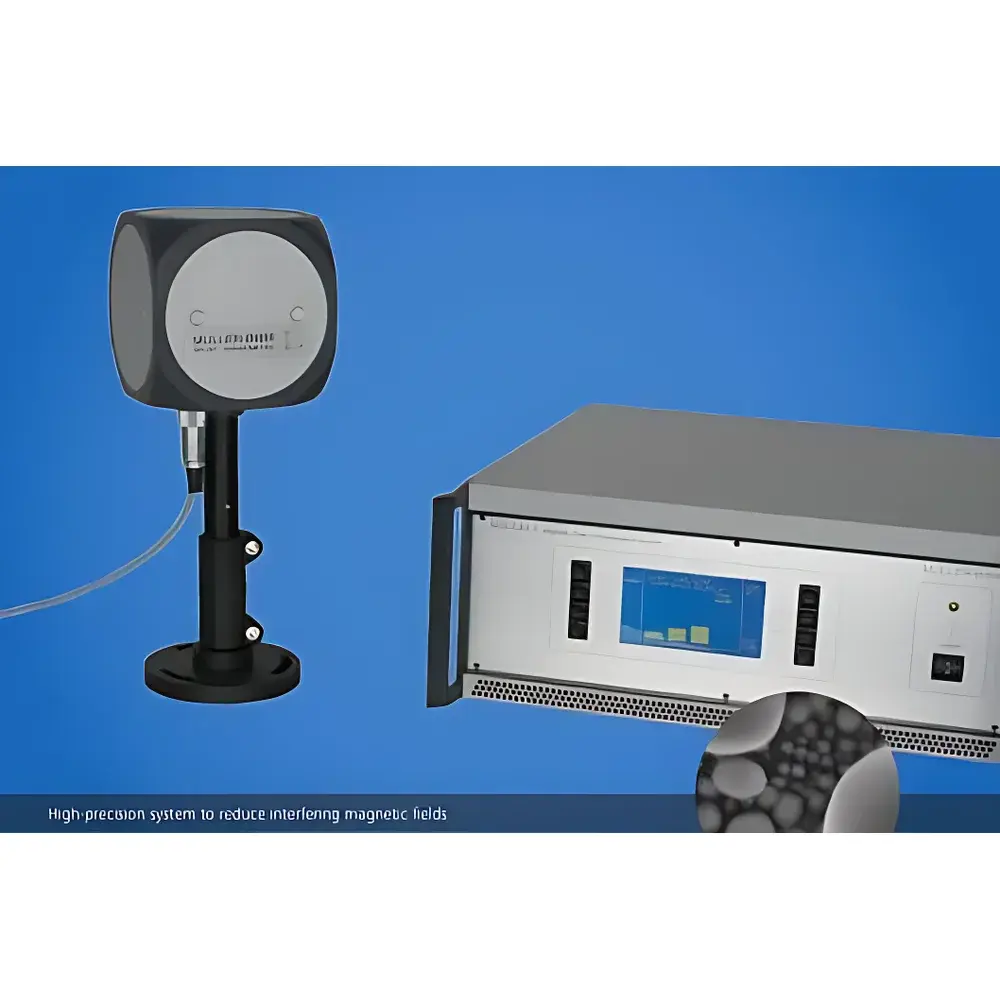
Müller-BBM MACOM II® Active Magnetic Field Compensation System
| Brand | Müller-BBM |
|---|---|
| Origin | Germany |
| Model | MACOM II® |
| Frequency Range | 0 Hz – 50 kHz |
| Operating Axes | 3-axis (X, Y, Z) |
| Interface | RS-232 serial + Ethernet (TCP/IP) |
| Display | Integrated LCD for real-time monitoring of residual field & coil current per axis |
| Compliance | Designed for GLP/GMP-adjacent environments |
Overview
The Müller-BBM MACOM II® Active Magnetic Field Compensation System is an engineered solution for achieving ultra-stable ambient magnetic conditions in high-sensitivity electron optical installations. It operates on the principle of vector field cancellation: three orthogonal sets of compensation coils generate precisely controlled counter-fields that oppose time-varying external magnetic disturbances—whether quasi-static (e.g., from elevators, moving steel structures, or DC-powered trams) or dynamic (e.g., 50 Hz power harmonics, switching transients in building supply networks). Unlike passive shielding alone, which attenuates but cannot adapt to temporal fluctuations, the MACOM II® continuously measures ambient field components using patented wideband fluxgate sensors and dynamically adjusts coil currents in real time. This active feedback architecture enables sub-nT residual field stability across a uniquely broad spectral bandwidth—from true DC (0 Hz) up to 50 kHz—making it especially suited for environments where both low-frequency drift and high-frequency noise coexist, such as TEM/SEM laboratories located near urban infrastructure or industrial facilities.
Key Features
- Patented wideband fluxgate sensor array with 0 Hz–50 kHz operational bandwidth, enabling simultaneous suppression of slow geomagnetic drift and fast transient interference.
- Three-axis independent compensation with real-time current regulation per axis, ensuring vectorial fidelity of the generated counter-field.
- Integrated LCD interface displaying instantaneous residual magnetic field (nT) and coil drive current (A) for each spatial axis—no external software required for basic monitoring or commissioning.
- Dual communication interface: RS-232 for local configuration and diagnostics; Ethernet (TCP/IP) for integration into facility-wide monitoring networks or secure remote access via authenticated VLANs.
- Self-calibrating design with factory-trimmed sensor offsets and temperature-compensated coil drivers—no routine recalibration or mechanical adjustment needed during service life.
- Modular coil layout compatible with installation inside mu-metal shielded rooms, Faraday cages, or standard laboratory spaces—supports retrofitting without structural modification.
Sample Compatibility & Compliance
The MACOM II® is purpose-built for integration with high-resolution electron beam instrumentation requiring long-term magnetic stability at the sub-nanotesla level. It is routinely deployed with transmission electron microscopes (TEM), scanning electron microscopes (SEM), electron beam lithography (EBL) systems, and MRI research platforms. Its control architecture complies with foundational requirements for regulated environments: event-logged parameter changes, timestamped operational records, and deterministic response behavior support traceability under ISO/IEC 17025, ASTM E2942 (for electron microscopy), and FDA 21 CFR Part 11 when paired with validated third-party data acquisition software. While not itself a medical device, its use in preclinical MRI development aligns with IEC 62708-1 electromagnetic compatibility guidelines for diagnostic imaging equipment.
Software & Data Management
The system includes embedded firmware supporting ASCII-based command protocols over serial and TCP/IP, allowing seamless integration with LabVIEW, Python (pySerial, socket), or MATLAB environments. Optional Müller-BBM-supplied software provides graphical visualization of time-series field residuals, frequency-domain analysis (FFT), and automated report generation (CSV/PDF) for QA documentation. All configuration changes—including filter cutoff frequencies, gain settings, and axis enable/disable states—are stored non-volatilely and logged with UTC timestamps. Remote monitoring sessions can be audited via server-side syslog forwarding or integrated into centralized SCADA platforms using standard Modbus TCP mapping (custom register map available upon request).
Applications
- Transmission and scanning electron microscopy: Mitigating image distortion, beam drift, and chromatic aberration induced by AC/DC magnetic perturbations.
- Electron beam lithography: Ensuring nanometer-scale pattern placement accuracy by stabilizing beam deflection in writing columns.
- High-field NMR and MRI development: Reducing low-frequency field inhomogeneity in prototype magnet assemblies prior to cryoshield integration.
- Fundamental physics experiments: Supporting atomic interferometry, spin-polarized electron transport studies, and quantum sensing setups requiring <1 nT RMS field stability over hours.
- Calibration laboratories: Maintaining ISO 17025-compliant magnetic environments for calibrating magnetometers, Hall probes, and SQUID-based measurement systems.
FAQ
What is the typical residual field performance after MACOM II® installation?
Typical residual field stability is ≤ 0.5 nT RMS in all three axes under representative urban electromagnetic conditions—measured using NIST-traceable triaxial fluxgate reference sensors.
Can MACOM II® operate inside a fully enclosed mu-metal room?
Yes. The system’s coil arrays are designed for internal mounting within shielded enclosures; calibration accounts for eddy current effects induced by conductive walls.
Does the system require periodic recalibration or maintenance?
No scheduled recalibration is required. The embedded sensors and coil drivers are thermally stabilized and factory-characterized for drift <0.02% per year.
Is remote firmware update supported?
Firmware updates are performed offline via USB memory stick or Ethernet TFTP—no internet connectivity is required during operation.
How is compliance with GLP/GMP documentation standards achieved?
All operational logs—including initialization events, parameter modifications, and fault alerts—are stored locally with ISO 8601 timestamps and exportable in machine-readable formats for inclusion in electronic lab notebooks (ELN) or LIMS workflows.



