
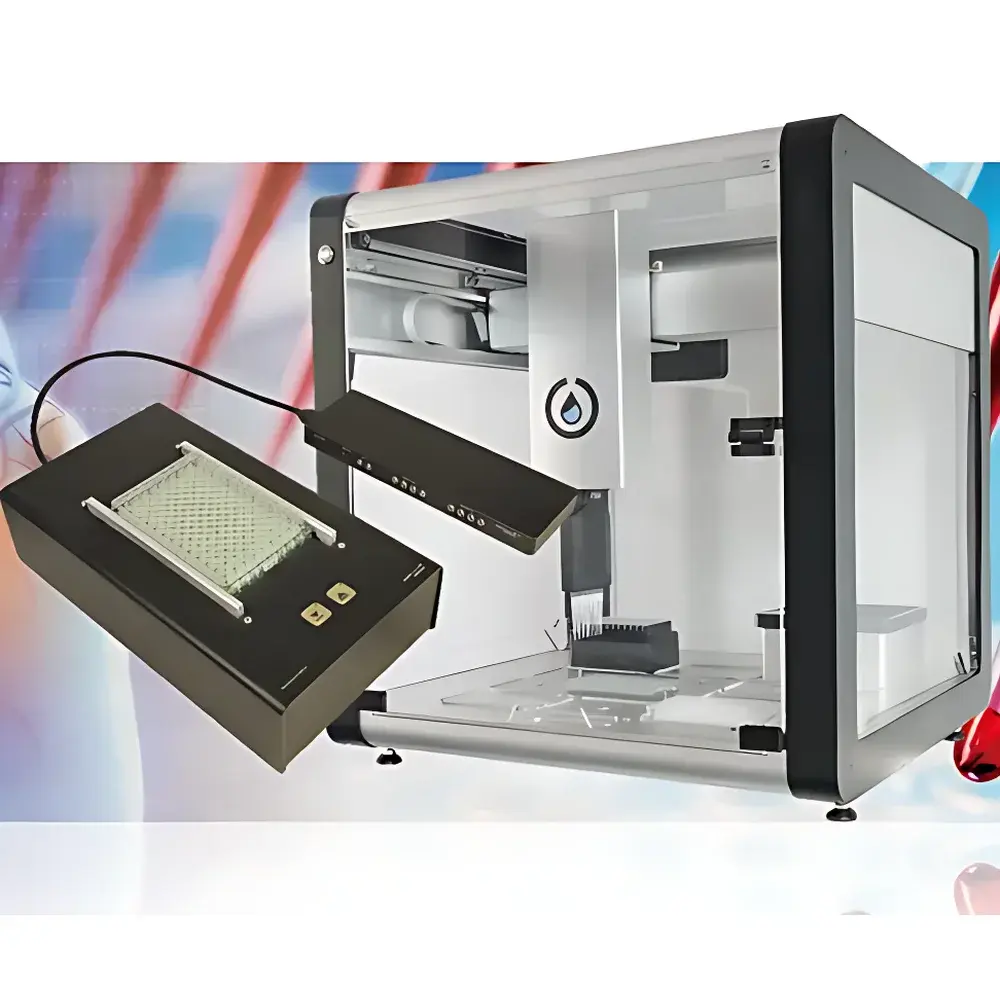
Multi Channel Systems MEA Xpress Automated High-Throughput Microelectrode Array Electrophysiology Platform
| Brand | Multi Channel Systems |
|---|---|
| Origin | Germany |
| Manufacturer Type | Original Equipment Manufacturer (OEM) |
| Product Origin | Imported |
| Model | MEA Xpress |
| Pricing | Upon Request |
| Sampling Rate | Up to 50 kHz |
| ADC Resolution | 24-bit |
| Pipetting Volume Range | 1–1000 µL (single-channel), 1–300 µL (8-channel) |
| Pipetting Accuracy (20–300 µL) | <5% systematic error / <2.5% random error (single-channel) |
| Environmental Operating Conditions | 20–24°C, 40–60% RH |
| Dimensions (W×D×H) | 63 × 57 × 66 cm |
| Weight | 40 kg |
| Throughput | ≤20 s per 96-well plate |
| Stimulator Output Range | ±5 V (DC), ±10 V (pulse), configurable for local electroporation |
| Compatible Substrates | Glass and epoxy-based 24-well and 96-well MEA plates |
Overview
The Multi Channel Systems MEA Xpress is an integrated, automated high-throughput electrophysiology platform engineered for rigorous in vitro functional phenotyping of excitable cells—primarily human iPSC-derived cardiomyocytes and neurons—under pharmacological challenge. At its core, the system combines a high-fidelity, low-noise analog front-end with real-time digital signal acquisition based on 24-bit analog-to-digital conversion and a maximum sampling rate of 50 kHz. This architecture enables faithful capture of both large-amplitude, low-frequency signals (e.g., field potentials from primary cardiomyocyte monolayers) and small-amplitude, high-frequency transients (e.g., spontaneous synaptic events or fast Na+ spikes in neuronal networks). Unlike conventional manual or semi-automated MEA systems, the MEA Xpress embeds a fully programmable robotic liquid handler (MEA Xpress Robot) directly into the electrophysiology workflow, enabling time-synchronized compound addition across multiwell MEA plates without interrupting ongoing recordings—a critical requirement for kinetic dose-response profiling and wash-free assay designs.
Key Features
- Integrated robotics: Dual-pipette head supports interchangeable single-channel (1–1000 µL) and 8-channel (1–300 µL) configurations, enabling flexible assay design across 24- and 96-well MEA formats.
- High-precision electrophysiology acquisition: 24-bit resolution and 50 kHz sampling ensure minimal quantization noise and accurate reconstruction of sub-millisecond waveform features, including upstroke velocity (dV/dtmax) and repolarization kinetics.
- Built-in biphasic stimulator: Delivers programmable voltage pulses (±5 V DC, ±10 V transient) for controlled local electroporation, pacing, and evoked response mapping—fully synchronized with recording triggers.
- Modular optical stimulation compatibility: Optional LED-based light activation module supports optogenetic interrogation (e.g., ChR2-expressing neurons or cardiomyocytes) with millisecond timing precision.
- Low-cost consumables: Direct compatibility with standard glass and epoxy-based 24- and 96-well MEA plates eliminates proprietary substrate lock-in and reduces long-term operational cost of ownership.
Sample Compatibility & Compliance
The MEA Xpress supports adherent and suspension-derived cell models cultured on commercially available planar MEA substrates. Validated applications include human iPSC-cardiomyocytes (iPSC-CMs), iPSC-neurons, primary rodent cortical/hippocampal cultures, and engineered cardiac microtissues. All hardware and firmware comply with IEC 61000-6-3 (EMC emission) and IEC 61000-6-2 (immunity) standards. The system’s data acquisition architecture supports audit-trail-enabled operation under GLP and GMP environments when used with compliant software configuration (e.g., timestamped metadata logging, user access control, and electronic signature support via optional validation package). It meets key requirements for preclinical safety pharmacology studies aligned with ICH S7B and FDA guidance on non-clinical assessment of proarrhythmic potential.
Software & Data Management
Acquisition and analysis are performed using MC_Rack v5.x, a modular, scriptable platform supporting both cardiac- and neuro-centric analysis pipelines. Cardiac modules compute field potential duration (FPD), beat rate variability (BRV), conduction velocity, and arrhythmia scoring (e.g., early afterdepolarizations, irregular beating). Neural modules extract spike rates, burst parameters (duration, inter-burst interval), network synchrony indices (e.g., cross-correlation lag), and spectral power in theta/gamma bands. Raw data is stored in HDF5 format with embedded metadata (stimulus protocol, pipetting timestamps, environmental logs), ensuring FAIR (Findable, Accessible, Interoperable, Reusable) compliance. Export options include CSV, MATLAB (.mat), and NWB 2.0 for integration with open neuroscience platforms.
Applications
- High-throughput cardiac safety screening: Quantitative assessment of hERG inhibition, sodium channel blockade, and multi-ion channel effects in iPSC-CM assays compliant with CiPA initiative standards.
- Neuropharmacology and neurotoxicity: Functional evaluation of GABAergic, glutamatergic, and dopaminergic modulators in human neuronal networks; detection of seizure-like activity and network hyperexcitability.
- Disease modeling: Longitudinal tracking of electrophysiological phenotypes in patient-derived iPSC lines (e.g., long QT syndrome, Rett syndrome, Alzheimer’s disease).
- Cell therapy quality control: Functional validation of cardiomyocyte or neuronal grafts prior to transplantation, including contractile synchrony and synaptic maturity metrics.
- Optogenetic circuit mapping: Combined electrical recording and light-triggered activation for probing connectivity and latency in co-cultures or organoids.
FAQ
Is the MEA Xpress compatible with third-party MEA plates?
Yes—the system interfaces natively with standard 24-well and 96-well MEA plates fabricated on glass or epoxy substrates from multiple suppliers (e.g., Axion BioSystems, Alpha MED Scientific, and custom OEM vendors), provided electrode pitch and connector pinout conform to ISO/IEC 60601-2-61 mechanical specifications.
Can the robotic arm perform serial dilutions or multi-step compound additions?
Yes—via user-defined protocols in MC_Rack, the robot supports sequential aspiration/dispense steps, cross-well transfers, and dynamic volume adjustment per well, enabling on-plate concentration gradients and multi-phase dosing regimens.
What level of environmental control does the system require during operation?
Stable ambient conditions are required: 20–24°C temperature and 40–60% relative humidity. While the system does not include active climate control, it is designed for integration into laminar flow hoods or temperature-stabilized incubator chambers with external CO2 regulation.
Does the system support FDA 21 CFR Part 11 compliance?
Out-of-the-box functionality includes audit trail generation and user authentication. Full Part 11 compliance requires deployment with validated IT infrastructure, documented SOPs, and optional IQ/OQ/PQ documentation packages available upon request.
How is calibration maintained across long-term experiments?
The system performs automatic zero-offset correction before each recording session. Gain calibration is traceable to NIST-certified reference voltages and verified annually via external metrology service—certificates are included with each maintenance visit.




