
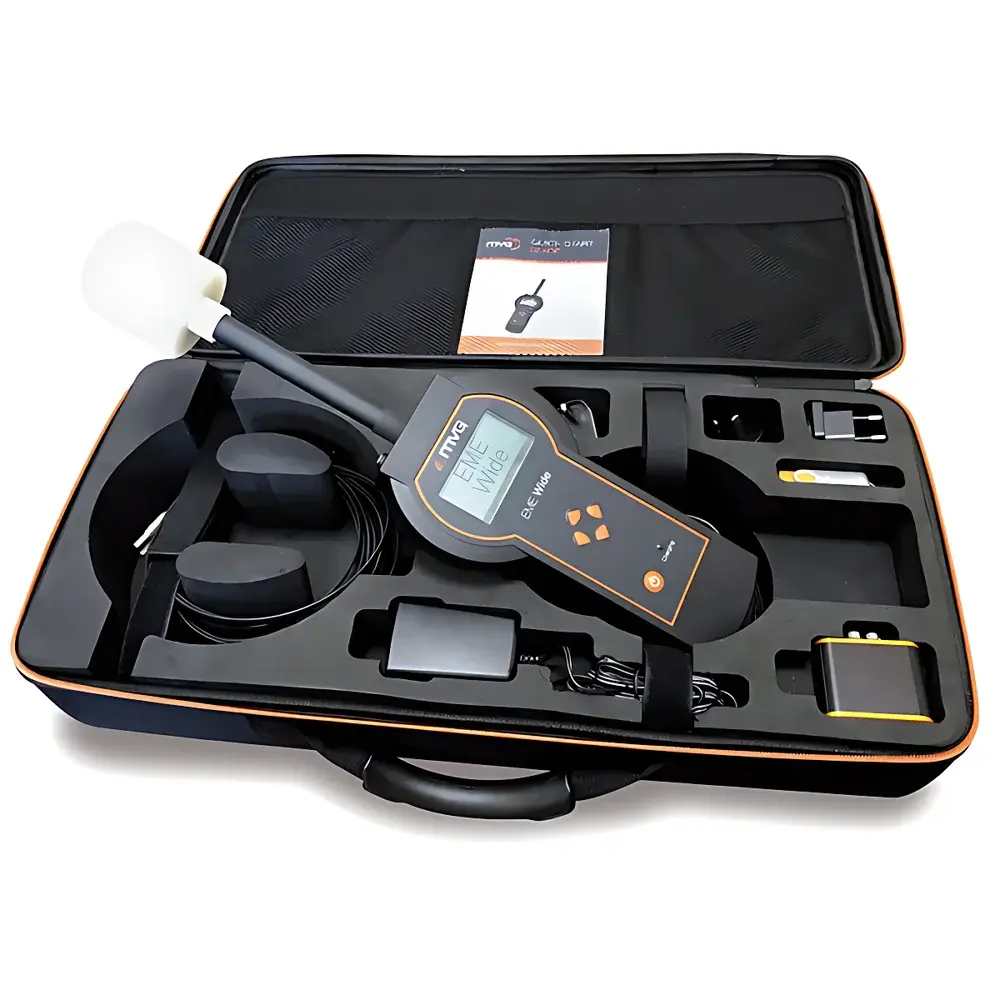
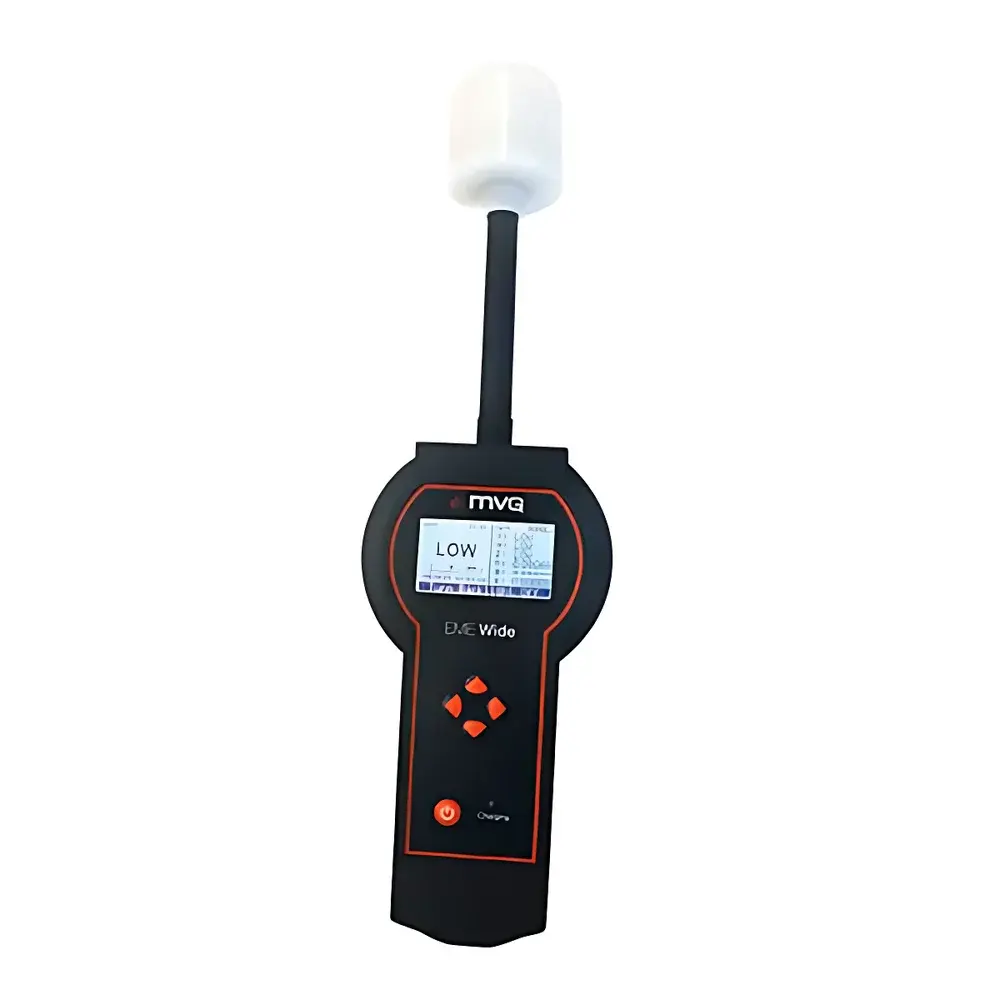
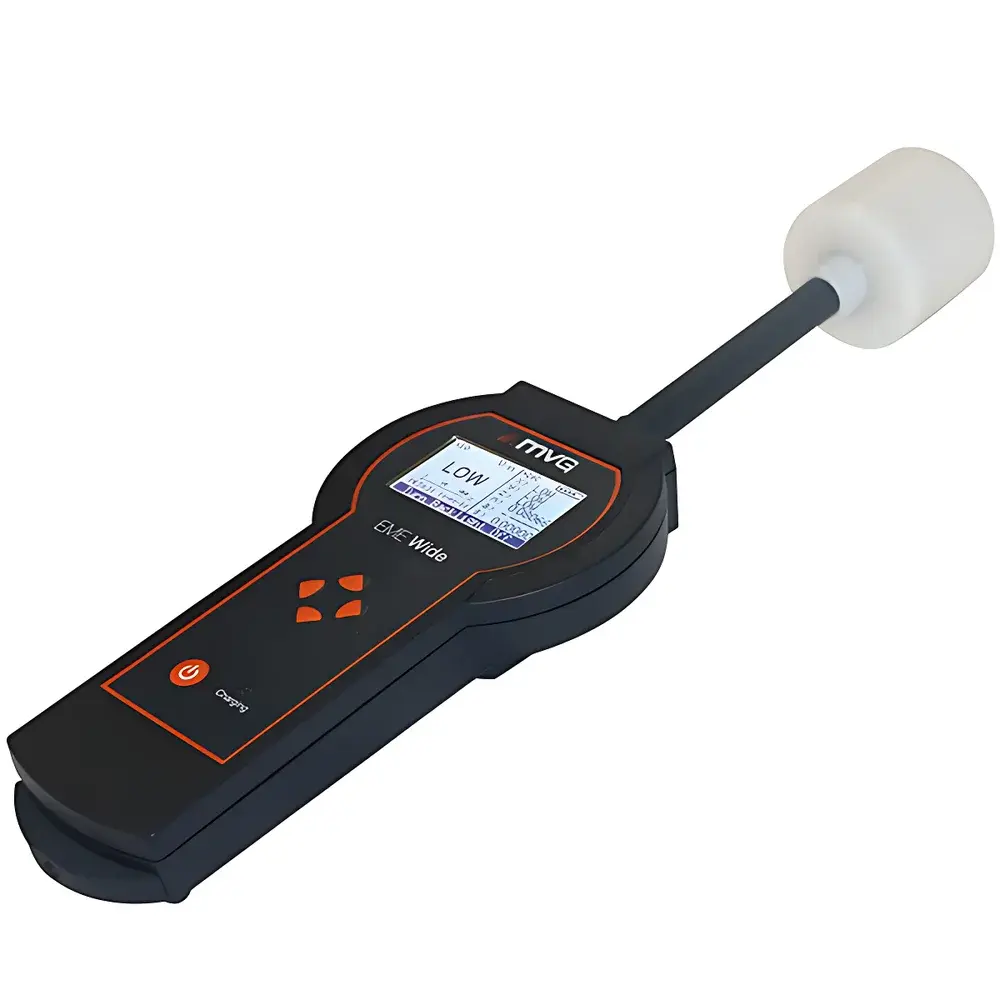
MVG EME WIDE Broadband Electromagnetic Field Analyzer
| Origin | France |
|---|---|
| Manufacturer Type | Authorized Distributor |
| Origin Category | Imported |
| Model | EME WIDE |
| Price Range | USD 6,800 – 13,600 (FOB) |
| Frequency Range | 100 kHz – 6.5 GHz |
| Measurement Accuracy | ±1 dB (100 MHz – 2.7 GHz), ±1.5 dB (2.7 GHz – 6.5 GHz) |
| Electric Field Range | 0.35 – 350 V/m |
Overview
The MVG EME WIDE Broadband Electromagnetic Field Analyzer is a handheld, high-fidelity field measurement system engineered for rigorous electromagnetic environment assessment across civilian, industrial, and regulatory applications. Based on isotropic triaxial electric field sensing and real-time RMS detection architecture, the EME WIDE implements calibrated broadband measurement from 100 kHz to 6.5 GHz — fully covering low-frequency (LF), high-frequency (HF), very-high-frequency (VHF), ultra-high-frequency (UHF), and microwave bands, including all 5G NR FR1 frequency allocations (e.g., n1, n3, n28, n41, n78) and legacy 2G–4G LTE infrastructure. Its design adheres to fundamental principles of electromagnetic field metrology: traceable calibration per ISO/IEC 17025 requirements, vector summation of orthogonal E-field components (Ex, Ey, Ez) to compute isotropic magnitude √(Ex² + Ey² + Ez²), and compliance with time-domain averaging protocols specified in IEC 62232 and EN 50492. The instrument is purpose-built for EMF compliance surveys, occupational exposure evaluation, and RF site safety verification where spectral complexity, pulsed modulation, and multi-source superposition demand robust, frequency-agile instrumentation.
Key Features
- Triaxial isotropic E-field probe with factory-applied NIST-traceable calibration coefficients stored directly in onboard flash memory — eliminating manual coefficient entry and reducing operator error.
- Ruggedized aluminum aviation-grade connector between probe and main unit ensures mechanical integrity and repeatable electrical contact under field conditions.
- Ergonomic handheld chassis with balanced weight distribution (< 850 g) and tactile 5-button interface optimized for one-handed operation in confined or elevated locations.
- 2.8-inch backlit LCD (7 cm diagonal) with high-contrast monochrome rendering for legibility under direct sunlight or low-light indoor environments.
- Dual-mode power system: rechargeable NiMH AA batteries (standard configuration) with hot-swap capability; supports alkaline AA cells for emergency deployment without charging infrastructure.
- Integrated audible alarm with user-defined thresholding (V/m, A/m, or W/m²) and visual alert indicators synchronized with real-time field magnitude display.
- Onboard data logging capacity for up to 2,000 measurement records, each timestamped with UTC date/time, ambient temperature, and battery state-of-charge metadata.
Sample Compatibility & Compliance
The EME WIDE is validated for quantitative assessment of radiated electromagnetic fields generated by diverse emitters, including cellular base stations (macro and small-cell), broadcast transmitters (AM/FM/DAB/DTV), radar systems (S-, C-, X-band), industrial RF heaters, medical diathermy units, and aerospace telemetry equipment. It satisfies measurement protocol requirements defined in multiple national and international standards: GB 8702–2014 (China’s EMF protection limits), HJ/T 10.2–1996 and HJ/T 10.3–1996 (PRC environmental monitoring methodology), GJB 5313–2004 (military exposure limits), GBZ 2.2–2007 and GBZ/T 189.1–2007 (occupational hygiene criteria), and the “Methodology for EMF Monitoring near Mobile Communication Base Stations.” While not certified as a Class I medical device, its measurement uncertainty budget aligns with GLP-aligned field survey practices and supports audit-ready reporting for regulatory submissions.
Software & Data Management
The EME WIDE interfaces with MVG’s proprietary PC-based analysis software via full-duplex optical fiber link — providing galvanic isolation for noise-free remote control, live waveform streaming, and synchronized multi-instrument acquisition. The software enables post-processing functions including spectral histogramming, spatial averaging over user-defined grid maps, exposure ratio calculation against ICNIRP/IEEE C95.1 or national reference levels, and automated report generation compliant with ISO/IEC 17025 documentation templates. All logged datasets include embedded calibration traceability IDs and firmware version stamps, supporting long-term data integrity and 21 CFR Part 11-compliant audit trails when deployed in regulated environments.
Applications
- Regulatory EMF compliance surveys around telecom infrastructure (5G mmWave exclusion zones, macro-cell perimeter monitoring)
- Occupational health & safety assessments in broadcasting facilities, radar installations, and RF-intensive manufacturing plants
- Third-party environmental consultancy services for municipal planning authorities and spectrum licensing bodies
- EMI pre-compliance screening in R&D labs prior to formal EMC chamber testing
- Academic research on bioelectromagnetics, antenna near-field characterization, and urban RF propagation modeling
- Military platform EMSEC evaluations and TEMPEST-level site surveys for secure communications infrastructure
FAQ
Does the EME WIDE require periodic recalibration?
Yes — MVG recommends annual recalibration at an ISO/IEC 17025-accredited laboratory using traceable reference field sources. Each unit ships with a certificate of initial calibration valid for 12 months.
Can the EME WIDE measure magnetic fields (H-field)?
No — the EME WIDE is optimized exclusively for electric field (E-field) measurement. For combined E/H assessment, MVG offers complementary systems such as the EMCO 4030 series.
Is the optical fiber interface compatible with standard USB-to-fiber converters?
No — it uses a proprietary full-duplex optical protocol requiring MVG’s dedicated interface module (part no. OPT-IF-EME) for PC connectivity.
What is the minimum detectable field strength at 3.5 GHz?
Based on system noise floor and probe sensitivity, the practical lower limit is approximately 0.4 V/m (RMS) under typical ambient conditions.
Does the device support GPS-tagged measurements?
Not natively — geotagging requires external integration via third-party mapping software that accepts CSV exports containing timestamps and coordinates manually entered during survey setup.







