
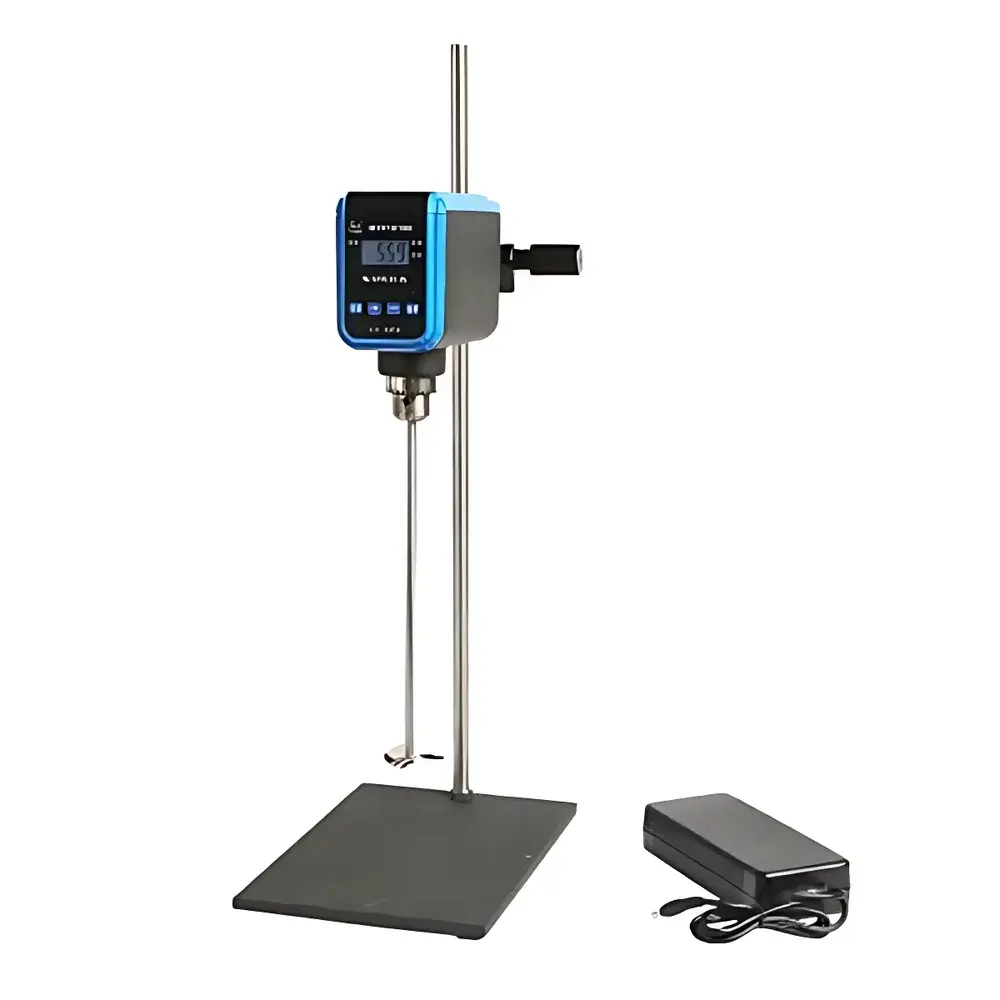
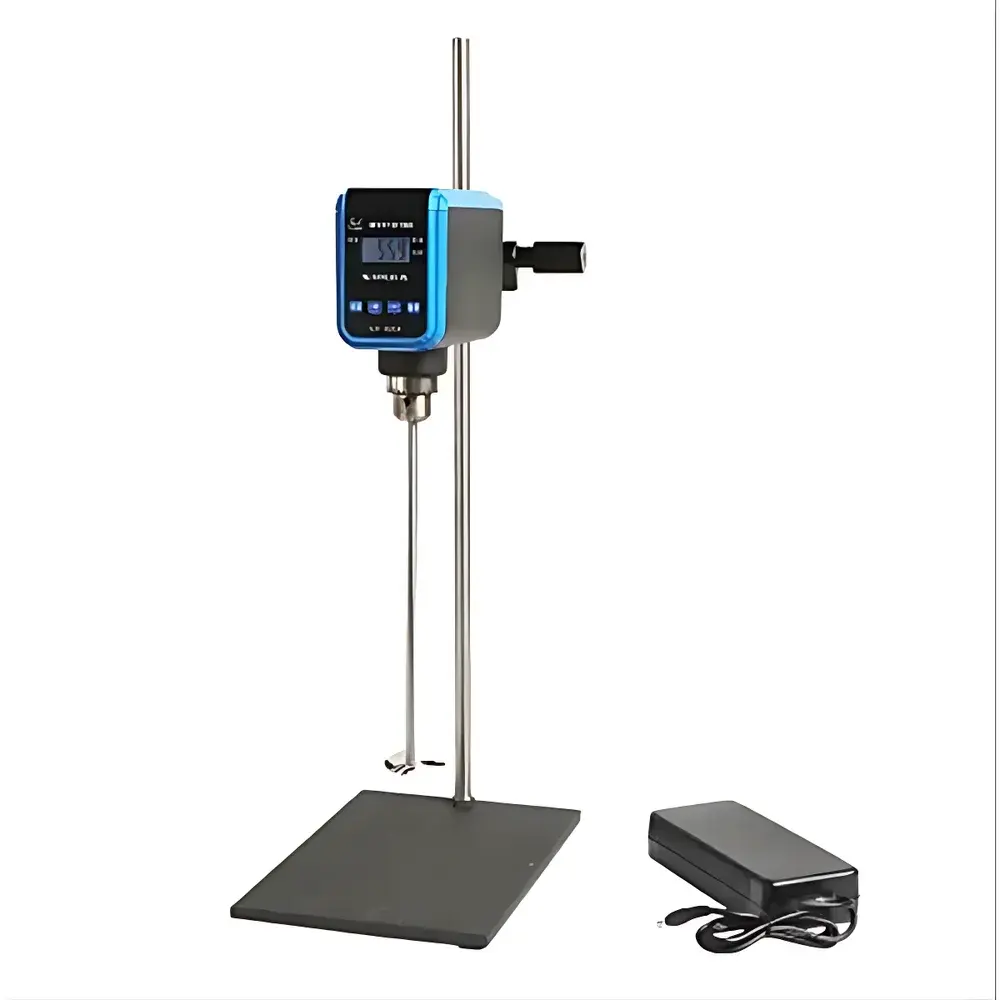
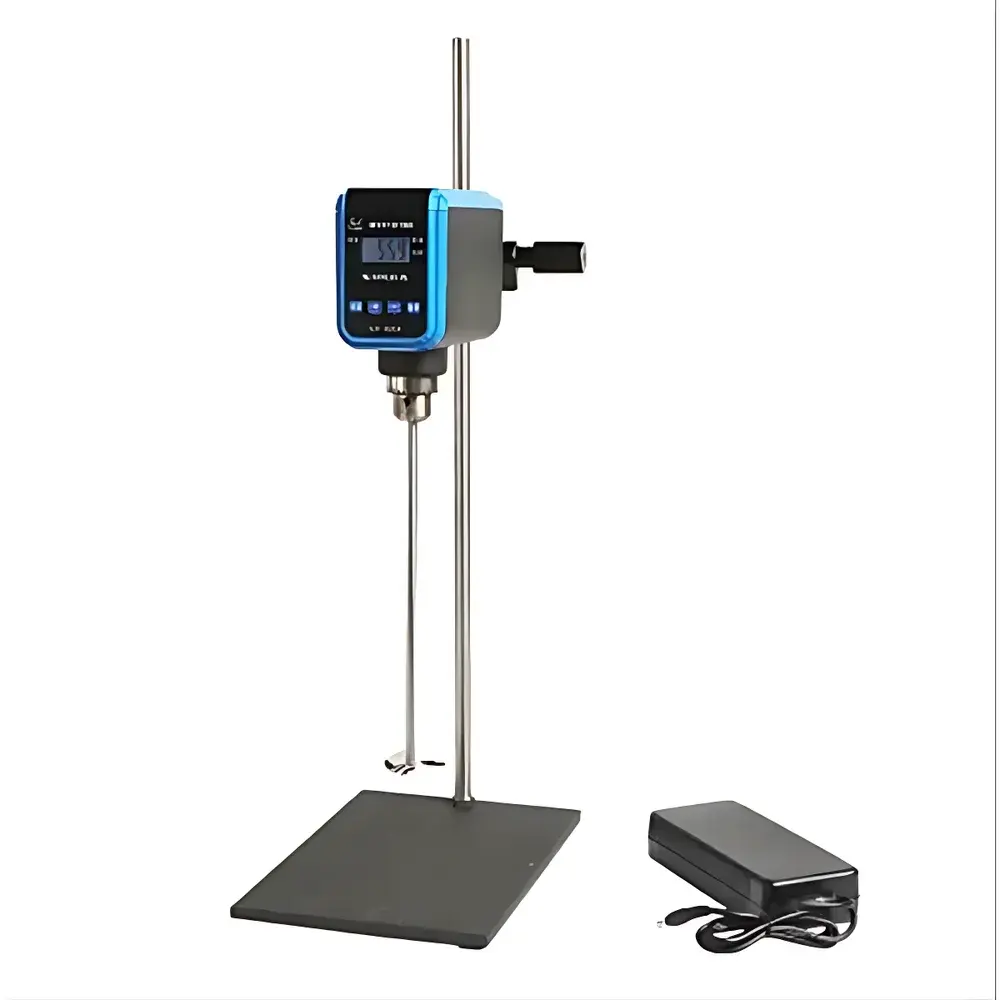
MyPu MYP19150 Digital DC Motor Stirrer
| Brand | MyPu |
|---|---|
| Model | MYP19150 |
| Drive Type | Brushless DC Motor |
| Speed Range | 30–2000 rpm |
| Speed Display | LCD, ±1 rpm Resolution |
| Timer Range | 0–9999 min |
| Chuck Capacity | 0.5–13 mm |
| Input Voltage | 100–240 V AC, 50/60 Hz |
| Power Consumption | 150 W |
| Safety Input | DC 36 V isolated drive circuit |
| Enclosure | Chemically resistant, sealed housing |
| Stirring Rod Through-Hole | Yes |
| Compliance | CE-marked design principles, IEC 61010-1 compliant architecture |
Overview
The MyPu MYP19150 Digital DC Motor Stirrer is an engineered solution for precise, repeatable mechanical agitation in laboratory and pilot-scale environments. Unlike traditional AC-motor or magnetic stirrers, this unit employs a brushless DC motor directly coupled to a low-backlash planetary gear reduction system—enabling high torque output (up to 1.8 N·m at low speeds) without thermal derating during extended operation. Its closed-loop speed control architecture maintains setpoint stability within ±1 rpm across the full 30–2000 rpm range, independent of load fluctuations typical in viscous or heterogeneous media. Designed for integration into GLP-compliant workflows, the device operates with a galvanically isolated DC 36 V drive stage, eliminating ground-loop risks and ensuring personnel safety under wet-condition protocols. The compact footprint (165 × 145 × 280 mm) and vertical through-hole configuration support seamless compatibility with standard lab glassware stacks—from 50 mL conical flasks to 5 L jacketed reactors—without requiring vertical repositioning of the stirring assembly.
Key Features
- Brushless DC motor with integrated thermal monitoring and automatic current limiting—ensures >20,000 hours MTBF and zero carbon dust accumulation in cleanroom or sterile environments.
- LCD interface with real-time display of actual speed (rpm), elapsed time, remaining timer duration, and system status flags (e.g., overload, overtemperature).
- Programmable timer with 1-second resolution and non-volatile memory retention—retains last-used settings after power cycle per IEC 60730-1 Class B requirements.
- Chemically inert ABS+PC housing rated IP42 for splash resistance; internal PCB conformal coating prevents corrosion from organic solvents, acids, and bases commonly used in synthesis and formulation labs.
- Quick-height adjustment mechanism with calibrated scale (0–120 mm travel) and locking collar—enables reproducible impeller submersion depth across batch transfers without recalibration.
- Universal chuck accepts standard ISO 8573-1 compliant stirring rods (0.5–13 mm OD), including PTFE-coated, glass-coated, and Hastelloy shafts for aggressive media handling.
Sample Compatibility & Compliance
The MYP19150 accommodates a broad spectrum of sample types—including aqueous buffers, polymer melts (up to 50,000 mPa·s), suspension slurries, emulsions, and cell culture media—provided appropriate impeller geometry (e.g., pitched-blade, anchor, or propeller) is selected. Its mechanical stirring principle avoids the limitations of magnetic coupling (e.g., vortex instability above 1000 rpm, demagnetization at >80 °C), making it suitable for high-viscosity, high-temperature, or paramagnetic applications where magnetic stirrers fail. The unit conforms to the safety architecture defined in IEC 61010-1:2010 (Edition 3) for electrical equipment for measurement, control, and laboratory use. While not certified to UL or CSA standards out-of-box, its design basis supports third-party certification pathways for FDA-regulated facilities operating under 21 CFR Part 11 Annex 11 data integrity requirements when paired with validated logging software.
Software & Data Management
The MYP19150 operates as a standalone instrument with no proprietary software dependency. All operational parameters are locally stored and displayed; however, analog voltage output (0–5 V DC proportional to rpm) and digital TTL-level timer-complete pulse are provided via rear-panel screw terminals for integration into SCADA, LabVIEW, or PLC-controlled process sequences. When connected to a compliant data acquisition system, speed and timer logs meet ALCOA+ principles (Attributable, Legible, Contemporaneous, Original, Accurate, Complete, Consistent, Enduring, Available) for audit readiness. Optional RS-485 Modbus RTU interface (add-on module) enables remote parameter setting, real-time monitoring, and event-triggered data export compatible with LIMS platforms supporting ASTM E1384 or ISO/IEC 17025 traceability frameworks.
Applications
- Pharmaceutical R&D: Dissolution testing of immediate- and extended-release tablets per USP , buffer preparation for chromatography mobile phases, and homogenization of nanoparticle suspensions prior to DLS analysis.
- Chemical Synthesis: Controlled addition of reagents under inert atmosphere in Schlenk-line setups; agitation of exothermic Grignard reactions with external cooling jacket synchronization.
- Materials Science: Dispersion of carbon nanotubes in epoxy resins, deagglomeration of ceramic powders in aqueous binders, and shear-thinning characterization of hydrogels using ramped-speed profiles.
- Clinical Diagnostics: Mixing of whole-blood samples with anticoagulants prior to centrifugation; uniform suspension of latex-agglutination reagents in immunoassay development.
- Quality Control Labs: Standardized blending of reference standards for FTIR or UV-Vis calibration curves; reproducible dilution series preparation under ISO 17025 clause 7.7.
FAQ
Is the MYP19150 compatible with corrosive solvents such as concentrated HCl or THF?
Yes—the housing material and internal conformal coating resist short-term exposure to common organic solvents and dilute mineral acids; prolonged immersion requires optional PTFE-sealed chuck upgrade.
Can the timer be paused and resumed without resetting?
No—the timer is non-interruptible per IEC 61010-1 functional safety guidelines; interruption triggers automatic reset to prevent unintended extended operation.
Does the unit support external temperature feedback for speed modulation?
Not natively; closed-loop thermal compensation requires integration via optional PID controller interfacing through the analog output and TTL trigger lines.
What is the maximum recommended viscosity for continuous operation at 2000 rpm?
For sustained duty at top speed, media viscosity should remain below 5,000 mPa·s; higher viscosities require speed reduction to maintain motor thermal margin and bearing life.
Is firmware update capability available?
Firmware is field-upgradable via UART interface using MyPu-provided utility software and FTDI cable—supporting version rollback and checksum-verified installation per ISO/IEC 15408 EAL2+ guidance.



