
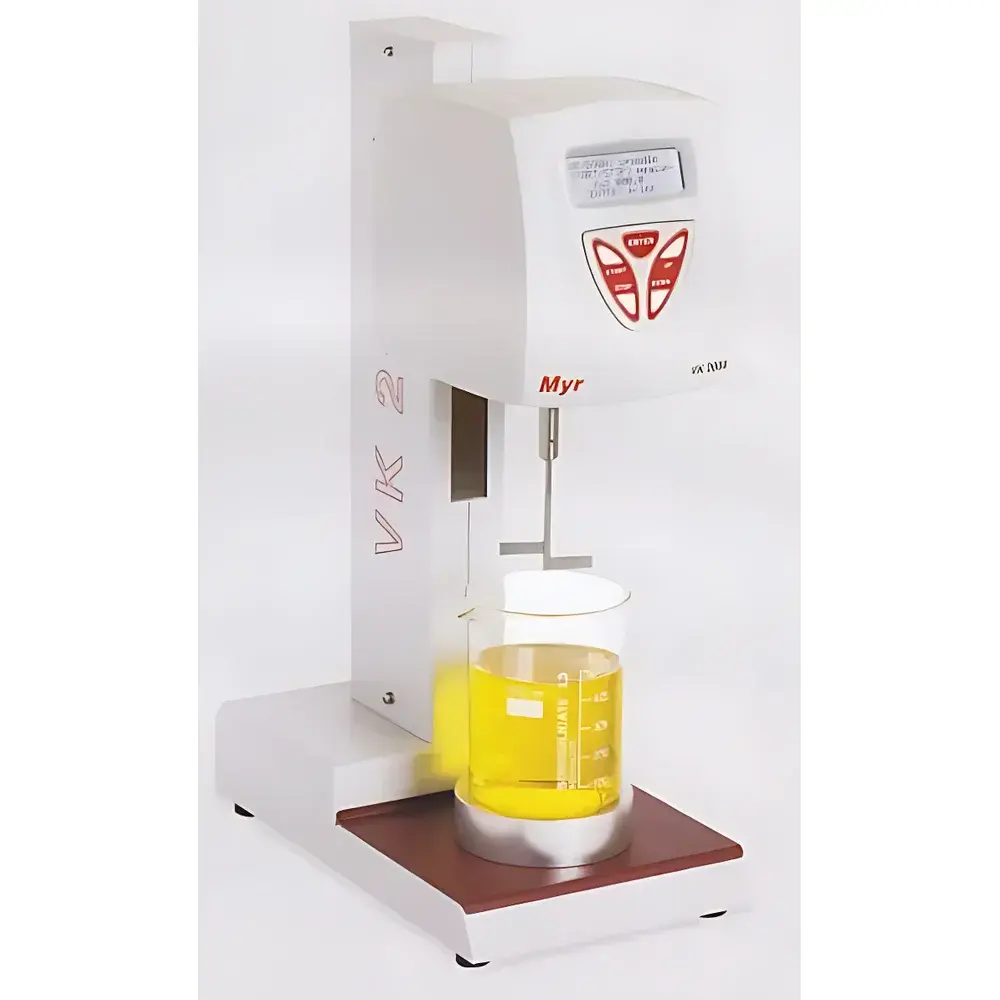
MYR VK2000 Automatic Krebs Viscometer for Coatings and Printing Inks
| [Origin | Spain |
|---|---|
| Model | VK2000 |
| Power Supply | 100–240 V, 50–60 Hz |
| Operating Temperature | 10–40 °C |
| Relative Humidity | < 80 % |
| Rotational Speed | 200 rpm |
| Rotor Type | Standard ASTM Krebs (KU) Rotor |
| Weight | 8.5 kg |
| Interface | RS232 |
| Viscosity Range | KU: 40.2–141.0 (±0.1 KU) |
| g | 32–1099 (±1.0 g) |
| cP | 27–5274 (±5 cP) |
| Accuracy | ±1% of full scale |
| Repeatability | ±0.2% |
| Compliance | ASTM D562-01, ASTM D856, ASTM D1131] |
Overview
The MYR VK2000 Automatic Krebs Viscometer is a precision-engineered instrument designed specifically for quality control and R&D laboratories in the coatings, printing inks, adhesives, and pigment dispersions industries. It implements the standardized Krebs unit (KU) measurement principle defined by ASTM D562—based on torque resistance experienced by a geometrically specified paddle-type rotor rotating at a fixed speed of 200 rpm in a defined sample volume. Unlike rotational viscometers employing cone-plate or coaxial cylinder geometries, the VK2000 replicates the empirical shear history typical of high-shear mixing and application processes (e.g., roller coating, blade metering), making it highly relevant for predicting real-world application behavior such as sag resistance, leveling, and film build. Its microprocessor-controlled architecture ensures consistent motor drive, thermal stability during measurement cycles, and traceable data acquisition aligned with GLP-compliant workflows.
Key Features
- Full compliance with ASTM D562-01, D856, and D1131 for Krebs viscosity determination—ensuring regulatory acceptability in QC documentation.
- Dual-mode operation: programmable automatic mode (user-defined pre-rotation and measurement durations from 0–99 s) and real-time manual mode via UP/DOWN keypad for exploratory testing or method development.
- Triple-unit display and output: simultaneous real-time readout and RS232 transmission of viscosity values in Krebs Units (KU), grams load (g), and centipoise (cP), facilitating cross-method correlation and internal reporting standardization.
- Integrated thermal management and low-drift DC motor drive to maintain stable 200 ± 0.5 rpm rotation under variable ambient conditions (10–40 °C).
- RS232 serial interface compatible with thermal printers and laboratory LIMS systems—supports ASCII-based data export with timestamp, unit identifier, and operator ID fields for audit trail integrity.
- Robust mechanical design with vibration-damped base and calibrated torque sensor, delivering repeatability of ±0.2% across repeated measurements on homogeneous samples.
Sample Compatibility & Compliance
The VK2000 accepts standard 1/2-pint and 1-pint glass containers (included), conforming to ASTM D562 specimen geometry requirements. Its Krebs paddle rotor (ASTM-compliant profile, stainless steel construction) ensures consistent immersion depth and shear field generation across batch-to-batch testing. The instrument is validated for Newtonian and mildly non-Newtonian systems typical of solventborne and waterborne architectural paints, UV-curable inks, acrylic dispersions, and PVA-based adhesives. All measurement protocols align with ISO/IEC 17025 documentation practices, and raw data files generated via RS232 support FDA 21 CFR Part 11-compliant electronic record retention when integrated with validated software environments.
Software & Data Management
While the VK2000 operates as a standalone benchtop instrument, its RS232 interface enables seamless integration into existing laboratory informatics infrastructure. Data packets include measurement timestamp, selected unit, numeric value, rotor identification code, and user-defined batch ID—structured for direct ingestion into ELN platforms (e.g., LabArchives, Benchling) or statistical process control (SPC) dashboards. No proprietary software is required; ASCII-formatted output is compatible with Python-based parsing scripts, Excel VBA macros, or custom SQL database ingestion pipelines. Audit trails—including parameter changes, calibration events, and firmware version logs—are retained in non-volatile memory and retrievable via serial query command.
Applications
- QC release testing of architectural and industrial coatings per ASTM D562 acceptance criteria.
- Formulation screening during R&D to correlate KU values with sag resistance (ASTM D4400) and brush drag performance.
- In-process monitoring of pigment grinding efficiency and dispersion stability in ink manufacturing.
- Batch consistency verification for water-based adhesives prior to packaging—ensuring rheological conformity across production runs.
- Method transfer validation between legacy manual Krebs units and automated systems in multi-site operations.
FAQ
Does the VK2000 require annual recalibration?
Yes. Annual traceable calibration against NIST-traceable torque standards is recommended per ISO/IEC 17025 and internal quality system requirements. Calibration certificates include as-found/as-left data and uncertainty budgets.
Can the instrument measure non-Newtonian samples accurately?
It provides empirically valid KU values for materials exhibiting mild shear-thinning behavior within the 200 rpm shear rate window. For strongly time-dependent or yield-stress fluids, complementary tests using controlled-stress rheometry are advised.
Is the RS232 interface compatible with modern Windows/macOS systems?
Yes—via USB-to-serial adapters (FTDI chipset recommended). Communication parameters: 9600 baud, 8N1, no flow control. Sample Python scripts for data capture are available upon request.
What maintenance is required beyond routine cleaning?
Biannual inspection of rotor shaft runout and bearing play; replacement of rotor O-rings every 12 months or after 500 measurements—both documented in the included maintenance logbook.
How does the VK2000 handle temperature-sensitive samples?
The instrument itself does not regulate sample temperature. Users must precondition samples to 23 ± 0.5 °C per ASTM D562 prior to loading. Ambient lab temperature control (10–40 °C) is sufficient for stable electronics performance.



